Showing posts with label rat poison. Show all posts
Sunday, September 23, 2012
PART 2 of Bomber the Hummingbird, Quicksilver, Pyewacket and the Spaghetti, Plus a Saturday Miscellany Which Includes a Link to Filmmaker Adam Welz' Wild New York
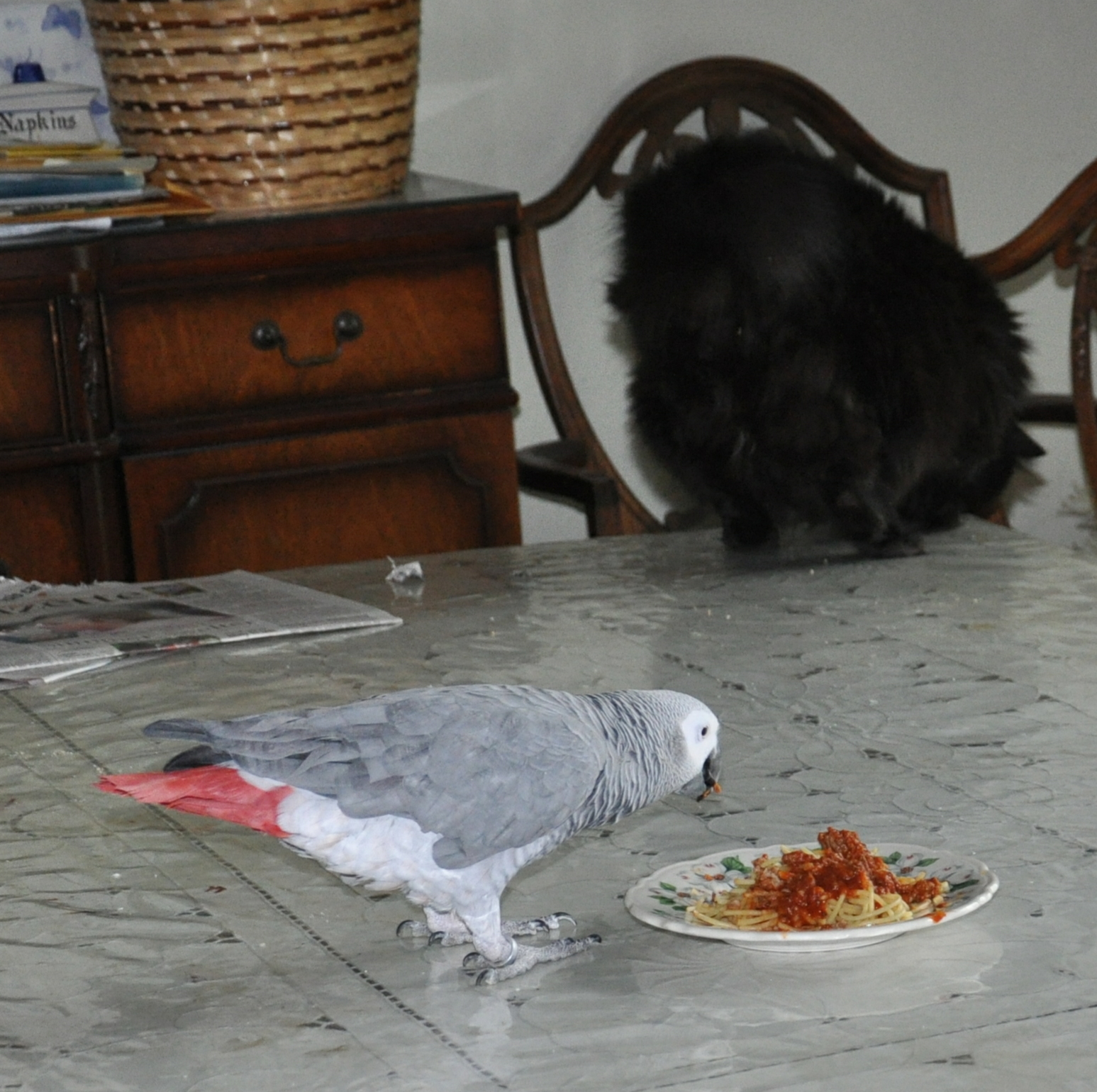
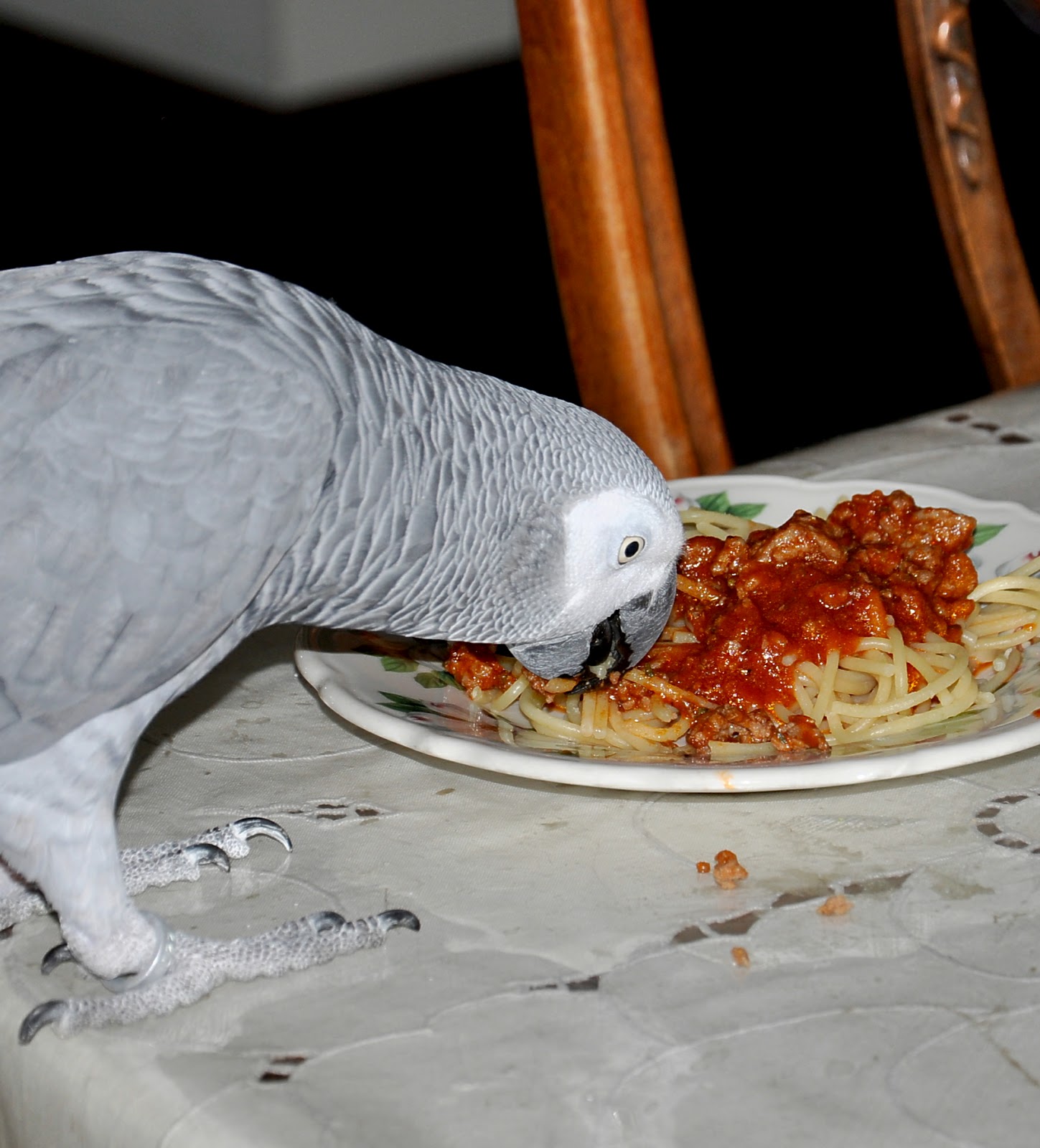
We pick up today's episode of The Adventures of Bomber the Hummingbird, Quicksilver, Pyewacket, and the Spaghetti, where we left off, with Pye bearing down on Silver over the spaghetti plate.
Silver goes into aggression mode, no nose touching for him. Eyes flashing, (His pupils go from large to small and back again repeatedly.) He stands his feathers on end while taking an aggressive posture which often is the prelude to his leaping precipitously at the object of his attentions, beak open and wings flapping.
Trust me. It's scary.
Pye must think so too because she pulls her head back. Silver glares, legs braced. It's a stand off over the spaghetti plate.
Pye bends right and slowly comes around the other way toward Silver. Silver has had enough and gives me the just- when-are-you-going-to-tell-the-CAT-to-get-off-the-table look.
Let me give you the larger view of the expression so you'll recognize it if it ever happens to you.
I don't want him leaping at me in disgust, so I say "Pye" quietly and as she knows she isn't supposed to be on the table, and actually cares that I disapprove, starts moving toward the edge.
Just to prove she is no pussy, Pye does a little playful feint of a scamper towards the parrot. Not the least unnerved, both knew this wasn't the least bit serious...
Silver gets back to eating as Pyewacket heads off the table into a chair.
Once in the chair, Pye stops short and appears to stare fixedly at "something" out of our view. Silver considers walking over and looking over the edge but he's fallen for that one before and restrains himself, taking another bite.
Pyewacket settles down at the patio door for a session of birdwatching, Quicksilver keeps eating, and if you look carefully you'll see Bomber the Hummingbird facing out waiting for another session of Hummingbird aggression.
She rouses her feathers and gives her wings a few flicks.
When I look again, Bomber has gone missing. I go to the door to see if she has taken up her station in the Maple tree, and a little dry, cracked voice says, "Fresh water."
Silver says it again in the same dried up old voice. Where he learned to say fresh water, like some old heat crazed prospector who's gone without water for a month, in say, "Treasure of the Sierra Madres", I'll never know.
But it is hilarious. No doubt the reason he keeps it.
Next up....
In case you missed it in the comments section, anti-rodenticide progress watcher Sally of Kentucky sends a story of an enlightened town--
http://elcerrito.patch.com/articles/council-endorses-anti-rodenticide-measure
South African film maker Adam Welz did a piece for South African Television, Wild New York, about the NYC hawks and hawkwatchers. Originally it was part of a series chronicling The Healing Power of Nature on South African television and later did well at film festivals.
When the film screened at a festival nearby, Adam and I teamed up again as part of a panel discussing pressing wildlife issues.
Director Welz has now made Wild New York available for viewing online in order, he hopes, to procure the wherewithal, as in artistic clout, name recognition, and angels in order to do his next film. Which let me add he feels very strongly should be made in order to get the word out about a tragic situation of humans vs wildlife which continues today and without any publicity to speak of.
Adam's next film will chronicle the conflict caused by human farming infiltration into previously untrammeled wildlife territory which has caused the tragic killing of many, many lions.
To see Wild New York click the link below!
www.vimeo.com/adamwelz/wildnewyork
And Betty Jo McDonald invites us all to sign the petition to stop the killing of whales in the Faroe Islands
http://www.causes.com/causes/165072-stop-dolphin-and-whale-slaughtering/actions/1680442?causes_ref=email&recruiter_id=133353103&template=activity_invitation_mailer%2Factivity_invitation&utm_campaign=action_invitation_email&utm_medium=email&utm_source=causes
Donegal Browne
Saturday, September 22, 2012
Contact the New Head of NYC Parks Department, Bomber the Hummingbird, Quicksilver, Pyewacket, and the Spaghetti
Why is there a photograph of a hummingbird feeder on a cold rainy day? Look up. There you will see Bomber. Bomber is a female Ruby-throated Hummingbird who has territorialized my two Hummingbird feeders.
Ordinarily she sits high in the Maple and comes blazing down on any other Hummer who attempts to access "her" feeders.
Today is very rainy and cold so Bomber has chosen the better part of valor and decided that sitting under the eave above the little feeder waiting to go after her fellow Ruby-throats at the bigger feeder has charms the tree hasn't.
Like a roof for instance.
Why is she doing this? It appears to be what hummingbirds do. Breeding season is over and migration hasn't started. She isn't interesting in watching TV so there we are.
Preservation of personal food supply?
Bomber has taken off like a heat seeking missile, chasing another Hummer (too fast for me to catch with the camera even if I hadn't been dishing out some spaghetti for myself) while Silver the African Grey looks on with great interest.
Okay I thought he was looking on with great interest and perhaps he was while I was looking at him, but upon sitting my plate on the table I see he's removed a 2 inch piece of carved wood from the front of the chair. Chair is removed, the dishwasher dragged over to the door with a parrot perch on top and the parrot deposited on it.
"Behave yourself."
"Watch the Hummingbirds try to intimidate each other."
Silver laughs and attempts to look charming instead of conniving.
Ah, Bomber is back in position waiting for the next victim. She's wetter than before but I assume she's just gotten an ego boost and doesn't much care.
Wait a minute. Wet birds preen. She isn't and I realize I've never seen a Hummingbird preen. They must, mustn't they? I mean they do have feathers that have to be cared for. But with that beak... I realize I need a fork and head for the silverware drawer.
When I turn back around...
Guess who is eating my spaghetti?
What? This wasn't for me?
(There is a reason the tablecloth is covered with plastic.)
In the meantime...
Pyewacket the Cat, using whatever kitty radar she has that allows her to appear in a twinkling when the parrot is eating people food and there may be stray snacks dropping to the floor, has arrived.
Bomber is now staring fixedly at the joint between the house and the eave. Insects? I forgot to get a fork. I go back to the drawer.
Now and again Bomber appears to look down and watch Silver eating.
Silver has turned round my way for some reason.
What did I come over here to get?
Bomber has turned round toward the yard. There must be more chasing fodder in sight. I wait to try and catch the moment.
There is a soft thump behind me.
What is it with everybody today?
By the way Pye isn't after the parrot, she too is after the spaghetti.
I give her a look. She knows she isn't supposed to be on the table.
"No really, I just wanted to watch the hummingbirds too. I'm on my way to the patio door to look out. It's a shortcut. Yeah, that's it."
"But wait, it wouldn't be polite for me to be on a surface with a fellow 'cat' and not touch noses. Besides what about that spaghetti. Done yet, bird?"
Silver discovered early on that if Pyewacket approached him, and if he yowled loudly like a cat in her face that she became confused and left. Pye then must have decided that though he didn't look like a cat or smell like a cat, he sounded like a cat and an attempt at a nose touch was only polite in certain circumstances.
(Did you ever notice that if one cat is on the bed and another jumps on, that the second will often touch noses with the first? Some sort of olfactory greeting?"
PART 2 OF PYEWACKET, QUICKSILVER, HUMMINGBIRDS, AND SPAGHETTI IN THE NEXT POST.
A heads up from Sally of Kentucky, who's been monitoring the rat poison situation in NYC, about a poster calling for those concerned to take action about the many deaths of our urban Red-tails of late. This particular poster was distributed with specific concern for Washington Square Park where rat poison has not been laid for some time. Washington Square Park is the home of Bobby and Rosie Red-tail and the site of their nest which has the New York Times Hawk Cam focused on it..
(No we cannot be sure that Bobby and Rosie will absolutely be poisoned but if second generation rat poisons are used in the park, and as these two hawks do eat rats nearly every day, the possibility is high.)
The dead hawk in the illustration is Ginger Lima, a previous mate of Pale Male's who's necropsy revealed she been killed by secondary poisoning from eating a tainted rat.
Do not miss Emily Frost's super piece on the hawk poisonings at DNAinfo--
http://www.dnainfo.com/new-york/20120921/upper-west-side/pale-males-mate-zena-presumed-dead
Just in from Robin of Illinois about a lucky accident prone Red-tail and a lucky driver, well... we'd think he was anyway-- Red-tail bounces off windshield, lands in driver's lap...
http://news.yahoo.com/blogs/sideshow/hawk-car-connecticut-205632975.html?_esi=1
Donegal Browne
Ordinarily she sits high in the Maple and comes blazing down on any other Hummer who attempts to access "her" feeders.
Today is very rainy and cold so Bomber has chosen the better part of valor and decided that sitting under the eave above the little feeder waiting to go after her fellow Ruby-throats at the bigger feeder has charms the tree hasn't.
Like a roof for instance.
Why is she doing this? It appears to be what hummingbirds do. Breeding season is over and migration hasn't started. She isn't interesting in watching TV so there we are.
Preservation of personal food supply?
Bomber has taken off like a heat seeking missile, chasing another Hummer (too fast for me to catch with the camera even if I hadn't been dishing out some spaghetti for myself) while Silver the African Grey looks on with great interest.
Okay I thought he was looking on with great interest and perhaps he was while I was looking at him, but upon sitting my plate on the table I see he's removed a 2 inch piece of carved wood from the front of the chair. Chair is removed, the dishwasher dragged over to the door with a parrot perch on top and the parrot deposited on it.
"Behave yourself."
"Watch the Hummingbirds try to intimidate each other."
Silver laughs and attempts to look charming instead of conniving.
Ah, Bomber is back in position waiting for the next victim. She's wetter than before but I assume she's just gotten an ego boost and doesn't much care.
Wait a minute. Wet birds preen. She isn't and I realize I've never seen a Hummingbird preen. They must, mustn't they? I mean they do have feathers that have to be cared for. But with that beak... I realize I need a fork and head for the silverware drawer.
When I turn back around...
Guess who is eating my spaghetti?
What? This wasn't for me?
(There is a reason the tablecloth is covered with plastic.)
In the meantime...
Pyewacket the Cat, using whatever kitty radar she has that allows her to appear in a twinkling when the parrot is eating people food and there may be stray snacks dropping to the floor, has arrived.
Bomber is now staring fixedly at the joint between the house and the eave. Insects? I forgot to get a fork. I go back to the drawer.
Silver has turned round my way for some reason.
What did I come over here to get?
Bomber has turned round toward the yard. There must be more chasing fodder in sight. I wait to try and catch the moment.
There is a soft thump behind me.
What is it with everybody today?
By the way Pye isn't after the parrot, she too is after the spaghetti.
I give her a look. She knows she isn't supposed to be on the table.
"No really, I just wanted to watch the hummingbirds too. I'm on my way to the patio door to look out. It's a shortcut. Yeah, that's it."
"But wait, it wouldn't be polite for me to be on a surface with a fellow 'cat' and not touch noses. Besides what about that spaghetti. Done yet, bird?"
Silver discovered early on that if Pyewacket approached him, and if he yowled loudly like a cat in her face that she became confused and left. Pye then must have decided that though he didn't look like a cat or smell like a cat, he sounded like a cat and an attempt at a nose touch was only polite in certain circumstances.
(Did you ever notice that if one cat is on the bed and another jumps on, that the second will often touch noses with the first? Some sort of olfactory greeting?"
PART 2 OF PYEWACKET, QUICKSILVER, HUMMINGBIRDS, AND SPAGHETTI IN THE NEXT POST.
A heads up from Sally of Kentucky, who's been monitoring the rat poison situation in NYC, about a poster calling for those concerned to take action about the many deaths of our urban Red-tails of late. This particular poster was distributed with specific concern for Washington Square Park where rat poison has not been laid for some time. Washington Square Park is the home of Bobby and Rosie Red-tail and the site of their nest which has the New York Times Hawk Cam focused on it..
(No we cannot be sure that Bobby and Rosie will absolutely be poisoned but if second generation rat poisons are used in the park, and as these two hawks do eat rats nearly every day, the possibility is high.)

The dead hawk in the illustration is Ginger Lima, a previous mate of Pale Male's who's necropsy revealed she been killed by secondary poisoning from eating a tainted rat.
Do not miss Emily Frost's super piece on the hawk poisonings at DNAinfo--
http://www.dnainfo.com/new-york/20120921/upper-west-side/pale-males-mate-zena-presumed-dead
Just in from Robin of Illinois about a lucky accident prone Red-tail and a lucky driver, well... we'd think he was anyway-- Red-tail bounces off windshield, lands in driver's lap...
http://news.yahoo.com/blogs/sideshow/hawk-car-connecticut-205632975.html?_esi=1
Donegal Browne
Wednesday, September 19, 2012
Pale Male Stands Vigil Plus Linda Maslin of PA's Responses from NYC Audubon Regarding Rat Poisons and Hawks
Beautiful Pale Male stands vigil in Central Park, photo courtesy of www.palemale.com/
Long time blog reader and contributor Linda Maslin has been working on the raptor poisoning problem and has been in touch with Glenn Phillips the Executive Director of New York City Audubon.
Donegal,
This is a response I received from NYC
Audubon. I had received another response a month or two ago when I
had complained to them about the poison, in which they said they are trying
to work out the problem, but it's on my other computer which is being
repaired.
Regards,
Linda Maslin
Blue Bell, PA
Glenn's response of August 4th, 2012
Linda-
I've been out of the office and have gotten a couple of emails about rat poison at AMNH. Im not sure why you would think we were unwilling to tackle this question...I will be back on the 13th, and will talk with my contacts
there. As you probably already know, NYC Audubon has been actively promoting rodent control policies that are safer for raptors. Our brochure is available on our website. We have verbal agreement from several city
agencies to follow those guidelines. AMNH is not among them, but the property they are on is technically owned by parks, so it should not be too hard to get them to conform. I will let you know.
I've been out of the office and have gotten a couple of emails about rat poison at AMNH. Im not sure why you would think we were unwilling to tackle this question...I will be back on the 13th, and will talk with my contacts
there. As you probably already know, NYC Audubon has been actively promoting rodent control policies that are safer for raptors. Our brochure is available on our website. We have verbal agreement from several city
agencies to follow those guidelines. AMNH is not among them, but the property they are on is technically owned by parks, so it should not be too hard to get them to conform. I will let you know.
And the promised update to Linda from Glenn--
Just to follow up... I spoke with my contact at Parks, who had
already spoken with AMNH, they have agreed to follow Parks Departments protocol,
which is not to use any poison from March-August, and not to use the two most
dangerous chemicals: Brodifacoum and Difethialone.
-Glenn
We've also spoken with colleagues at the NYS Department of Conservation,
who will be helping us draft legislation that will outlaw both of those
chemicals in NYC, and possibly in the state (they'd like that, but aren't sure
that it is possible.)
Glenn Phillips
Executive Director
New York City Audubon
71 West 23rd Street, Room 1523
New York, NY 10010
Executive Director
New York City Audubon
71 West 23rd Street, Room 1523
New York, NY 10010
If you'd like to thank Glenn Phillips and NYC Audubon for their efforts see address above.
And it would be a fine time for all to write their law makers regarding the dangers of rat poison. Get on the keyboard folks, take out that pen!
AND A BIG ROUND OF APPLAUSE AND A KEEP UP THE GOOD WORK TO ALL THOSE WORKING TOWARD A POISON FREE ENVIRONMENT FOR HAWKS, DOGS, CHILDREN, US AND ALL THE CREATURES OF THIS GOOD GREEN EARTH~
Donegal Browne
Tuesday, July 24, 2012
We're Searching for the Sick Central Park Fledgling!
Photos and italicized commentary by Jeff Johnson
Donegal,
Donegal,
Got into the Park at 1030 from 82nd Street going
along MET north side to back area where the sick female stayed on
Sunday (as shown in the frame I sent) progressing on over to the tree
the sick female roosted in last night, a;ll with no joy. Saw nor heard
any Red-tails at all. Scanned trees in the vicinity and searched ground
with no joy. Park employees encountered along the way driving those
oversize arts were all unaware of any dead hawks or birds being
reported. Proceeded NE using sick females last tracking plot . Stopped
at Central Park West and checked Beresford for activity with no joy.
Went south to ANHis museum with no joy.
Beresford NW Tower. no one visible. Metadata time 1120.
Beresford SW Tower. no one visible. Metadata time 1120.
Swept back to north side of MET museum with no joy. Oreo antenna check from NE of Ramble. Metadata time 1145.
Back at Sailboat Pond for 927 Nest check with no one visible. Metadata time 1155
Heading back to the tree on the perimeter of The Great Lawn where the
sick female roosted last night a Red-tail soared over the 927 Nest north
up 5th Avenue and out of sight. Metadata time 1155
I couldn't ID the Red-tail at the time. CS6 enlargement makes me think it was an adult. Metadata time 1155.
(If this is an adult Red-tail it is Zena. The belly band is too heavy for Pale Male.)
Got back to the Great Lawn perimeter area and searched until 1300
with no joy. Try to get back into the Park tonight and hope for good
news.
Jeff
Thanks Jeff, we're waiting to hear from you.
If you have seen the sick Central Park Fledgling today, July 24th, email me at--- palemaleirregulars at yahoo dot com.
Next, hawk watchers are uniting against the use of poison, sign the petition.
For those of you who have asked what metadata time is, here is Jeff's explanation.
Donegal,
Attached screenshot shows an image brought up in CS6 Photoshop Bridge:
At left is the sidebar showing all the information that's available about the image…there's so much it's labeled Metadata.
Each
menu triangle will reveal an entire column of data about what's
selected…anything and everything to do with lens, camera, and every
possible setting used to make the image including time…so I don't have
to have a time stamp in the image itself to clutter it up yet I still
know exactly when it was taken.
Jeff
Labels:
AMNH,
Central Park,
MET,
pale male,
rat poison,
Red-tailed Hawks,
sick fledgling,
Urban Hawks,
Zena
Monday, July 23, 2012
FLASH!!! TWO FIFTH AVENUE FLEDGLINGS POSSIBLY POISONED. UPDATED!
Donegal,
Very bad news--one fledgling
was found sick in an enclosed space on the American Museum of Natural History grounds yesterday and is
now in the care of the Horvath Rehabilitators.
This second fledgling is
displaying symptoms of rat poisoning also…it has not left the tree it
has been perched in for almost two days now and refused to eat a meal
left in plain view.
[This behavior is similar to that of previous
Pale Male mate, Ginger Lima, who eventually fell to the ground dead and
through later necropsy was found to have been killed by secondary
poisoning, i.e. from eating a poisoned rat. D.B.]
This tree
located on the west side of the Natural History Museum has been the perch (left circle) (correction sent by Jeff, tree may be nearer MET) of
what appears to be a fledgling sickened by rat poisoning. At its extreme
height and location the fledgling is presently inaccessible for capture so
that the Horvath's can try and treat it.
1453 Metadata time.
Fledgling on the left has hardly moved in almost two days now. Fledgling on
the right appears animated and still normal.
1456 Metadata time.
[AMNH is on Central Park West facing Central Park between 77th and 81st. D.B.]
Combined frame enlargement. Fledgling on the right flew away. 1459 Metadata time.
After all the wonderful things that have happened
for the 927 Red-tail Family, now comes this potential disaster which if
it is indeed rat poisoning is wholly man-made.
Jeff
P.S from D.B.-- Hawkwatchers report that Zena has been sighted watching over the ill fledgling in the tree. If a predator should appear, as might be more likely in the true wild, she would protect her fledgling from being taken as easy prey. If only she could fight this poison to the death.
Donegal Browne
Donegal Browne
Wednesday, May 02, 2012
PALE MALE HAS A HATCH! FRANKLIN DAD LIKELY DEAD. ATLAS AND ANDROMEDA HAVE A HATCH!
Photo courtesy of http://www.palemale.com
GOOD NEWS, BAD NEWS, GOOD NEWS
Good News--
Photographer Rik Davis, a fixture at the hawk bench for many years, called Marie Winn, author of Red-tails in Love, with the news of a hatch at 927 Fifth Avenue. Lincoln Karim also states that Pale Male is busy hunting for his new family.
Bad News--
Contributer Linda Maslin sent in possible news of the Franklin tiercel. We do not have a positive ID, but the area in which the hawk was hit could be indicative.
Mike Thierfelder
Hello,
I have unfortunate news about what happened to Dad. On Saturday morning
at about 6:30 AM I was driving east on I76 when I witnessed a Red Tail
Hawk struck and killed by a small truck in the left lane several car
lengths ahead of me. The location was just west of the 30th street
underpass, between the BFB split and the 30th oncoming ramp. Given the
location and timing this was certainly Dad.
The
bird came out from under the truck, skiddied accross the road ahead of
me and ended on the right shoulder. I am positive it was a red tail. He
may still be there on the shoulder. Sorry it took so long to get this
out. I heard about this Tuesday morning and was unable to ever get
through the FI phone system to a real person. So I applied to your group
and had to wait for acceptance
Mike T.
Then an update from Tulsa's Jackie Dover, by way of Robin of Illinois--
"Carolyn Card Sutton Just
returned from driving the area of I76 described by Mike. Most
definitely the red tail killed there was Dad; it was so VERY much his
primary hunting grounds; directly across river from the Schuylkill Banks
Park across off ramp from Spring Garden Bridge next to Art Museum where
we have watched him so many times over 4 years. Unfortunately, although
I drove the route twice, there was no sign of Dad on the shoulder of
the road. There are many construction crews/lane closures in area, and I
believe some worker or other cleaned up the remains.. The area there
was very clean (no trash, litter, anything), considering all the 24/7
traffic.".............
Now we know.
A memorium in photographers for Franklin Dad,
http://www.photoshow.com/watch/CI9iG9dm
GOOD NEWS
Update on Astoria Park/RFK Bridge Hawk Nest
From Jules Corkery, major watcher of the Astoria Park Nest-
Hi All
This morning, Atlas brought food to the nest so we got to see
both parents - they look alert and well fed. After Atlas left,
Andromeda brought the rat around to the back of the nest and two little
grey downy heads popped up above the nest to greet her for breakfast.
They are still only visible when they are super active so we're not sure if there are any others.
Good luck, little family.
Jules and Robert
Jules is also a community activist and urban hawk educator who, particularly since Atlas' original mate Athena was poisoned leaving eggs on the nest, has been out there spreading the news about the dangers of secondary rat poison. She's now distributing NYC Audubon's brochure/flyer about safer rat control.
Just an example of what we can all be out doing from house-a-fire Jules referring to the flyer NYC ,
The Astoria Park Allliance would love to distribute the
flyer! It's My Park Day is May 19th - we come in contact with an
estimated 500 park patrons. We will have volunteers from NY Cares,The
International High School, Green Shores NYC, and a few others. We also
will be presenting at our Community Board 1 on May 15th.
I'd also like to bring flyers to our Astoria Civic Association meeting
and give some to the local BID, Central Astoria Local Development Corp.
Thanks!
Jules
Here is the link for the flyer
http://www.nycaudubon.org/images/protecting%20raptors.pdf
The end game would be to have Brodifacoum and Difethialone, the second generation poisons that give hawks no clues of their presence, made illegal first in the communities where we live and then everywhere.
Donegal Browne
Thursday, April 26, 2012
FLASH!!! Lincoln Karim's Companion on the Evening He Was Arrested Has Her Day In Court
As many of you may remember, when Lincoln Karim was arrested for the possession of Ginger Lima's remains, another longtime hawkwatcher was with him. (We'll call her Ms. H for hawkwatcher.). As you will also remember the charges against Mr. Karim were later dismissed by the court. As Ms. H had held the rat poisoned Ginger Lima momentarily on the evening in question the DEC felt she was implicated in something illegal. She was given a summons.
Today was Ms. H's day in court. The judge after hearing that Ms. H had held Ginger Lima's body briefly on the evening in question asked, What did she do that was illegal? Did she kill the hawk? No? Then what?
As the DEC had no answer as to exactly what Ms. H. had done illegally, all charges against her were dismissed as well.
D.B.
Today was Ms. H's day in court. The judge after hearing that Ms. H had held Ginger Lima's body briefly on the evening in question asked, What did she do that was illegal? Did she kill the hawk? No? Then what?
As the DEC had no answer as to exactly what Ms. H. had done illegally, all charges against her were dismissed as well.
D.B.
Labels:
birds,
DEC,
Ginger,
Lima,
Lincoln Karim,
Ms. H,
rat poison,
Red-tailed Hawk,
rodenticide
Thursday, April 19, 2012
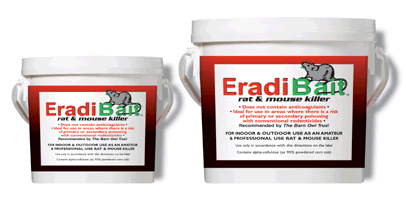
Could Eradibait be the Answer to Stopping Secondary Rodenticide Poisoning in Raptors? And an African Grey Parrot Cam!
Earlier today as I was checking my email, I cruised past the chat room connected to the NYTimes City Blog and Hawk Cam which features Rosie, Bobby, and the two new fuzz heads of the Washington Square Park nest.
I suspect that due to the loses of so many beloved Red-tailed Hawks in New York City, when the words rat poison scrolled by the corner of my eye on the chat, heart in mouth, I focused. What?
WHAT INDEED? Is this a DREAM???
There is actually a rodenticide, apparently non-toxic to everything except rats and mice and there is absolutely no chance of secondary poisoning from it?
Number one, this I had to see!
Number two, why didn't we know about this before?
My apologies for not nabbing the screen name of the person who was the fount of this information I just grabbed the link and went.
The PDF was on the website of the Barn Owl Trust in the U. K. who are out to save Barn Owls from secondary poisoning. Barn Owls also are often victims just like our Red-tails...and our owls and other raptors as well.
After comprehensive information concerning the first generation poisons, the second generation poisons, then came the usual first step sane suggestions.
Number 1-the need to eliminate food sources.
Number 2-the need to eliminate areas of rodent entry.
Then came Number 3- the folks at the Barn Owl Trust's recommendations for rat killing.
Their recommendations were...?
Number 3. Use non-toxic products such as Eradibait (see box)
or alternative methods of killing such as traps, cats,
terriers, ferrets or shooting.
(They're so British and so practical you can just see the tweeds and the sensible shoes can't you.)
Though Central Park has used traps, an officially sanctioned Rat Killing Day once a month in which you bring your black- hearted assassin Fox Terrior, Fred, or James, your Jack Russel, your pet ferret Francis, or Francine your fluffy Persian cat lusting for blood, and of course your rat killing rifle just didn't seem to be in the cards.
BUT ERADIBAIT ? COULD THIS BE THE ANSWER WE'VE BEEN LOOKING FOR?
They said (SEE BOX), and I was on it!
Eradibait
Also sold as -
Growing Success Rat & Mouse
Killer
NON-TOXIC PRODUCTS
Made entirely of food-grade natural
vegetable
materials with NO added toxins or
artificial
chemicals.
Environmentally safe.
Highly effective against rats and
mice (when used
properly) and apparently safe for
other species.
Humane
For more information and a list of
suppliers
please visit www.eradibait.com or phone
the distributors
Ilex EnviroSciences on:
01673
885175
You ask, how does this stuff work?
"It coats the lining of a specific part of a rodent’s lower
gut. The coating of the “fine hairs” in
the lower gut called “villi”, disrupts the message system of the rodent’s brain
causing it to stop drinking. This leads
to dehydration, blood thickening, kidney dysfunction, coma and eventual death."
And as rodents can’t vomit and get rid of it, there we are.
Death occurs in 4 to 7 days.
Okay, supposing this really works and is rodent specific,
what about other members of rodentia?
What about squirrels? Can a
squirrel vomit? (I have that query out
to some squirrel people. ) Or perhaps more to the point,
they don’t have the same breakdown of brain signals that rats and mice do from
coated villi. Or we use squirrel proof bait boxes.
Wow.
Here are the links. Check them out. I've got my fingers crossed and I'm hoping to see a safe avenue of rat control plus a new rat control brochure in our future.
Remember hawk watching Jackie Dover of Oklahoma? She's sent a heads up about a cam that watches Bibi an African Grey. Bibi has quite the vocabulary to say nothing of personality. She's well worth a look.
In fact, I can't wait to show the cam to Quicksilver, the Grey who lives with me and see his reaction. He is constantly attempting to get other birds to talk. The resident pigeons though proven to be extremely smart in any number of ways don't have the double larynx which allows parrots to speak English, and are therefore a sore disappointment to him.
Check out Bibi's cam by clicking the link.
http://www.ustream.tv/channel/Watch-the-Birdie
Happy Hawking!
Donegal Browne
Wednesday, April 11, 2012
DEC NECROPSY RESULTS FOR FOUR MANHATTAN HAWKS
Intrepid, the Riverside Mom
DEC NECROPSY RESULTS NOW AVAILABLE FOR MANHATTAN RED-TAILED HAWKS
The
four red tailed hawks found deceased in and around Manhattan late
February and early March 2012, were submitted for examination to the
State Department of Environmental Conservation’s (DEC) Wildlife Health
Unit. Anticoagulant rodenticides were found as the primary cause of death in three of four birds.
DEC’s Wildlife Health Unit performs necropsies (animal autopsies) and diagnostic laboratory tests to identify the causes of sickness and death in New York State’s wild animals. To
improve public communication regarding these and other cases of
interest, detailed reports and background information is now available
on DEC’s website on the Wildlife Health Program webpage: http://www.dec.ny.gov/animals/81470.html.
Thanks to Bobby Horvath and Katherine Herzog for the link.
Today's regular post appears beneath this one.
Dongegal Browne
Labels:
DEC,
Ginger,
Intrepid,
Lima,
Necropsy,
pale male,
rat poison,
Riverside Park Mom,
Urban Hawks
Friday, April 06, 2012
Pale Male, A Prairie Burn, County M Hawk, a Grumpy Cardinal, plus a Sandhill Crane, a Great Blue Heron and a Wild Turkey in Flight
photo courtesy of palemale.com
Beautiful Pale Male looks at the camera.
Remember the Red-tailed pair who nested in the oak in the middle of a field off County Highway M in Wisconsin? Well, they've still managed to hide their current nest from me but I did catch Mrs. M hunting from their old nest tree. She of course recognized my car and took off before I could her picture perched.
This male Cardinal menaces another in a male Cardinal brawl at Mud Lake. I say brawl but it was mostly about glaring and posturing.
A Great Blue Heron Heads for His Night Roost
Dale Dean and Edie Baran of Landscape Restoration start the fire for the burn of an oak savannah, in which the landowner's house complete with their big propane tank are smack in the middle. All went well and the mistress of the house wasn't even bothered by smoke coming in her windows. These folks really know what they're doing.
Photo by Edie Baran
(How can you tell this is a photo op during my lunch? I don't have my gloves on.)
My apologies for the absence of posts the last few days. For two days I worked very long days on prairie burns then came down with the flu.
(Obviously I didn't get the flu from the prairie burns but rather from a cast member in the show in which I'm working as a vocal coach.)
My big excitement at the burns occurred when a stand of Common Reed, Phragmites australis, that nasty tall invasive that often crowds out the native plants in wet areas given half a chance, went up in flash, leaving me looking at a 14 foot wall of fire. Beyond setting a small patch of a nearby old cornfield on fire, that I with my flapper (the thing I'm holding above) and a guy with big boots stomping, managed to put out before it spread in the wrong direction.
Speaking of flappers, just how does that flap of rubber tool work anyway? It can be used two ways. If you've only got a small leader in the fire making it's way in a direction you don't like, you lay the flapper on it and press he rubber down with your booted foot. If you've a somewhat bigger blaze that is a problem, you raise the flapper up high and bring it down with all your strength whacking the fire, which blows it out in that area. And you keep doing it until it behaves or needs stronger measures
If the fire is blazing a bit higher yet but in a controllable line though starting in a bad direction a fire broom may be the answer. This is a special broom that lives when not in use in a bucket of liquid, I assumed water, but upon thought might have had some additive in it, where it saturates. When it is needed you pull it out and sweep whatever fuel is in front of the flames, such as debris in a cornfield or dead leaves back into the fire where it burns leaving the area in front of the flames less fuel to spread.
And if there is a bigger problem? Everyone on the burn was told a height on their body, for me as I'm short a place a little above my knees where if a long flame line has taken a bad turn, it's time to get yourself out of there, pick up the radio and call for the water truck.
I'd seen the resident Red-tails sky dancing earlier on the property then I spied their nest in a typical location of choice. Rural Red-tailed Hawks like one of the highest trees available with a configuration that will hold a nest. That way the nest has a view. Not only can they see what might be coming at them, they can keep an eye on the territory and perhaps best of all while sitting a nest with not much to do but sit, they watch prey patterns for use later on while hunting.
Photo D.B. A Wild Turkey in flight.
By the way, that puff of smoke left of center is way back where I am with the camera. It isn't anywhere near the turkeys.
Not to worry about the birds and animals during this burn, great areas of the habitat are saved and not burned by the slow moving fires every year. Everybody just moved to those areas of the land which weren't affected for a little while and in many cases then moved right back. Because of the early Spring there were many green spots that didn't really burn at all. The fire dealt with the invasive woody stuff, such as Asiatic Honeysuckle and Buckthorn.
Next up from Richard Fleisher, a prof over in the Political Science Department at Fordham in the Bronx and a chief watcher of Rose and Vince--
Writing to let you know that one of my recent photos of the Hawks was selected by Popular Photography magazine as their photo of the day. It is posted on their Facebook page (http://www.facebook.com/ popularphotography) and on their website (http://www.popphoto.com/ photo-of-the-day/04-02-2012). This shot as well as other recent photos of Rose and Vince can be seen on my flickr page (http://www.flickr.com/photos/profman_wildlife_photos/)
Rich
Congratulations Rich! Great work and super publicity for urban hawks. The more people who get to know Rose and Vice and love them, the safer all hawks are!
The Sandhill Cranes have returned to Wisconsin and are busily finding mates if they need one plus nailing down their nest-sites.
PROTECTING RAPTORS BROCHURE --For those who haven't had much luck convincing folks that immaculate sanitation is the only real answer to rats, New York City Audubon has produced a brochure which names the kill-everything-including-your-hawk-child-or-dog poisons in hopes they may be avoided and those with less chance of secondary poisoning for those who just can't live without using rat poison.
Along with tips on sanitation, blocking rat entry to buildings, plus the recommendation that no poison at all be used from March through August when the parents become hunting maniacs to feed their young and inexperienced fledglings are doing their initial hunting.
The brochure may be ordered from NYC Audubon or you may download it online.
http://www.nycaudubon.org/images/protecting%20raptors.pdf
Donegal Browne
Beautiful Pale Male looks at the camera.
Remember the Red-tailed pair who nested in the oak in the middle of a field off County Highway M in Wisconsin? Well, they've still managed to hide their current nest from me but I did catch Mrs. M hunting from their old nest tree. She of course recognized my car and took off before I could her picture perched.
This male Cardinal menaces another in a male Cardinal brawl at Mud Lake. I say brawl but it was mostly about glaring and posturing.
A Great Blue Heron Heads for His Night Roost
Dale Dean and Edie Baran of Landscape Restoration start the fire for the burn of an oak savannah, in which the landowner's house complete with their big propane tank are smack in the middle. All went well and the mistress of the house wasn't even bothered by smoke coming in her windows. These folks really know what they're doing.
Photo by Edie Baran
(How can you tell this is a photo op during my lunch? I don't have my gloves on.)
My apologies for the absence of posts the last few days. For two days I worked very long days on prairie burns then came down with the flu.
(Obviously I didn't get the flu from the prairie burns but rather from a cast member in the show in which I'm working as a vocal coach.)
My big excitement at the burns occurred when a stand of Common Reed, Phragmites australis, that nasty tall invasive that often crowds out the native plants in wet areas given half a chance, went up in flash, leaving me looking at a 14 foot wall of fire. Beyond setting a small patch of a nearby old cornfield on fire, that I with my flapper (the thing I'm holding above) and a guy with big boots stomping, managed to put out before it spread in the wrong direction.
Speaking of flappers, just how does that flap of rubber tool work anyway? It can be used two ways. If you've only got a small leader in the fire making it's way in a direction you don't like, you lay the flapper on it and press he rubber down with your booted foot. If you've a somewhat bigger blaze that is a problem, you raise the flapper up high and bring it down with all your strength whacking the fire, which blows it out in that area. And you keep doing it until it behaves or needs stronger measures
If the fire is blazing a bit higher yet but in a controllable line though starting in a bad direction a fire broom may be the answer. This is a special broom that lives when not in use in a bucket of liquid, I assumed water, but upon thought might have had some additive in it, where it saturates. When it is needed you pull it out and sweep whatever fuel is in front of the flames, such as debris in a cornfield or dead leaves back into the fire where it burns leaving the area in front of the flames less fuel to spread.
And if there is a bigger problem? Everyone on the burn was told a height on their body, for me as I'm short a place a little above my knees where if a long flame line has taken a bad turn, it's time to get yourself out of there, pick up the radio and call for the water truck.
I'd seen the resident Red-tails sky dancing earlier on the property then I spied their nest in a typical location of choice. Rural Red-tailed Hawks like one of the highest trees available with a configuration that will hold a nest. That way the nest has a view. Not only can they see what might be coming at them, they can keep an eye on the territory and perhaps best of all while sitting a nest with not much to do but sit, they watch prey patterns for use later on while hunting.
Photo D.B. A Wild Turkey in flight.
By the way, that puff of smoke left of center is way back where I am with the camera. It isn't anywhere near the turkeys.
Not to worry about the birds and animals during this burn, great areas of the habitat are saved and not burned by the slow moving fires every year. Everybody just moved to those areas of the land which weren't affected for a little while and in many cases then moved right back. Because of the early Spring there were many green spots that didn't really burn at all. The fire dealt with the invasive woody stuff, such as Asiatic Honeysuckle and Buckthorn.
Next up from Richard Fleisher, a prof over in the Political Science Department at Fordham in the Bronx and a chief watcher of Rose and Vince--
Writing to let you know that one of my recent photos of the Hawks was selected by Popular Photography magazine as their photo of the day. It is posted on their Facebook page (http://www.facebook.com/ popularphotography) and on their website (http://www.popphoto.com/ photo-of-the-day/04-02-2012). This shot as well as other recent photos of Rose and Vince can be seen on my flickr page (http://www.flickr.com/photos/profman_wildlife_photos/)
Rich
Congratulations Rich! Great work and super publicity for urban hawks. The more people who get to know Rose and Vice and love them, the safer all hawks are!
The Sandhill Cranes have returned to Wisconsin and are busily finding mates if they need one plus nailing down their nest-sites.
PROTECTING RAPTORS BROCHURE --For those who haven't had much luck convincing folks that immaculate sanitation is the only real answer to rats, New York City Audubon has produced a brochure which names the kill-everything-including-your-hawk-child-or-dog poisons in hopes they may be avoided and those with less chance of secondary poisoning for those who just can't live without using rat poison.
Along with tips on sanitation, blocking rat entry to buildings, plus the recommendation that no poison at all be used from March through August when the parents become hunting maniacs to feed their young and inexperienced fledglings are doing their initial hunting.
The brochure may be ordered from NYC Audubon or you may download it online.
http://www.nycaudubon.org/images/protecting%20raptors.pdf
Donegal Browne
Subscribe to:
Posts (Atom)