Showing posts with label secondary poisoning. Show all posts

Monday, March 25, 2013

Chris Lyons Continues the Search for Rose of Fordham

 
 The nest at Fordham with eyasses of a previous season. 

 Chris Lyons, who has watched Rose, first with her mate Hawkeye, and after Hawkeye's death by secondary rat poison, has watched she and her now mate, Vince, continues his search for the missing Rose.   

Chris wrote:
One of the people I contacted yesterday was Bobby Horvath, and he said he hadn't been notified about a female he banded having been found dead or ailing.   There's no guarantee that she'd be found if she died, or that the one who found her would know who to contact--but she is banded, and that may eventually yield information.  

 I'm hoping somebody will have seen her alive, but from what you say, that is sounding less likely.   Rich Fleisher hasn't seen her lately, but he hasn't had much chance to look.  He did see one hawk near the nest some days back, but that could have been Vince.  Over at the Botanical Garden, a sick hawk was found recently, but no mention of it being banded--I'm trying to get more info.  It will take some time. 
I would hate to think it was poison.   Call me a romantic, but I'd rather she died in fierce battle with a a rival female, or a Great Horned Owl, or got hit by lightning, or anything else, anything.   I hate it that we do this to them.  It's a bad way for them to die.  I don't even put out poison for the mice in our apartment anymore.   


 Chris, I completely and utterly concur.  According to STOP THE POISON activists  in NYC, there are numerous towns in California that have seen the light and outlawed rodenticides.  We all need to work to educate the public that sanitation is the only weapon that actually works to stop infestations of rodents.

And poisons are just not an option!  Particularly non-species specific poisons which injure or kill wildlife, pets, and even children every year.  That's too large a price to pay for being slovenly when a little care would nip burgeoning  rodent populations in the bud. 

Also, I received several emails from readers who are unfamiliar with the Fordham site.  Therefore, a few words about the Fordham Nest ... 

The Fordham site is likely the most fledgling friendly building nest in the city.  The overhang protects the hawks from a good bit of weather and trees as you can see, are within feet of the building.

Those handy trees at nest height, make the fledge of these eyasses far more similar to the fledgling environment of hawks in a non-urban nest while having  the shelter of a building to protect the family earlier in life.  


With a short flight hop, the youngsters can "branch" within the trees.  They rarely if ever get grounded and fly back and forth so frequently from the nest that it is difficult to tell whether the eyasses have already fledged or not as they so easily return to the nest.

More as it happens!

And don't forget the NYU HawkCam and chat are up...
 http://www.livestream.com/nyu_hawkcam
Donegal Browne 

Wednesday, October 17, 2012

Does Pale Male Recognize His 2012 Fledglings? And the Monarch of Central Park Still Knows How to Impress a Girl!

The two fledglings of Pale Male and Zena who were poisoned not long after this photograph was taken and are now back in Central Park.               Courtesy of  http://www.palemale.com/  

FROM ROBIN OF ILLINOIS REGARDING THE RELEASE OF THE FIFTH AVENUE FLEDGLINGS BACK TO CENTRAL PARK  AND THE POSSIBILITY OF PALE MALE RECOGNIZING THEM AND CONTINUING HIS TRAINING OF THE YOUNG HAWKS--

I'm thinking of the Franklin step-dad, stepping in as a stranger, to raise another male's young, contrary to everything we thought we knew about RTHs. 
PM's hormones may be waning, and that may signal to us that these young RTHs are now strangers to him, but he was seen flying overhead and watching. As you've said, and time has proven, as we are able to see more of the private lives of the hawks, never underestimate a red tail! 

Who knows?He may indeed still recognize them in some way, and pick up the training (and supplemental feeding) with his two surviving progeny. 
I was considering whether the two young'uns might stay in the Park, over-wintering there, with PM's help. Just because we haven't seen that kind of behavior before, doesn't mean it can't happen. Franklin's T2 is certainly testimony to that! 
I'm glad they painted the toenails and suspect that Rob will be keeping a careful and caring eye out, to see if they stay or leave. That was an excellent idea. WINORR is the BEST! And Rob is too.
And your blog is too! Thank you. 
Robin

Indeed, one must Never Underestimate a Red-tail!

But in this case I've a little snippet of past experience that makes me believe that Pale Male likely does recognize his previous progeny.
Back in 2005, I was watching the 927 Fifth Avenue Nest.  Lola was sitting on eggs and Pale Male had just dropped in  for a visit.  When suddenly, out of-- it seemed nowhere-- but likely from Madison the next Avenue beyond Fifth, a third Red-tail  appeared perched on the overhang directly over the nest and looked down at Pale Male and Lola.  Pale Male looked up and in a nanosecond he'd zipped up to the third Red-tail  and instead of bowling him right over backwards, Pale landed with a quick turn, less than a foot away from the new hawk, leaned over towards him and glared.  Third hawk, appeared to realize his transgression, looked utterly startled and hot winged it out of there.  Unexpectedly Pale Male didn't give chase.  He calmly floated down and landed on the nest again, as if nothing had happened. Not a whiff of the usual hot-pursuit-adrenalined-out-look hawks usually get in instances like these.  
Remember this was the time of year when the territorial boundaries are utterly rigid and no birds except perhaps some pigeons or a few dickey birds are allowed to loiter.  Even Gulls and Turkey Vultures learn to keep clear.  But in this case something was very different and after much thought as to "Why?", I began to think it was possible that the third hawk was one that Pale Male recognized and likely a youngster from the previous year who had come to check out the old homestead.

That said it does not necessarily follow that if Pale Male did recognize these two from the 2012 nest that he would necessarily pick up their training from where it was left off.   But then again, as Robin pointed out, T2 certainly surprised everyone didn't he?  
Though Pale Male may be a touch distracted at the moment with courting his now "New Girl", Octavia.  There are so many twigs and amorous flights and so little time.  
This of course does not keep the youngsters from watching Pale Male as he hunts.  Often the way adults teach techniques to their fledglings anyway.  
Though when the youngsters are six months younger the adult will make sure their attention has been taken from tussling with each other and killing rocks and twigs to the training at hand.  
At this point these two are old enough to pay attention on their own.  Therefore it may not be obvious that they are being trained but I believe their hawk eyes will be focused on the adult hawks in their environment.

And please God, no poisoned rats!

Photo courtesy of http://www.palemale.com/ 
Pale Male and Octavia in courtship flight.  See the hanging talons?
 
 That's right!  Plus it's never too early to nail down one's mate for the upcoming season. 
Donegal Browne

Tuesday, October 16, 2012

Pale Male's Earlier Poisoned 2012 Fledglings Return to Central Park!


       Photo courtesy of Henry Willson / Senior Staff Photographer, Columbia Spectator
  Cathy Horvath releases one of Pale Male and Zena's previously poisoned Fledglings in Central Park.

http://www.columbiaspectator.com/2012/10/15/young-hawks-return-wild-after-battle-rat-poison

I received an email this evening for Ellen Smithson, who recently relocated from Tucson, Arizona to NYC and who just happened to be enjoying Central Park when she stumbled upon the release of the two fledglings of Pale Male and Zena.  They who survived a bout of secondary rat poisoning under the care of Cathy and Bobby Horvath of WINORR, Wildlife in Need of Rescue and Rehabilitation.  

Ellen wrote in part-

I was taking a walk in the Ramble when I saw a long haired park ranger and a dark haired woman painting the toe nails of a large bird.  

I thought to myself, "Only in New York City".

There were others looking on during this phenomena so I too stopped to watch what might happen next.  

It was one of the most beautiful sights I'd ever seen. Two hawks  flew from the hands of a person into the freedom of  air and sunshine.  A sun that flashed off the gold in their feathers.  

Two hawks which were poisoned by anonymous people who'd set out to kill rats and who had been brought back to life by people who cared enough to do all the tending it took to get to this spot on this day.  It was a blessing.

I was told that there wasn't any guarantee that these birds wouldn't be poisoned again and that, I found, a very tragic thought.  How can people be so thoughtless?  Is there no other way? 

I then got my first look at Pale Male later.  I was befriended by some  very nice hawk people and we saw him fly over the younger hawks. I guess he recognized them as he didn't chase them away, which I'm told he would have done if he didn't know them.  

I think I'm going to like New York City after all. 

 Many thanks Ellen, and if you can be intrigued by people painting nail polish on a hawk's talons and wait around for the second act.  I think you definitely have the stuff to "like" the Big Apple.  Keep in touch!

Opera Star the third fledgling of this year's nest on 927 Fifth Avenue is believed to have succumbed to secondary rat poisoning,  as likely, did his mother, Zena.

A few of the  known lost to secondary rat poison are Ginger Lima, Pale Male's mate before Zena,   Hawkeye, mate of Rose, at the Fordham nest, Athena, mate of Atlas of the Triborough nest, and Intrepid, the beautiful Riverside Park Mom, who had lost three eyasses still in their natal feathers on the nest, due to secondary rat poisoning in a previous season. 

Though Pale Male's fledglings were poisoned while in or around Central Park by eating already poisoned rats, they were also released back to the area.  There are any number of reasons for doing this which include their familiarity with their natal territory and the fact that when it comes down to it, secondary poisoning is a problem all over the country. 

 Though Central Park has reputedly done what they can to remove poison, there are buildings which face the park which undoubtedly have not.

 Nowhere is truly safe for them. 

BESIDES...another reason why Central Park would be best, at least in my opinion,  is as these birds were so young when they were poisoned they had not had the time to be trained thoroughly by their super hunter father Pale Male in his many hunting techniques.  The ways of hunting are not innate for Red-tailed hawks.  They must be apprenticed to hunting by their parents.  The better the training  the more chance they have of surviving their first year, when a very high percentage of  young Red-tailed hawks die.

I'm hoping that Pale Male will pick up where he left off  as hunting mentor.  I realize that in young Red-tailed fathers the training of their offspring may come from hormonal urges.  A hormonal level that after six months Pale Male may not feel.  But just perhaps Pale in his many seasons of training young hawks, has the cognizance to know what they need and will do it because he knows it needs doing not just because his hormones tell him so. 

Donegal Browne

Sunday, September 23, 2012

PART 2 of Bomber the Hummingbird, Quicksilver, Pyewacket and the Spaghetti, Plus a Saturday Miscellany Which Includes a Link to Filmmaker Adam Welz' Wild New York


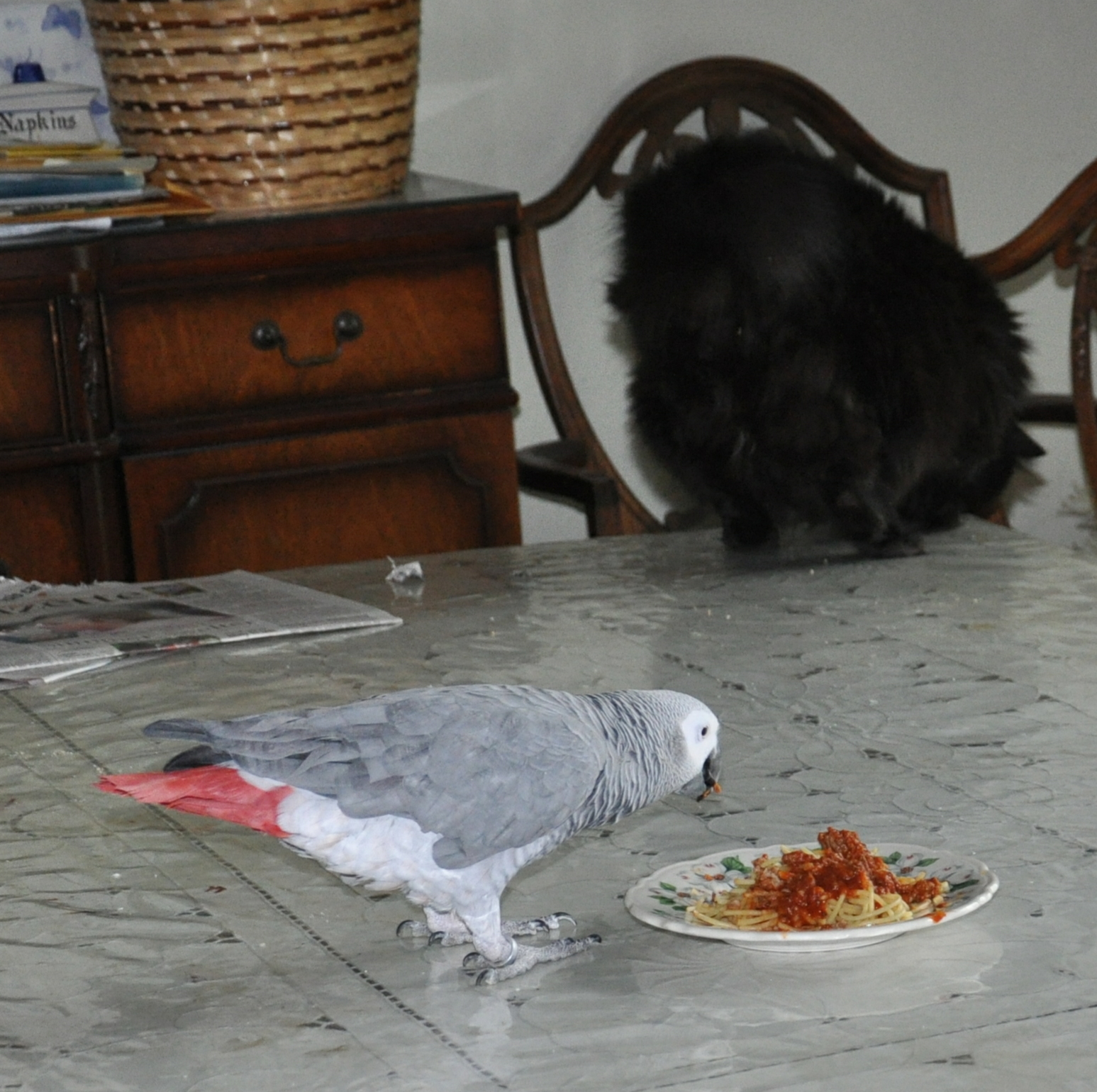
We pick up today's episode of The Adventures of Bomber the Hummingbird, Quicksilver, Pyewacket, and the Spaghetti,  where we left off,  with Pye bearing down on Silver over the spaghetti  plate.

 Silver goes into aggression mode, no nose touching for him.  Eyes flashing, (His pupils go from large to small and back again repeatedly.) He stands his feathers on end while taking an aggressive posture which often is the prelude to his leaping precipitously at the object of his attentions, beak open and wings flapping.

Trust me. It's scary.

Pye must think so too because she pulls her head back.  Silver glares, legs braced.  It's a stand off over the spaghetti plate.
 Pye bends right and slowly comes around the other way toward Silver.  Silver has had enough and gives me the just- when-are-you-going-to-tell-the-CAT-to-get-off-the-table look.

Let me give you the larger view of the expression so you'll recognize it if it ever happens to you.
I don't want him leaping at me in disgust,  so I say "Pye" quietly and as she knows she isn't supposed to be on the table,  and actually cares that I disapprove, starts moving toward the edge.


Just to prove she is no pussy, Pye does a little playful feint of a scamper towards the parrot.  Not the least unnerved, both knew this wasn't the least bit serious...
Silver gets back to eating as Pyewacket heads off the table into a chair.
 Once in the chair, Pye stops short and appears to stare fixedly at "something" out of our view.  Silver considers walking over and looking over the edge but he's fallen for that one before and restrains himself, taking another bite.
Pyewacket settles down at the patio door for a session of birdwatching, Quicksilver keeps eating, and if you look carefully you'll see Bomber the Hummingbird facing out waiting for another session of Hummingbird aggression.
She rouses her feathers and gives her wings a few flicks.
 When I look again, Bomber has gone missing.  I go to the door to see if she has taken up her station in the Maple tree, and a little dry, cracked voice says, "Fresh water."
 Silver says it again in the same dried up old voice.  Where he learned to say fresh water, like some old heat crazed prospector who's gone without water for a month, in say, "Treasure of the Sierra Madres", I'll never know.

But it is hilarious.  No doubt the reason he keeps it.

Next up.... 
 

 In case you missed it in the comments section, anti-rodenticide progress watcher Sally of Kentucky sends a story of an enlightened town--

 http://elcerrito.patch.com/articles/council-endorses-anti-rodenticide-measure

 South African film maker Adam Welz did a piece for South African Television, Wild New York, about the NYC hawks and hawkwatchers.  Originally it was part of a series chronicling The Healing Power of Nature on South African television and later did well at film festivals.

When the film screened at a festival nearby, Adam and I teamed up again as part of a panel discussing pressing wildlife issues.

Director Welz has now made Wild New York available for viewing online in order, he hopes, to procure the wherewithal, as in artistic clout, name recognition, and angels in order to do his next film. Which let me add he feels very strongly should be made in order to get the word out about a tragic situation of humans vs wildlife which continues today and without any publicity to speak of.  

Adam's next film will chronicle the conflict caused by human farming infiltration into previously untrammeled wildlife territory which has caused the tragic killing of many, many lions.  

 To see Wild New York click the link below!

www.vimeo.com/adamwelz/wildnewyork


And Betty Jo McDonald invites us all to sign the petition to stop the killing of whales in the Faroe Islands

http://www.causes.com/causes/165072-stop-dolphin-and-whale-slaughtering/actions/1680442?causes_ref=email&recruiter_id=133353103&template=activity_invitation_mailer%2Factivity_invitation&utm_campaign=action_invitation_email&utm_medium=email&utm_source=causes

Donegal Browne

Wednesday, September 19, 2012

Pale Male Stands Vigil Plus Linda Maslin of PA's Responses from NYC Audubon Regarding Rat Poisons and Hawks

Beautiful Pale Male stands vigil in Central Park, photo courtesy of www.palemale.com/
 
 
Long time blog reader and contributor Linda Maslin has been working on the raptor poisoning problem and has been in touch with Glenn Phillips the Executive Director of New York City Audubon. 
 
Donegal,
This is a response I received from NYC Audubon.  I had received another response a month or two ago when I had complained to them about the poison, in which they said they are trying to work out the problem,  but it's on my other computer which is being repaired.
Regards,
Linda Maslin
Blue Bell, PA
 
 
Glenn's response of August 4th, 2012
 
Linda-

I've been out of the office and have gotten a couple of emails about rat poison at AMNH.  Im not sure why you would think we were unwilling to tackle this question...I will be back on the 13th, and will talk with my contacts
there. As you probably already know, NYC Audubon has been actively promoting rodent control policies that are safer for raptors. Our brochure is available on our website. We have verbal agreement from several city
agencies to follow those guidelines. AMNH is not among them, but the property they are on is technically owned by parks, so it should not be too hard to get them to conform. I will let you know.
 
 
 And the promised update to Linda from Glenn--
 
Just to follow up... I spoke with my contact at Parks, who had already spoken with AMNH, they have agreed to follow Parks Departments protocol, which is not to use any poison from March-August, and not to use the two most dangerous chemicals: Brodifacoum and Difethialone.

We've also spoken with colleagues at the NYS Department of Conservation, who will be helping us draft legislation that will outlaw both of those chemicals in NYC, and possibly in the state (they'd like that, but aren't sure that it is possible.)

-Glenn
 
Glenn Phillips
Executive Director
New York City Audubon
71 West 23rd Street, Room 1523
New York, NY 10010
 
If you'd like to thank Glenn Phillips and NYC Audubon for their efforts see address above. 
 
And it would be a fine time for all to write their law makers regarding the dangers of rat poison.  Get on the keyboard folks, take out that pen!

AND A BIG ROUND OF APPLAUSE AND A KEEP UP THE GOOD WORK TO ALL THOSE WORKING TOWARD A POISON FREE ENVIRONMENT FOR HAWKS, DOGS, CHILDREN, US AND ALL THE CREATURES OF THIS GOOD GREEN EARTH~

Donegal Browne

Monday, July 23, 2012

FLASH!!! TWO FIFTH AVENUE FLEDGLINGS POSSIBLY POISONED. UPDATED!

From Central Park hawkwatcher Jeff Johnson,

Donegal,

Very bad news--one fledgling was found sick in an enclosed space on the American Museum of Natural History  grounds yesterday and is now in the care of  the Horvath Rehabilitators. 
This second fledgling is displaying symptoms of rat poisoning also…it has not left the tree it has been perched in for almost two days now and refused to eat a meal left in plain view. 

[This behavior is similar to that of  previous Pale Male mate, Ginger Lima, who eventually fell to the ground dead and through later necropsy was found to have been killed by secondary poisoning, i.e. from eating a poisoned rat. D.B.]


This tree located on the west side of the Natural History Museum has been the perch (left circle) (correction sent by Jeff, tree may be nearer MET) of what appears to be a fledgling sickened by rat poisoning. At its extreme height and location the fledgling is presently inaccessible for capture so that the Horvath's can try and treat it. 
1453 Metadata time.
 Fledgling on the left has hardly moved in almost two days now. Fledgling on the right appears animated and still normal. 
1456 Metadata time. 
[AMNH is on Central Park West facing Central Park between 77th and 81st. D.B.]

Combined frame enlargement. Fledgling on the right flew away. 1459  Metadata time.  
After all the wonderful things that have happened for the 927 Red-tail Family, now comes this potential disaster which if it is indeed rat poisoning  is wholly man-made.
Jeff

P.S from D.B.-- Hawkwatchers report that Zena has been sighted watching over the ill fledgling in the tree.  If a predator should appear, as might be more likely in the true wild, she would protect her fledgling from being taken as easy prey.  If only she could fight this poison to the death. 

Donegal Browne

Wednesday, May 02, 2012

PALE MALE HAS A HATCH! FRANKLIN DAD LIKELY DEAD. ATLAS AND ANDROMEDA HAVE A HATCH!

 Photo courtesy of http://www.palemale.com
GOOD NEWS, BAD NEWS, GOOD NEWS
 Good News--
Photographer Rik Davis, a fixture at the hawk bench for many years, called Marie Winn, author of Red-tails in Love, with the news of a hatch at 927 Fifth Avenue.  Lincoln Karim also states that Pale Male is busy hunting for his new family.
 Bad News--
 Contributer Linda Maslin sent in possible news of the Franklin tiercel.  We do not have a positive ID, but the area in which the hawk was hit could be indicative.
Mike Thierfelder
Hello, I have unfortunate news about what happened to Dad. On Saturday morning at about 6:30 AM I was driving east on I76 when I witnessed a Red Tail Hawk struck and killed by a small truck in the left lane several car lengths ahead of me. The location was just west of the 30th street underpass, between the BFB split and the 30th oncoming ramp. Given the location and timing this was certainly Dad.

The bird came out from under the truck, skiddied accross the road ahead of me and ended on the right shoulder. I am positive it was a red tail. He may still be there on the shoulder. Sorry it took so long to get this out. I heard about this Tuesday morning and was unable to ever get through the FI phone system to a real person. So I applied to your group and had to wait for acceptance
Mike T.
 Then an update from Tulsa's Jackie Dover, by way of Robin of Illinois--
"Carolyn Card Sutton
Just returned from driving the area of I76 described by Mike. Most definitely the red tail killed there was Dad; it was so VERY much his primary hunting grounds; directly across river from the Schuylkill Banks Park across off ramp from Spring Garden Bridge next to Art Museum where we have watched him so many times over 4 years. Unfortunately, although I drove the route twice, there was no sign of Dad on the shoulder of the road. There are many construction crews/lane closures in area, and I believe some worker or other cleaned up the remains.. The area there was very clean (no trash, litter, anything), considering all the 24/7 traffic.".............
Now we know.
A memorium in photographers for Franklin Dad,
http://www.photoshow.com/watch/CI9iG9dm
GOOD NEWS

Update on Astoria Park/RFK Bridge Hawk Nest

From Jules Corkery, major watcher of the Astoria Park Nest-

Hi All

This morning, Atlas brought food to the nest so we got to see both parents - they look alert and well fed.  After Atlas left, Andromeda brought the rat around to the back of the nest and two little grey downy heads popped up above the nest to greet her for breakfast.
They are still only visible when they are super active so we're not sure if there are any others.
Good luck, little family.

Jules and Robert
Jules is also a community activist and urban hawk educator who, particularly since Atlas' original mate Athena was poisoned leaving eggs on the nest, has been out there spreading the news about the dangers of secondary rat poison.   She's now distributing NYC Audubon's brochure/flyer about safer rat control.

Just an example of what we can all be out doing from house-a-fire Jules referring to the flyer  NYC ,

The Astoria Park Allliance would love to distribute the flyer!  It's My Park Day is May 19th - we come in contact with an estimated 500 park patrons.  We will have volunteers from NY Cares,The  International High School, Green Shores NYC, and a few others.  We also will be presenting at our Community Board 1 on May 15th. 
 I'd also like to bring flyers to our Astoria Civic Association meeting and give some to the local BID, Central Astoria Local Development Corp.

Thanks!
Jules
Here is the link for the  flyer

http://www.nycaudubon.org/images/protecting%20raptors.pdf

 The end game would be to have Brodifacoum and Difethialone, the second generation poisons that give hawks no clues of their presence,  made illegal first in the communities where we live and then everywhere.

 Donegal Browne

Thursday, April 19, 2012

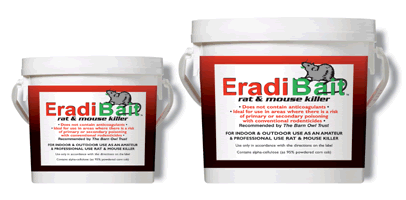
Could Eradibait be the Answer to Stopping Secondary Rodenticide Poisoning in Raptors? And an African Grey Parrot Cam!


Earlier today as I was checking my email, I cruised past the chat room connected to the NYTimes City Blog and Hawk Cam which features Rosie, Bobby, and the two new fuzz heads of the Washington Square Park nest.

I suspect that due to the loses of so many beloved Red-tailed Hawks in New York City, when the words rat poison scrolled by the corner of my eye on the chat, heart in mouth, I focused.  What?  

WHAT INDEED?  Is this a DREAM???

There is actually a rodenticide, apparently non-toxic to everything except rats and mice and there is absolutely no chance of secondary poisoning from it?


Number one, this I had to see!  

Number two, why didn't we know about this before?

My apologies for not nabbing the screen name of the person who was the fount of this information I just grabbed the link and went.

The PDF was on the website of the Barn Owl Trust in the U. K. who are out to save Barn Owls from secondary poisoning.  Barn Owls also are often victims just like our Red-tails...and our owls and other raptors as well.


After comprehensive information concerning the first generation poisons, the second generation poisons, then came the usual first step sane suggestions. 


Number 1-the need to eliminate food sources.
Number 2-the need to eliminate areas of rodent entry. 

Then came Number 3- the folks at the Barn Owl Trust's  recommendations for rat killing.  

Their recommendations were...?


Number 3. Use non-toxic products such as Eradibait (see box)
or alternative methods of killing such as traps, cats,
terriers, ferrets or shooting.


(They're so British and so practical you can just see the tweeds and the sensible shoes can't you.) 


Though Central Park has used traps,  an officially sanctioned Rat Killing Day once a month in which you bring your black- hearted assassin  Fox Terrior, Fred,  or James, your Jack Russel, your pet ferret Francis, or Francine your fluffy Persian cat lusting for blood, and of course your rat killing rifle just didn't seem to be in the cards.


BUT ERADIBAIT ?  COULD THIS BE THE ANSWER WE'VE BEEN LOOKING FOR?

They said (SEE BOX), and I was on it!
 
Eradibait

Also sold as -
Growing Success Rat & Mouse Killer
NON-TOXIC PRODUCTS

Made entirely of food-grade natural vegetable
materials with NO added toxins or artificial
chemicals.

Environmentally safe.

Highly effective against rats and mice (when used
properly) and apparently safe for other species.

Humane

For more information and a list of suppliers
please visit www.eradibait.com or phone the distributors
Ilex EnviroSciences on:
01673 885175

You ask, how does this stuff work?  

"It coats the lining of a specific part of a rodent’s lower gut.  The coating of the “fine hairs” in the lower gut called “villi”, disrupts the message system of the rodent’s brain causing it to stop drinking.  This leads to dehydration, blood thickening, kidney dysfunction, coma and eventual death."

And as rodents can’t vomit and get rid of it, there we are.

Death occurs in 4 to 7 days.

Okay, supposing this really works and is rodent specific, what about other members of rodentia?  What about squirrels?  Can a squirrel vomit?  (I have that query out to some squirrel people. )  Or perhaps more to the point,  they don’t have the same breakdown of brain signals that rats and mice do from coated villi.  Or we use squirrel proof bait boxes.

Wow.

Here are the links.  Check them out.  I've got my fingers crossed and I'm hoping to see a safe avenue of rat control plus a new rat control brochure in our future. 


Remember hawk watching Jackie Dover of Oklahoma?  She's sent a heads up about a cam that watches Bibi an African Grey.  Bibi has quite the vocabulary to say nothing of personality.  She's well worth a look.

In fact, I can't wait to show the cam to Quicksilver, the Grey who lives with me and see his reaction.  He is constantly attempting to get other birds to talk. The resident pigeons though proven to be extremely smart in any number of ways don't have the double larynx which allows parrots to speak English, and are therefore  a sore disappointment to him. 
Check out Bibi's cam by clicking the link.

http://www.ustream.tv/channel/Watch-the-Birdie

Happy Hawking!

Donegal Browne

Tuesday, March 13, 2012

A HAWK SEASON OF DESPAIR- Four Gone in a Month

 Intrepid broods eggs.  Her three eyasses that season were accidentally poisoned on the nest by being fed a poisoned rat.

 Photo Donegal Browne
2011-Young Ginger Lima, recently deceased,  tends her eyasses fathered by Pale Male- photo courtesy of palemale.com

                
From Myisha Priest,  hawk watcher,  NYU professor,  and the host of a seminar that 

celebrated the wildlife of New York City --


                                    Donna,                                    
   I just read the news of Intrepid. Heartbroken. She was singular in her ability to persevere. Though I guess they all are, which is one of the reasons we love them. Remember when her beak was broken and she made it through the winter anyway?
  What a sad hawk season. Violet, Lima, the Southside hawk and now Intrepid. Yet they say that grief is the price we pay for love...
 I send wishes for peaceful rest for those who are gone, wishes for better times for those who are here, and kind thoughts to the hawks and the tender (and bruised) hearts of those who love them.


 Myisha your note is beautiful.  Thank you.  I am afraid that my heart, among many others, has been bruised very badly this time around.

There have been times of despair before for those who love and attempt to succor New York City's urban hawks but the last year, which includes the long drawn out travail of Violet due to  human failure, has been, I think, the darkest.


Though there is no proof and may never be, as the testing of the very common Red-tail Hawk for poison is low on the list of priorities for the financially strapped New York State Wildlife Pathology budget, the known evidence points to secondary poisoning as the cause of death in this  latest wave of unblemished beautifully feathered corpses.

 Poison is also arguably a possible vector in the disappearance of Pale Male's mate of many years, Lola.

Today I am at a loss as to what more we can do soon enough to help the now living survive.  For assuredly what we have done has not been enough to save those who are gone and my feeling is that only luck has allowed those who still live to continue their lives.


Education is slow.  Poison is fast.


If mature, city-savvy hawks such as Intrepid, and before her, Builder,  Athena, Hawkeye, Ginger Lima, and Lola to name a very few, have not found any clues to warn them away from the rats that killed them, there likely aren't any clues and the death toll will only continue. 


Can we find a strategy that works with the rapidity that poison does?   


Hawkeye of Fordham, mate of Rose and the father of many, many well fledged young died of poison.  Photo Donegal Browne

Photo Donegal Browne

Athena of the Triborough Bridge nest,  a mother for many seasons, died of  rodenticide secondary poisoning leaving a clutch of eggs.  Her mate Atlas attempted to hatch the eggs on his own, but with no one to hunt for him or spell him on the nest so he could leave to hunt and eat,  the eggs were sometimes unattended.  They never hatched.

 FROM NEW YORK MAGAZINE

Yet Another Red-Tailed Hawk Found Dead


It hasn’t been a good late winter for New York’s red-tailed hawk population. The first big news came when the first lady of New York’s hawks — Pale Male’s latest love interest — was found dead. Shortly thereafter, the body of another unidentified red-tailed hawk was found in Central Park. There was also a young hawk found dead in the park, which was mostly ignored outside of hawk watching circles.  But now, yet another  bird, this one a Riverside Park resident, has bitten the dust, bringing the recent death toll up to four.

 READ MORE

 Intrepid, Riverside Mom hunts.  Before she died, she had outlived a mate and three eyasses who had all died of poison.                                                      Photo Donegal Browne

EDUCATE AND ORGANIZE YOUR FRIENDS AND NEIGHBORS ABOUT SANITATION, RATS,  SECONDARY POISONING AND WHAT THEY CAN DO TO MAKE THINGS BETTER FOR THE RAPTORS IN THEIR NEIGHBORHOODS.

Thanks to Rachel Shriff for posting flyers about secondary poisoning and the dangers of second generation poisons in her Queens neighborhood.

In memory also of all the hawks unnamed, who have died of secondary poisoning and human negligence. 

Donegal Browne