Showing posts with label Rats. Show all posts

Tuesday, May 01, 2012

THE FRANKLIN INSTITUTE TIERCEL IS MISSING!!! Do Pale Male and Zena Have a Hatch?

                                       Photo courtesy of    http://sunnydixie.blogspot.com/

The Franklin Institute tiercel was last seen on Friday.  He has gone missing leaving his formel with three very young eyasses on the nest.


The formel left the nest today to hunt.  She was gone two hours but did return with a large rat. Unfortunately it will be very difficult if not impossible for her to feed and care for three eyasses on her own.  

I have suggested that the local Hawkwatchers institute a supplemental food program similar to the one rehabber Bobby Horvath and the Riverside Park Hawkwatchers used when Riverside Dad was poisoned leaving Intrepid, the Riverside Mom with eyasses on the nest. Previously frozen rats and Quail were left where she could see them.  She took to the program without missing a beat. It worked very well and no eyass starved on the nest.


If memory serves, The Franklin Institute Nest overlooks a highway which will possibly make leaving visible and easily obtainable food for the formel to take to the nest somewhat more difficult.  Perhaps there is an adjacent window ledge where food could be left discretely for her to find.  This would also keep her closer to the eyasses in case they needed to be protected from predators.

The Franklin Hawk Cam was turned off for a short while after the tiercel went missing but then began broadcasting again.  It is currently off again. ???  http://www.ustream.tv/channel/the-franklin-institute-haw-cam

Fingers crossed.

Donegal Browne

 P.S.  Word began to circulate today that feeding behavior may have been observed on the part of Zena on the 927 nest.  No confirmation yet from long time Fifth Avenue Hawkwatchers. 
                           

Thursday, April 19, 2012

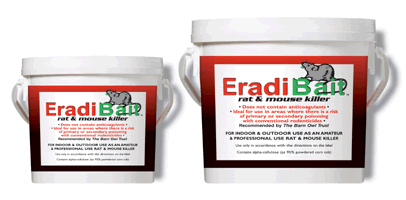
Could Eradibait be the Answer to Stopping Secondary Rodenticide Poisoning in Raptors? And an African Grey Parrot Cam!


Earlier today as I was checking my email, I cruised past the chat room connected to the NYTimes City Blog and Hawk Cam which features Rosie, Bobby, and the two new fuzz heads of the Washington Square Park nest.

I suspect that due to the loses of so many beloved Red-tailed Hawks in New York City, when the words rat poison scrolled by the corner of my eye on the chat, heart in mouth, I focused.  What?  

WHAT INDEED?  Is this a DREAM???

There is actually a rodenticide, apparently non-toxic to everything except rats and mice and there is absolutely no chance of secondary poisoning from it?


Number one, this I had to see!  

Number two, why didn't we know about this before?

My apologies for not nabbing the screen name of the person who was the fount of this information I just grabbed the link and went.

The PDF was on the website of the Barn Owl Trust in the U. K. who are out to save Barn Owls from secondary poisoning.  Barn Owls also are often victims just like our Red-tails...and our owls and other raptors as well.


After comprehensive information concerning the first generation poisons, the second generation poisons, then came the usual first step sane suggestions. 


Number 1-the need to eliminate food sources.
Number 2-the need to eliminate areas of rodent entry. 

Then came Number 3- the folks at the Barn Owl Trust's  recommendations for rat killing.  

Their recommendations were...?


Number 3. Use non-toxic products such as Eradibait (see box)
or alternative methods of killing such as traps, cats,
terriers, ferrets or shooting.


(They're so British and so practical you can just see the tweeds and the sensible shoes can't you.) 


Though Central Park has used traps,  an officially sanctioned Rat Killing Day once a month in which you bring your black- hearted assassin  Fox Terrior, Fred,  or James, your Jack Russel, your pet ferret Francis, or Francine your fluffy Persian cat lusting for blood, and of course your rat killing rifle just didn't seem to be in the cards.


BUT ERADIBAIT ?  COULD THIS BE THE ANSWER WE'VE BEEN LOOKING FOR?

They said (SEE BOX), and I was on it!
 
Eradibait

Also sold as -
Growing Success Rat & Mouse Killer
NON-TOXIC PRODUCTS

Made entirely of food-grade natural vegetable
materials with NO added toxins or artificial
chemicals.

Environmentally safe.

Highly effective against rats and mice (when used
properly) and apparently safe for other species.

Humane

For more information and a list of suppliers
please visit www.eradibait.com or phone the distributors
Ilex EnviroSciences on:
01673 885175

You ask, how does this stuff work?  

"It coats the lining of a specific part of a rodent’s lower gut.  The coating of the “fine hairs” in the lower gut called “villi”, disrupts the message system of the rodent’s brain causing it to stop drinking.  This leads to dehydration, blood thickening, kidney dysfunction, coma and eventual death."

And as rodents can’t vomit and get rid of it, there we are.

Death occurs in 4 to 7 days.

Okay, supposing this really works and is rodent specific, what about other members of rodentia?  What about squirrels?  Can a squirrel vomit?  (I have that query out to some squirrel people. )  Or perhaps more to the point,  they don’t have the same breakdown of brain signals that rats and mice do from coated villi.  Or we use squirrel proof bait boxes.

Wow.

Here are the links.  Check them out.  I've got my fingers crossed and I'm hoping to see a safe avenue of rat control plus a new rat control brochure in our future. 


Remember hawk watching Jackie Dover of Oklahoma?  She's sent a heads up about a cam that watches Bibi an African Grey.  Bibi has quite the vocabulary to say nothing of personality.  She's well worth a look.

In fact, I can't wait to show the cam to Quicksilver, the Grey who lives with me and see his reaction.  He is constantly attempting to get other birds to talk. The resident pigeons though proven to be extremely smart in any number of ways don't have the double larynx which allows parrots to speak English, and are therefore  a sore disappointment to him. 
Check out Bibi's cam by clicking the link.

http://www.ustream.tv/channel/Watch-the-Birdie

Happy Hawking!

Donegal Browne

Tuesday, March 13, 2012

A HAWK SEASON OF DESPAIR- Four Gone in a Month

 Intrepid broods eggs.  Her three eyasses that season were accidentally poisoned on the nest by being fed a poisoned rat.

 Photo Donegal Browne
2011-Young Ginger Lima, recently deceased,  tends her eyasses fathered by Pale Male- photo courtesy of palemale.com

                
From Myisha Priest,  hawk watcher,  NYU professor,  and the host of a seminar that 

celebrated the wildlife of New York City --


                                    Donna,                                    
   I just read the news of Intrepid. Heartbroken. She was singular in her ability to persevere. Though I guess they all are, which is one of the reasons we love them. Remember when her beak was broken and she made it through the winter anyway?
  What a sad hawk season. Violet, Lima, the Southside hawk and now Intrepid. Yet they say that grief is the price we pay for love...
 I send wishes for peaceful rest for those who are gone, wishes for better times for those who are here, and kind thoughts to the hawks and the tender (and bruised) hearts of those who love them.


 Myisha your note is beautiful.  Thank you.  I am afraid that my heart, among many others, has been bruised very badly this time around.

There have been times of despair before for those who love and attempt to succor New York City's urban hawks but the last year, which includes the long drawn out travail of Violet due to  human failure, has been, I think, the darkest.


Though there is no proof and may never be, as the testing of the very common Red-tail Hawk for poison is low on the list of priorities for the financially strapped New York State Wildlife Pathology budget, the known evidence points to secondary poisoning as the cause of death in this  latest wave of unblemished beautifully feathered corpses.

 Poison is also arguably a possible vector in the disappearance of Pale Male's mate of many years, Lola.

Today I am at a loss as to what more we can do soon enough to help the now living survive.  For assuredly what we have done has not been enough to save those who are gone and my feeling is that only luck has allowed those who still live to continue their lives.


Education is slow.  Poison is fast.


If mature, city-savvy hawks such as Intrepid, and before her, Builder,  Athena, Hawkeye, Ginger Lima, and Lola to name a very few, have not found any clues to warn them away from the rats that killed them, there likely aren't any clues and the death toll will only continue. 


Can we find a strategy that works with the rapidity that poison does?   


Hawkeye of Fordham, mate of Rose and the father of many, many well fledged young died of poison.  Photo Donegal Browne

Photo Donegal Browne

Athena of the Triborough Bridge nest,  a mother for many seasons, died of  rodenticide secondary poisoning leaving a clutch of eggs.  Her mate Atlas attempted to hatch the eggs on his own, but with no one to hunt for him or spell him on the nest so he could leave to hunt and eat,  the eggs were sometimes unattended.  They never hatched.

 FROM NEW YORK MAGAZINE

Yet Another Red-Tailed Hawk Found Dead


It hasn’t been a good late winter for New York’s red-tailed hawk population. The first big news came when the first lady of New York’s hawks — Pale Male’s latest love interest — was found dead. Shortly thereafter, the body of another unidentified red-tailed hawk was found in Central Park. There was also a young hawk found dead in the park, which was mostly ignored outside of hawk watching circles.  But now, yet another  bird, this one a Riverside Park resident, has bitten the dust, bringing the recent death toll up to four.

 READ MORE

 Intrepid, Riverside Mom hunts.  Before she died, she had outlived a mate and three eyasses who had all died of poison.                                                      Photo Donegal Browne

EDUCATE AND ORGANIZE YOUR FRIENDS AND NEIGHBORS ABOUT SANITATION, RATS,  SECONDARY POISONING AND WHAT THEY CAN DO TO MAKE THINGS BETTER FOR THE RAPTORS IN THEIR NEIGHBORHOODS.

Thanks to Rachel Shriff for posting flyers about secondary poisoning and the dangers of second generation poisons in her Queens neighborhood.

In memory also of all the hawks unnamed, who have died of secondary poisoning and human negligence. 

Donegal Browne

Saturday, March 10, 2012

Intrepid. the Riverside Mom is Dead-UPDATED


Photo by Donegal Browne

  Intrepid, the Riverside Mom was found dead beneath the tree in which her nest had been built.  There were no apparent injuries.

We called her Intrepid as her first nest, which eventually fell, was situated far out on a limb which bobbed dangerously in the wind and "out on limb" was where she as an urban hawk intrepidly attempted to live her life and where she lost it after loosing eyasses to poison, fledglings to speeding cars and her mate poisoned as well.

 We shall miss her courage, her beauty and her perseverance.
  
May she now rest, finally at peace.

Photo by Donegal Browne

Third hawk found dead in Manhattan park

All three hawks appeared to be healthy and uninjured

Comments (5)


For the third time in less than two weeks, a hawk has been found dead in a Manhattan park.
The female hawk, who had nested in Riverside Park for years, was found Friday under the tree where she nested. An Urban Park Ranger picked up the body about 12:30 p.m.
The discovery comes less than two weeks after the body of Pale Male's mate, Lima, was discovered in Central Park. Another hawk was found dead in a section of Central Park near Columbus Circle last Sunday.


"They all appeared to be healthy and didn't have any traumatic injuries," said Bobby Horvath, a wildlife rehabilitator. "It's not like they were hit by a car or crashed into a building."
Horvath said it’s too soon to know for sure if the birds ate a poisoned rat or where they could have picked it up.


"They birds aren't married to these parks, they hunt outside," he said. "High-rise buildings and restaurants still use poison."


Horvath said a fourth hawk was found stumbling in the northern part of Central Park several weeks ago. It died 24 hours later.


The state Department of Environmental Conservation is conducting tests on the dead birds to determine if they were felled by poison or something else.


Birdwatchers in Riverside Park have closely followed the female hawk, who had chicks every year.
"Every year there is a tragedy with this poor bird," said Horvath, who has helped care for the hawk and her offspring over the years. "One year there was storm, the nest blew out of a tree and three babies died and last year her mate was found dead by a Dumpster."

A post script, whether Intrepid was poisoned or not, her mate and a number of her offspring have been.  Awhile back,  I was contacted by a maintenance person who works in a building adjacent to Riverside Park.  He told me that the building in which he is employed uses the second generation poison which the slightest ingested amount causes raptors to drop dead.  One bite of poisoned prey of this sort is more than enough.

 Intrepid's mate was found to have been poisoned by a compound which was not one being used in Riverside Park.  And assumption could be made that the rat which poisoned him had been poisoned by someone who laid poison in or directly around a building near to Riverside Park.


Hence not only must we be vigilant about poisons the parks may put down and stress sanitation but to find ways to educate those who live in the buildings of NYC and beyond to investigate the policies of the buildings in which they live and if necessary try to do something about the practice.

 Educating those who don't understand the issues can be instrumental in saving wildlife. In some cities citizens have distributed flyers with the facts concerning secondary poisoning, that not all rat poisons are alike, and that sanitation is the real answer.


We must all do what we can, or soon particularly when it comes to the repercussions of these second generation poisons there will be no more urban hawks. 


In  Central Park and Riverside alone, there are four dead hawks in the last month that we know of.  No we do not know that these four died of poison.  Nor do we know how many more have died in the city that we don't know about but some  will have died due to poison.  Poison that will have been laid by members of our own species who did it because of ignorance or sloth.
What can you do that will make a difference?

MORE TO COME AS WE FIND OUT MORE
NEW UPDATE--
How the news of Intrepid, Riverside Mom's death came to the Hawk Bench--in from Katherine Herzog


While watching Pale Male and Zena on their Fifth Avenue nest from the "Hawk Bench", a Park's Ranger came over to me and told me the body of a Red-tailed hawk was found this morning on the ground in riverside Park underneath an active Red-tailed Hawk nest tree.  He strongly believed it was the female who has been using the nest for the past two years.


That's the 4th red-tail hawk death, that we know of, in Manhattan in a few weeks time-this one in Riverside Park and the other three in Central Park.

Donegal Browne

Thursday, March 08, 2012

Another Red-tailed Hawk Found Dead in Central Park and Good-bye to the Norfolk Botanical Eagles


Photo courtesy of palemale.com

 Zena, Pale Male's new mate, flies with dinner.  Let's hope she isn't partial to NYC rats.  

We do not know what killed Pale Male's mate Ginger Lima, nor do we know what happened to the most recent Red-tail found dead in the south end of Central Park on Sunday, but as I'm told both were found unblemished the suspicion of death by poison rackets up a notch.  Yes perhaps there might have been totally different causes of death that made both the hawks drop dead but it does raise more suspicion about poison.

Though we often put singular blame on New York City's parks for using rat poison, and the ensuing deaths of many other creatures which consume rats or carrion, keep in mind that many city buildings also place rat bait as well and some of those poisoned rats kill other creatures as well, including raptors.  They don't just hunt in the parks.  I've seen them take prey off streets with no green space in sight..

Whether the latest hawk deaths were by poison or not, past deaths have been  and we know rats are actually controlled by careful methodical sanitation not the supposed quick fix of poison.

New York City would go a long way in the  reduction of secondary poisoning, not just of Red-tailed Hawks but also beloved pets and sometimes even children by passing laws which require garbage to be put out on the street for pick up in rat proof containers.

Does your building lay rat bait? Find out. Talk to your neighbors about  better alternatives.  Or in the phrase used by many many different people over many many years who try to change entrenched but no-brainer unenlightened behavior-

 Educate, Agitate, Organize!


From the New York Times City Room Blogs


March 5, 2012, 4:54 pm

Red-Tailed Hawk Found Dead in Central Park

A red-tailed hawk was found dead in Central Park on Sunday, a week after the body of Lima — a companion of the much-watched red-tail Pale Male — was discovered under a tree.

A parks department spokeswoman said the hawk found Sunday was at the south end of the park, near Columbus Circle. It was not immediately clear whether it was a male or a female. Hawk-watchers say there had been a nest outside the park, not far from where the dead hawk was retrieved by Central Park Conservancy staff members, but it was not clear whether the dead hawk was one of the pair from that nest.

Read More..

   From Sally of Kentucky, regarding the plight of the Norfolk Botanical Gardens Eagles--
What next, are they going to cut trees, or otherwise prevent eagles from nesting in the area? Are they going to poison them? Shoot or trap them? what about the hundreds of shorebirds in  the area and geese? Very sad...
 
https://www.facebook.com/#!/groups/47037033923/
 
Julie Bonner
SAD NEWS for all fans:
Today I received a short letter from Senator Mark Warner, responding to my email to him outlining my fears for the Eagle nest at NBG. On my behalf he must have written to Norfolk Airport because he enclosed a copy of a letter dated Feb 26, 2012, which they sent back to him regarding my complaints. The letter does NOT look good for the eagles!! Sr. Warner also enclosed a copy of a letter dated Feb 3, 2012, that was signed by US Fish & Wildlife Service, US Dept of Agriculture, and VGDIF and addressed to The City Mgr of Norfolk (Marcus D. Jones). This letter is 3 pages long and I have not read its entirety yet - but here is what page.3 says :

"We strongly recommend that the City of Norfolk move forward by requesting the appropriate permit to enable the removal of the bald eagles nests at NBG, as outlined in the Airport's Wildlife Hazard Management Plan and requested the Airport in correspondence to the Garden in Nov 2011. The continued presence of the nests there is a liability and poses a significant risk to public safety and the safety of the eagles. Please note that the public safety threat goes beyond those on the aircraft to people living and working in the vicinity of the airport."

"A first step in this process is the application by the City (as landowner) to the USFWS for a permit that allows for the removal of the nest. To expedite this process, a copy of the application is enclosed for your use." 
"The DGIF also has a role in authorizing the nest removal, since the bald eagle is currently designated as a state threatened species. Ms. Becky Gwynn, regional Assistant Bureau Director for DGIF, will coordinate with your office as in that regard."

"We recognize that there are other attractants for eagles around the Airport, and are working with the operations staff there to develop a more comprehensive eagle management plan to discourage eagles from nesting on properties adjacent to the Airport. We also appreciate the educational opportunity that the EagleCam has provided to the public for so many years and are certainly interested in working with the City or other partners to provide similar opportunities at another, more safe location".

"If you have any questions or need more information, please feel to contact Scott Barras, USDA-Ws, at (804) 739-7739 or via email at scott.c.barras@aphis.usda.gov or Becky Gwynn at (804) 829-6720 or via email at becky.gwynn@dgif.virginia.gov

WHAT IS GOING ON?  DIDN'T WE WORK OUR HARDEST TO BRING THESE BIRDS BACK FROM THE BRINK OF DESTRUCTION NOT SO VERY LONG AGO?  


Donegal Browne

Monday, May 09, 2011

FLASH! Could Double Dipping Greed Be the Real Reason Riverside Hawks Have to Die of Poison?

I received the information below in the comments section of the blog a few moments ago.

John Herrold was also in the news last year regarding the uncommon "double dipping" salary arrangement he has with both the city AND the non-profit Riverside Park Fund.

For example, NYC paid John Herrold $94,099 to run Riverside Park in 2008, (the year the three eyasses died of poison on the nest. D.B.) while at the same time the non-profit Riverside Park Fund Inc. paid him an additional $33,000. (Unfortunately, it seems that being well-connected is the primary consideration when choosing a park administrator.)

http://articles.nydailynews.com/2010-07-11/local/27069594_1_specific-parks-recreation-commissioner-adrian-benepe-city
Could Mr. Herrold be having a conflict of interest here? Though he was told by Parks to follow certain procedures for the hawks benefit, he didn't. There appeared to be a communication breakdown.

Could it be that Mr. Herrold had suddenly grown deaf due to the fact that he was afraid an unenlightened citizen who contributed to the Riverside Park Fund would take umbrage about his complying with directives from Adrian Benepe, Commissioner, Department of Parks and Recreation?

Might he fear that person might see a rat? (Remember the issue of the Director of Recreation aggressively attempting to remove Riverside Mom and the kid's food? Was this due to fear of a deep-pocketed-rat-a-phobe who is a Friend of Riverside Park? )


Is it really so much easier, though certainly not moral, to snatch Riverside Mom's food and poison rats than to clean up the parks nasty garbage mess and put the grass seed in metal containers with metal lids and control the rats that way?

After all Adrian Benepe has lots of parks to keep track of and maybe he just wouldn't notice.


(Still working on today's blog containing some all sorts of things of particular interest plus some very good news about Washington Square. Hope to have it up tonight.)

Donegal Browne

Tuesday, May 03, 2011

Pale Male, Riverside Park Hawks, and Funny Fur Fox


Photo courtesy of palemale.com

All seems well on the Fifth Avenue front for Pale Male and Ginger Lima so far. Keep those fingers crossed!


Photo courtesy of palemale.com
Riverside Mom and one of her eyasses.

Bruce Yolton at urbanhawks reports that Riverside Park Mom is accepting food left near the nest by humans and so far she and the two eyasses are making it without the tiercel who was likely poisoned.

(No permission for a feeding station necessary as she's just picking the human supplied food up from where ever when she sees it.)

We aren't out of the woods yet as it is difficult for a single parent to feed and watch over multiple young particularly when one has fledged and one is still on the nest. Though she is likely experienced enough to know the tricks of tempting them with food to keep them somewhat together once off nest as she and her mate have fledged three eyasses at once in past years.

Read through and then go to the link above for the full story and to find email addresses for the person in charge of placing the rat poison, and his letter which reads in part--


"Please rest assured we have been actively engaged in working to care for the hawks."


Really?
Then how come one of them is dead likely due to rat poison that you placed, and kept in place even after being alerted to the probable danger to the hawks?

I think Mr. Herrold could use a few emails making our deep concern about how he has handled this and our feelings about the death of Riverside Dad very clear, don't you?

Somehow I don't think I'll be buying anything from the Boat Basin Cafe either until they get some better garbage control going. The real answer to rat problems according to all the studies is GOOD SANITATION, not poison.


Zonotrichia albicollis stares at Pyewacket the cat.

Every year just about the time the Juncos head north, a couple of White-throated Sparrows appear, feed up for a week or so and then they too head further north. I find them quite beautiful, not to mention plucky.

A fox with what appears to be a possible fur problem trots cheekily towards the threshing shed and I'm assuming a den I've not discovered quite yet. I'm wondering if she could use some nice chicken with an anti-fungal on it similar to what we do for squirrels with a similar look?

Of course the squirrels get peanuts with their anti-fungal not chicken.


Donegal Browne

Wednesday, March 09, 2011

The Pales Perch, Driving in Mourning Doves, the C Crows Protect Their Kitchen, the First Fly, and the Rats on the Galapagos


Photo courtesy of palemale.com

Typically Pale Male faces out keeping an eye on things while at ease stretching out his leg and curling his talons. Also typically his mate perches looking into the building. That's how Pale Male and his mates have sat on this particular perch on Linda for all the years I've watched. It is obviously an innate behavior for that situation. Also note that their neighbors have courteously pulled the shades down so that they will not see their reflections in the glass. At this time of year, Pale Male has a tendency to thump the glass hard with his feet as a reflex when he sees the reflection of a hawk there.

Copulation, twigging, and long scrutiny of the nest for possible faults, particularly by Pale Male, are proceeding apace for this time of year.


Suddenly a male "driving" a female Mourning Dove appears in view on the feeding area. Note how the female's head is forward; she is rushing. These are young unbonded birds and the male is attempting to get the female to say, "you are the one". He will follow very closely on the driven female's tail in an upright stiff legged posture. She keeps going faster and faster in an attempt to get him off her tail. She will also fly off and he'll often follow her closely as she tries to get away. On occasion he will even peck at her tail in this special form of pigeon/dove courting. Note her tail does look a bit worn compared to the rest of her plumage.

Also note the slightly purplish color on the top of the male's head and his neck. Those sections of feathers will be iridescent in brighter sunlight. That is how one can tell that a particular dove is male without a smaller female mate nearby to compare their sizes.

This male is so determined he flies up in the air and appears to be going to land on the female. She's already got one foot up ready to trot away. She doesn't fly off yet as there is fresh seed in the snow and she attempts to peck some of it while being rushed around. His eye is on her and he seems not to notice the fresh pickings in the snow at this moment.

She's trotting off when she notices me with the camera and takes to the air.

The male stands stock still and looks kind of befuddled that she left. Why would she do that? He wants her.

He then happens to look down. Oh, seed! He begins to feed, forgetting the female he was driving momentarily.

She on the other hand has done an end run and is now behind him sitting on the toasty warm birdbath.

Perhaps there will be two pairs of doves to watch this breeding season.

A few days earlier, the C family of Crows protects their kitchen, the goodie stump and the bird bath that they use to rehydrate human food items they've foraged. Both are a prime part of their territory. Groups of Crows are migrating through the area and the Cs have chosen for the most part to protect my back yard.

Their primary defense consists of Carol and Junior sitting on the log fence, calling warnings while Chris, the large male does flyovers, perches out of sight, and then does another flyover.


Having been warned, the visiting Crows are allowed to fly through on the other side of the wood fence and so far none have come into the backyard proper. Crow manners?


First House Fly of the season, on the outside of the glass.


RATS TO BE POISONED ON THE GALAPAGOS ISLANDS TO SAVE ORIGINAL ENDANGERED FAUNA

The Galapagos Conservancy said on its website that before the poison was deployed last weekend, scientists removed 20 Galapagos hawks from two islands and placed them in cages where they will be held for about two months. The raptors might otherwise have fed on rodents that consumed the poison, it said.
(There are only 20 Galapagos Hawks?)
http://www.huffingtonpost.com/2011/01/24/galapagos-islands-rats-ki_n_812972.html

Happy Hawking!
Donegal Browne

Tuesday, February 22, 2011

Pale Male Bangs Windows, and the 1 Police Plaza Hawk Is Back


Photograph courtesy of palemale.com
Pale Male sees his reflection in the window and goes for it with his extremely strong feet. BANG! At this point in the season he is so testosteroned out that he does a lot of this, which has to be a bit startling for the residents inside the apartments. Eventually you'll see many of the blinds go down on Fifth Avenue during the season at certain times of day when the reflection is most likely to catch his eye.

Photograph courtesy of palemale.com
Pale Male scopes the area from one of his favorite perches on the Linda Building. Note that today the blinds are closed and will likely remain closed for some months when no one is actively looking out the window.

In fact I've watched from the Hawk Bench as residents of Linda slowly approach an open blind from the side and gently pull it down as Pale Male sits on the wrought iron outside the window.

Photograph courtesy of palemale.com
Pale Male's Mate eyes a Robin. This Robin perched in the tree is not likely to be in much danger but I have seen Pale Male nab an unsuspecting Robin on the ground by flying in behind it..

Our hawk watching buddy Bill, down at 1 Police Plaza, after keeping an eye peeled for ages, has finally spotted the local hawk yet again.

Well I finally saw the hawk behind 1 Police plaza. All I had was my cell phone and it takes crappy pictures.

Anyway this guy/gal looked kind of small, but it was 30 feet in the air so who knows. Feasting on a pigeon. Didn’t seem the least bit concerned that an audience had formed.

Just thought I would forward it to you

Be well

Bill

I love the fact that people were interested enough to form a crowd and also that she (that's the universal "she", I don't know this bird's sex) was human habituated enough to enjoy her squab while being watched.

Which brings up another topic-

As a majority of you know, many an urban Hawk eats pigeons as a mainstay of their diet as does their young. Four years ago I did a study in Central Park and the Central Park hawks diet consists of 80% pigeon. When the pigeon flock fails due to lack of food, the hawks might be hungry enough to eat a dicey rat, (possibly poisoned) which ordinarily they'd only consider eating a nice healthy one. Therefore it would be nice if when eating lunch outside for instance, you might accidentally make sure the pigeons have some lunch too.

Though do absolutely make sure the food is all gone before dusk. The rats do just fine on their own when it comes to food. They have the capacity to rip open the thousands of plastic trash bags left on curbs and feast. Urban pigeon flocks often depend on direct feeding from humans to survive.

Happy Hawking!
Donegal Browne

Tuesday, March 10, 2009

Valkyrie and Company, the Mystery Hawk at the NY Botanical Garden, and Mama of Queens


Photograph by Francois Portmann, www.fotoportmann.com/
Beautiful Valkyrie seemingly showing off her tail. Francois pointed out to me that if you look closely the ends of Valkyrie's tail feathers above the white band, they have a rufous tinge.

Photograph by Francois Portmann
Look at Valkyrie's strong focus and the command she has of her strong fluid body.

Photograph by Francois Portmann
An adult on 2nd Street with some left-over pigeon, eyeing the next one.

Photograph by Francois Portmann
An urban Crow doing what Crows love to do best, hassle Hawks. Take note a grand photograph to compare the size and shape difference between a Red-tailed Hawk and an American Crow in flight.


Photograph by Francois Portmann
Valkyrie heads for a pigeon who does a tummy up take off in order to make her get away.

Photograph by Francois Portmann

Val gains altitude.

Photograph by Francois Portmann
She does a balletic in air turn, talons at the ready.

Photograph by Francois Portmann
And it's time for a Rat Supper. At first I couldn't decide exactly what Valkyrie was eating.

Photograph by Francois Portmann
But as Val takes off with the trash, if you look carefully, you can see she is carrying the prey by a hairless tail.

Photograph by Pat Gonzales
A beautiful photograph of this species taking a bath. Most often they are photographed looking intense perched on the branch of a tree getting ready to zip over and grab something.

Remember yesterday's photograph of the squirrel attacking the hawk in the New York Botanical Garden by tour guide and novice Hawkwatcher Pat Gonzales? Here are two more photographs from Pat, also taken in the Botanical Garden. Here is her accompanying note--

When I first took these photos, I thought this was a young hawk. Today I spoke with a gentleman who told me that in addition to the three Red tails, the Botanical Garden is home to a kestrel as well as a Merlin. He told me I should look at the eyes. Upon closer examination, I noticed the beak was different as well as the eye.

I'd love to know what this little guy or gal is. : )
Photograph by Pat Gonzales
Pat, thanks so much for sending these in. You're right in that this is not a young Red-tailed Hawk, which would be a buteo, a large thick set raptor with broad wings and a wide rounded tail.
See Valkyrie above for a nice example of an immature Red-tailed Hawk. She has a perpendicularly streaked breast and is rounder and more heavily built. Check out her thick feet and talons.
Nor as it turns out, is it a Kestrel or a Merlin, both of which are Falcons. Falcons are sleek streamlined birds of prey, with pointed wings, and longish thin tails.
A Kestrel is about the size of a Jay and it is the only small hawk with a rufous tail and back.
A Merlin could be the size of your mystery hawk but the bars on the breast would run up and down on a Merlin instead of from side to side as is the case with this bird. And both a Merlin and a Kestrel would have a mustached black and white pattern on their faces.
What you photographed wasn't mentioned by your helpful birding friend. You photographed an accipiter, but after that your bird is still a bit of a mystery for us to figure out. It is one of two species which are very similar and have given many of us fits in attempts to identify them.
It is either a Sharp-shinned Hawk or a Cooper's Hawk. A Sharpie would be 10 to 14 inches in length and a Cooper's would be 14 to 20 inches.
And there lies the rub because a large Sharp-shinned and a small Cooper's Hawk would be the same size. And size is a large point of differentiation in making an identification of these species.
There are other field marks for identification but they are subtle unless a hawkwatcher has seen a number of each species, which sharpens the eye for the differences. Most of us haven't seen enough of either in the flesh for that to happen.
20 inches would make the bird the length of a small Red-tail and would be a large Cooper's. 10 inches in length, Jay length, but chunkier would mean this bird was a small Sharp-shinned.
Could you make a guess at length?
Both adults of both species have a slate colored back and rusty-barred breast. The folded tail of a Sharpie is straight across or slightly notched. That of a Cooper's is more rounded when folded and more broadly tipped with white. A difficult point without one of each to compare.
This point though may help with this particular bird. The top of a Cooper's Hawk's head is darker than the nape of the neck and is proportionally larger than the head of a Sharpie.
Look up at the photo of the bird bathing. The top of the head is not in the least darker than the nape even taking into account the shadow. I think this bird is a Sharp-shinned Hawk, Accipiter striatus.
Both species are bird eaters and use stealth and amazing feats of flying between tree branches to catch their prey. They are a bane of those people who can't accept that if they bring many birds into their yards with feeders to watch them that they will also draw accipters to eat those birds.
Once again we are reminded; there is no free lunch.
PLUS JEFF KOLLBRUNNER, www.jknaturegallery.com/ REPORTS THAT MAMA OF BRIARWOOD QUEENS RED-TAILS, BEGAN TO OVERNIGHT ON THE NEST MARCH 7th.
Donegal Browne

Saturday, February 21, 2009

Valkyrie, the Queen of Tompkins Square Park, Squirrel Copulation, and the Jones Beach Saw-whet


Photograph by Francois Portmann, www.fotoportmann.com/
A treasure trove of this week's wonderful moments in Tompkins Square Park from professional photographer Francois Portmann.
And here comes Valkyrie gliding through the park--looking for something. Something to kill perhaps?

Photo by Francois Portmann
In this case, the something that she's killing is a stick. Valkyrie is young enough that she has the urge for "play". Play in young animals as in humans is activity that helps them learn control of their bodies and practicing the skills that are important in life.

Photo by Francois Portmann

Scoping the territory.

Photo by Francois Portmann

My, my, a pair of squirrels copulating. Spring must be just around the corner.

Photo by Francois Portmann

Valkyrie sees something and flies towards it with focus.

Photo by Francois Portmann
SNAP! And the rat never knew what hit him.


Photo by Francois Portmann

And off she goes to find a nice quiet spot for dinner.

Photo by Francois Portmann

Now what?

Photo by Francois Portmann

BAM! Time to kill another stick.

Photo by Francois Portmann
A passer-by gets the "look".

Note Valkyrie's feet. She grips one side of the bar with one foot and the other side with the opposite foot. That way she can't be blown off in a stiff wind, and she can push off in either direction.


Photo by Francois Portmann

Another stealth glide..

Photo by Francois Portmann

It isn't easy landing on points.

Photo by Francois Portmann


Photo by Francois Portmann

A Red-bellied Woodpecker keeps an eye peeled at the treetops.

Photo by Francois Portmann
Valkyrie the Drum Major throws her "baton" into the air.


Photo by Francois Portmann
THERE!

Photo by Francois Portmann
This squirrel has made a large mistake; Being seen by a hungry hawk while on the ground.

Photo by Francois Portmann
Mine.

Photo by Francois Portmann
And now to prepare and eat her catch.

Photograph by Richard Fleisher
Rich Fleisher, a professor at Fordham, a birder, and often a watcher of the Fordham Red-tails, Hawkeye and Rose, takes a winter trip to the beach and shares a treat with us.


Hi,

Went to Jones Beach two weeks ago and was lucky enough to see both a Snowy Owl and a Saw-Whet Owl. The Snowy Owl was too far to get a good photo but here is one of the Saw-Whet.

Best,

Rich

D.B.