Showing posts with label Red-tailed Hawk. Show all posts

Wednesday, March 23, 2016

Just What Is So Special About Pale Male

Click to enlarge
Photo courtesy of www.palemale.com/ 

We all know that Pale Male is one smart cookie.  

Beyond all the hawk hunting and living skills that he's adapted to urban life he also recognizes individual humans.  He knows who he can trust not to interfere with him in any way and which humans are  new in his fiefdom and must be studied first before nabbing prey a foot from their feet.

Pale knows how to build a nest on a human made structure as well as no doubt, many details of human domestic life from looking through windows for decades.

While we have studied him, he has scrutinized us.

And it has also been marveled at that Pale Male has lived so long in the dangerous metropolis of New York City, to say nothing of living in Central Park where any rat you eat may have been poisoned and could be your last meal.  

He has lived on while seven mates have left him a seven time widower after all.

Is there something special about Pale Male?  Any watcher of any length will tell you there is but exactly what it is has been under discussion many an hour on the Hawk Bench since the beginning of his time with us.

That he was smarter than your average hawk is almost always first on the list.  Luck has also been mentioned but he is also very skilled in hawk activities, appears to be remarkably healthy, and when he does loose a mate, it seems hardly five minutes before another comes to take her place.  Females find him a prime catch

Just what is it about Pale Male?

Well.....a new  research study suggests urban birds my actually be more clever and have stronger immune systems than their rural counterparts.

See below. 

Urban birds may be smarter than their country cousins, new study suggests...

A new study suggests that modern cityscapes may be turning birds into better problem solvers. The McGill University research, published recently in Behavioral Ecology, found that city birds studied were different from their rural counterparts in several ways.
"We found that not only were birds from urbanized areas better at innovative problem-solving tasks than bullfinches from rural environments, but that surprisingly urban birds also had a better immunity than rural birds," first author Jean-Nicolas Audet, a PhD candidate at McGill, said in a statement.

Audet and his colleagues tested 53 bullfinches from different parts of Barbados - something he was inspired to do after being terrorized by bold city birds at a restaurant.
"Barbados bullfinch are always watching and trying to steal your sandwich," Audet told CBC News.
So what's the difference between a bold city bruiser and a demure country bird? According to cognitive tests, an awful lot: The city birds really were more bold by some measures (they were quicker to eat food presented to them in a familiar dish by a human who then hid, meaning they cared less about how likely a human was to interrupt their meal), and better at solving problems - getting to food that had been placed in jars or drawers, for example.
They weren't any better or worse at learning to distinguish between different colored dishes that gave them access to food, and they were actually more cautious about obtaining food with unfamiliar objects nearby than their rural cousins were (a trait referred to as neophobia).
But surprisingly, there was one other area where they came out ahead: They had stronger immune systems. Audet and his colleagues thought it might make sense for better cognitive abilities to be associated with weaker immune systems, because the birds don't have infinite resources to fuel their brains and bodies. But it seems that city birds really can have it all.


Researchers ask: 'Will the young adults be good parents?'
Taken all together, these traits seem to serve a pretty obvious purpose. When humans are around, it means that birds have more reason to learn to access food in new and challenging places. A bird in the country is pretty much always going to find seeds in the same sorts of places, but a city bird can, for example, learn to snatch sandwiches off restaurant plates. That's where the boldness comes in, too. And perhaps a fear of novel objects is just part of the same routine: A city bird encounters new and strange dangers more often than one in a rural environment, so it needs to be smart about sussing out situations before blundering in.

Fifty-three birds from one country is a pretty small sample size, so we can't assume that these findings are true for birds all over the world - or even for birds all over Barbados. But the results suggest that humankind's influence might have a profound effect on the behavior (and health) of urban birds. It's especially interesting in Barbados, where birds likely aren't isolated enough from one another to become different species, or even to change much from generation to generation.

"Barbados is a very small island, and it would be surprising if urban and rural bullfinches were geographically isolated, even if the island has a high population density and the original vegetation of the island has been destroyed and replaced by sugar cane and other anthropogenic plants for over 350 years," the authors write in the study. "Enhanced boldness, problem solving, and immunocompetence in urbanized bullfinches might all be experience-driven responses to environmental variation in food, human disturbance, and pathogens."

In other words, these changes probably aren't due to long-term natural selection: They're made on the fly.
Story written by Rachel Feltman.
 http://www.nola.com/pets/index.ssf/2016/03/urban_birds_may_be_smarter_tha.html  


HAPPY HAWKING!

Donegal Browne


Saturday, March 19, 2016

Continued...Another Red-tailed Hawk, Another Deer...

And around the next curve, another deer  stands contemplating me.  This one stands his ground and I continue on my way on foot.
 A Redtail flies over my head.

Then she heads toward the treeline, flies deftly through the branches and is lost to distance.

 The Seventh Fence Post Nest....
 The nest does not appear to hold a sitting bird.  Is it too early?  Or is this an alternate nest that wasn't chosen this year?  Back to the circuit.
I come round the curve....ah, this is likely the Red-tail we just saw go into the treeline.
 I'm distracted by a pair of Mallards paddling in tandem in the creek.
 The hen's bill drips with water plants.  Yes, I know...what is the Red-tail up to?  
She's still there.
In the blink of an eye she's standing, watching something beneath her.

And either it flew, or something else more interesting did.

And she's off!  I see her go off and then veer left into the trees, but then...?
 Where is she?  Maybe she didn't come this far.  Back track.
 There she is!
 It's getting dark.  Soon she'll no longer be visible. 
 She's still watching.
And watching...
And waiting.  
This is the actual view and I'm beginning to loose her in the distance from lack of light but so far she is still there. (Center)
Good night Red-tail, and happy hunting.

Donegal Browne

Thursday, March 17, 2016

A Hunting Red-tailed Hawk and a Pair of Fascinating White-tailed Deer

 All times PM

4:55:30  It is a dark day,  chilly with a thin layer of snow on the ground.  One of the favorite hunting perches for raptors in the Brodhead Conservation Area is being used today by a male Red-tailed Hawk.  I'm told that he is known as Speed. 
                         And  he is giving me a look.  

 4:55:57  Then it is back to business.  I don't know what he sees but he is looking at it fixedly.


4:56:06   A Red-tailed Hawk at this distance and much closer in Central Park would give me not the least time of day but here I could conceivably interrupt his hunt so I go on my way.  I'll check back.


5:04:16 No action at the Teneyke Eagle Nest.
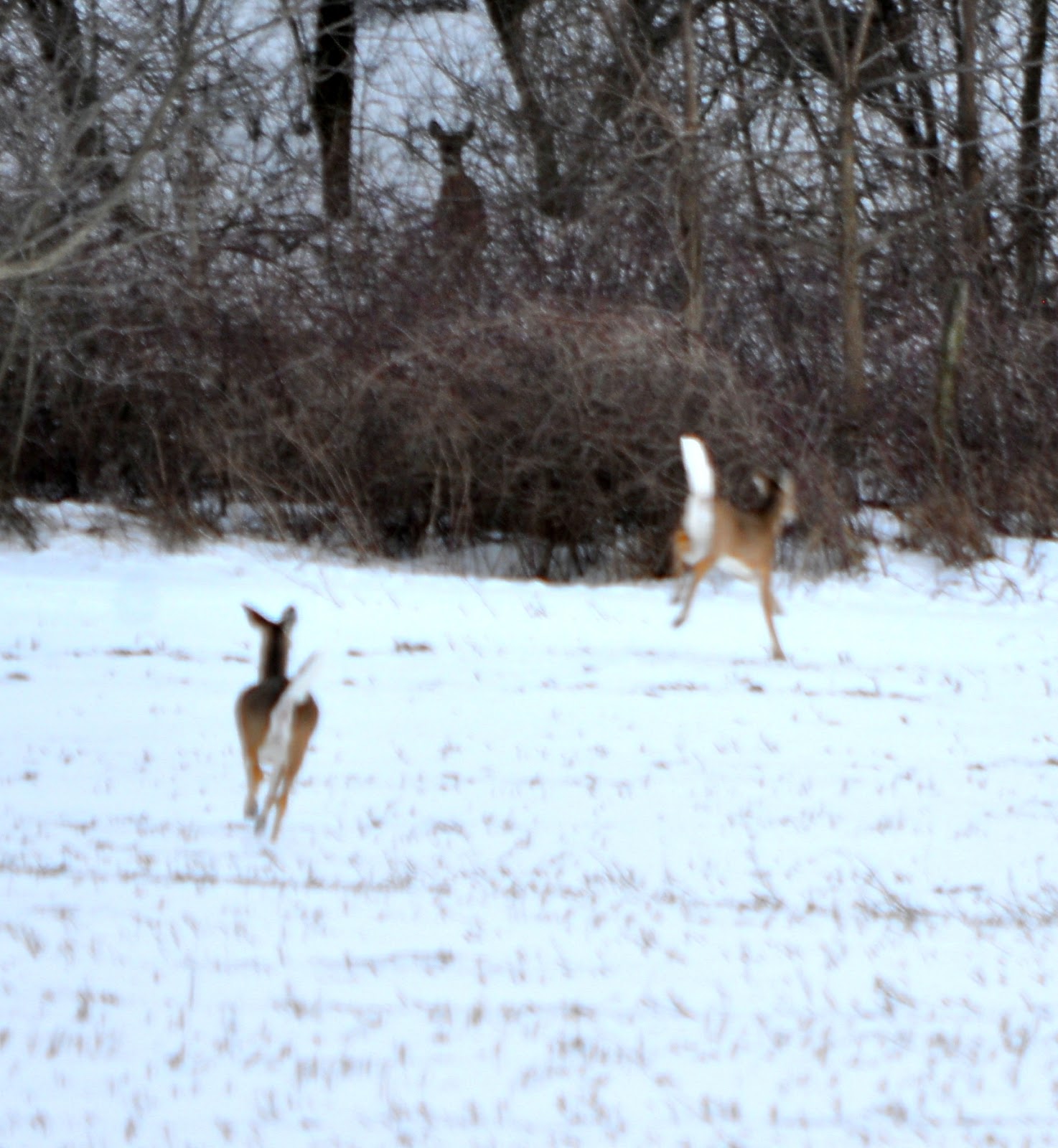
5:06:47 Further down the road, two White-tailed Deer interrupt their browsing to stare.  I stop and stare and the does stare some more.


5:06:56  We stare at each other.  Then left deer jumps round on her little hooves.  Right dear continues to stare.


5:06:57  One second later her tail flips up and she's heading  toward the woods.  Hence the name, of course, White-tailed Deer.  The top of her tail is the same color as the rest of her top side.  
5:06:57  Within the same second, the second deer has turned, flipped tail up and they are running for cover.
 5:06:58   Notice they aren't running straight for the woods, but rather doing a breaking run mixed with leaping.  As to the white flipping tail, that is to attract the attention of the predator to the rear end of the animal, much in the same way most pigeons have a light rump patch that also attracts the eye and evolutionarily speaking gives a greater shot at survival.  The end of the animal is gone by the time the predator leaps for the spot.


5:07:02 An excellent example of broken field running and that bright white under tail that catches the eye.  Then something amazing happens.  Hmm, the animal that waited is now the animal who is ahead.
5:07:02  Note this is the same second as the previous photograph.  The lead deer leaps high in the air, (6 feet or so?) the tail comes down  obscuring the white bottom of the tail and the white part of the rear of the deer.
5:07:03 It is one second later and by this point the second deer is doing nothing more than a less than speedy trot.  Dum de dum...see the first deer back lit by the snow in the woods left?


 Actually due to the behavior I'm beginning to think that  the leaping deer is a stag.  At this time of year, deer antlers are just beginning to grow so unless you check out the genitalia of a deer, which isn't all that easy, any deer could be either.
. 
 Here's an interesting factoid.  Whitetail deer antlers are one of the fastest growing tissues known to man.   Wow.
5:07:06   Back to our saga,  he waits vigilant, and she trots toward the cover.
5:07:22  The doe stops and looks back at me.
5:07:36  Then she turns and ducks her head into what  I now realize are raspberry brambles upon scrutiny.  A reason that the stag may have leapt them I suppose.  The doe ducks her head and flattens her ears.  The stag now looks out into the area where I assume they will go next.  Always vigilant.
5:07:38  And she's gone.  And I go too.

To be continued...

Happy Hawking!
Donegal Browne

Monday, March 14, 2016

The Adventures of the Stealthy Belly Band, the Red-tailed Hawk.

When last we met, Belly Band the Red-tailed hawk, whom I was leaning toward being the female of the pair, was heading off into the distance.

 In actuality this is what she looked like using my long lens so in actuality she was about twice as far away as this view and no more than a speck.
  I cropped this down so you could see BB's wing span. That is definitely more of a female span than a male's.  She's gliding, looking around.
She catches an updraft.
 She starts to gain altitude.  There is no flapping involved here.

 She's still gaining altitude.  She's now at the top of that ribbon of blue sky.


                                                     Faster.


                            She tips up slightly.


 She banks left.  Yes, the bird is still Belly Band.  They've switched off so many times I keep checking whenever I get a chance.
Her right wing tip flips up.  
She heads towards a wood lot.  Suddenly there is the most gosh awful ruckus over my head.

It's a flock of geese trying to arrange themselves into a tidy flying V and everyone has something to say.

The cacophony continues but things are shaping up. 


  I often wonder if they are honking get out of the way or make room or here I come or whether it is just a sound cue so everyone knows where everyone else is?

WAIT!


Then I realize....where did the hawk go?  DRAT!  I look back.  She of course is long  gone having taken her chance to disappear while I was distracted.

We shall meet again!

Happy Hawking!
Donegal Browne