Showing posts with label ravens. Show all posts

Wednesday, April 03, 2013

Ravens In Manhattan?


Today there were these photographs of two birds published on http://www.palemale.com/    They appear to be Corvids but which species?  Discussion then ensued as to exactly  which species these birds are.  

Are they Crows or Ravens?

 No size comparison is possible from a photograph with nothing in it but the birds themselves.  Nor are we privy to their voices or possible ruffed feathers at the neck.

The beaks look a bit thick, but not definitive enough for me to be positive.

Supposedly Crows have fan shaped tails and Ravens have a wedge shaped tail.  Here without anything to compare the tails  of actual Crows vs Raven tails to these, it appears that the bird on the left may have a wedge shape and the bird on the right has a possible fan shape....but maybe it's a bit wedgie as it is slightly curved?

No clincher so far.  

In my opinion when in doubt about identification based on physical attributes, it is time to look into the differences in behavior.  

And it appears to me that these two birds are participating in some sort of courtship display.

The question:  What does courtship behavior consist of in Crows and what in Ravens? 

As it turns out, courtship in Crows involves the male doing a good bit of strutting. 

But Ravens do a courtship flight which includes flying with wingtips touching.

BINGO!  WE'VE GOT A RAVEN PAIR!

Donegal Browne

Monday, June 28, 2010

Behavior: Raven Nest, Cowbird Fledgling, and Cottontail Rabbit


Having seen wing pulling as a disciplining behavior in Crows, and read about foot biting in that species as well, I wondered if Ravens, being Corvids, displayed the same behavior. I asked Jeff Kollbrunner to keep an eye peeled for it, and sure enough there it was. He even got photos.
Donna,

Here are images of the Queens, NY Ravens taken since June 2nd.

They started to leave their nest at the beginning of June and walk on the steel I beam that supports the water tower as seen in the associated images. One of the June 2nd images has all three young Ravens standing together.

On June 3rd early in the evening with very low flat light providing only a silhouette with little detail the parent disciplined one of the youngsters. It started biting and tugging the wing at the shoulder

and then a few minutes later started biting and tugging hard the toe of the youngster. In all instances the young Raven vocalized very loudly, clearly wasn't happy and tried to pull itself free of the parents grip. Each time after a few good moments the parent let go, this occurred a few times over the course of ten minutes. There was food next to the young Raven, after the disciplining the parent took this remaining food located on the steel beam and brought it over to the young Raven sitting in the nest and fed it the remnants of this meal.

On June 5th one of the young Ravens left the safety of the water tower and landed on a satellite dish mounted about six feet off the ground on the side of a home about 100 feet away. It used the dish as shelter and shade from the intense heat (90+ degrees) of the afternoon sun. Later in the day all the young Ravens were back on the water tower.

June 8th, two of the Ravens returned to the nest for a long while before venturing back onto the steel beams to exercise and play with the wires.

It appeared one of them was not accounted for today while I was there for two hours but it could have been hiding on one of the beams and not visible. They are doing very well and have been all over the water tower the last week, even landing on the grass and shrubs below. At the end of the day they still return to the steel beams near their nest.

Over the next few days I will create a Raven Gallery on my site and post additional Raven images to that gallery. Our Briarwood Red-tailed Hawk fledgling is doing very well it is out of the nest for a couple weeks now, looking very strong in flight and getting around. Last night I added new images of the fledgling to the Nest Photos 2010 gallery with more to come soon.

All the best, Jeff

A Cowbird fledgling foraging without a foster parent.
The young bird knows there is a watcher but continues anyway. I've noticed that there is often a several day lag between when the foster parent isn't seen with a young bird and when a female cowbird then gathers in the fully functional young bird to her group.
In the meantime the young bird is very alert and seems to be watching other birds, people, rabbits, bugs, even more attentively than other fledglings.
The other day a female cowbird who already had one fledgling with her made one of the display moves which is part of the male courtship dance in the sight of a second fledgling. She pointed her beak straight up at the sky and froze for a moment. The second fledgling then trotted up and joined the other two. Whether this is an attention getting move for youngsters who have wondered off or whether a cue to activate an inborn behavior for the young bird to join a cowbird group, or conceivably something else altogether, I don't know. It's the first time I've seen it in the presence of fledglings.
Tiny Jolly Bunny is a bit bigger now and was out eating dandelions and grass. She'd pluck a leaf and it would methodically disappear by degrees into her mouth. Then suddenly she stopped in mid-chew and stared for a very brief moment.
She made a jump.
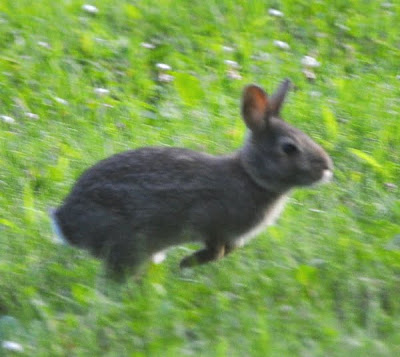
And another...
...gathering speed. Why?
Because across the way, near the Spruce, that's got to be Mom. I'd suspected that the nest was under the Spruce tree as Jolly Bunny always comes and goes from there.
At first I thought Jolly Bunny was running for Mom, which in a way she was, but she didn't go to Mom, she scampered under the Spruce, I assume, hoping that Mom would join her for a little nursing session. And after a few minutes of leaf munching herself, mom did disappear under the evergreen as well.
FROM MY MAN IN NYC, W.A. WALTERS, GLEANER OF THE NYTIMES--

OPINION June 27, 2010
Op-Ed Contributor: Losing the Owl, Saving the Forest
By JONATHAN RABAN
How the Endangered Species Act saved forests in the Pacific Northwest.
http://www.nytimes.com/2010/06/27/opinion/27raban.html?emc=eta1

Tuesday, June 08, 2010

Redtailed Hawk Update: Chris Lyons at the Fordham Nest, Stella Hamilton oat the Cathedral Nest on St. John the Divine Plus Francois at the Raven's Nes


Photo by Chris Lyons\\
FROM A CHIEF WATCHER OF THE FORDHAM NEST CHRIS LYONS--
The three Fordham eyasses seem to be doing very well, and I'd guess the first fledge will happen this week. First fledge ever out of Collins was on 6/8/06, and subsequent fledges have happened around that time.


Photo by Chris Lyons

Today, for reasons best known to herself, Rose was spending some quality time with her young, instead of the more typical "Here I am, here's your food, gotta fly" routine you see this late in the nesting cycle, with both parents working overtime to feed the almost adult-sized youngsters.

Photo by Chris Lyons
She was there resting on the ledge when I arrived, and stayed for at least another ten minutes--her visit might well have lasted half an hour, or more. Maybe she just wanted to assess their progress, or had some other instinct-driven function to perform--or maybe she was enjoying the chance to hang out with them.

Photo by Chris Lyons
She wasn't actually doing anything, best as I could tell--they didn't need to be beak-fed, or protected, or sheltered from the elements. She was watching her kids pretty intently, while they actually seemed to be much less focused on her (since she had no food). After she flew off, she returned shortly afterward with prey, and departed immediately. No sign of Vince, but he's around.


Photo by Chris Lyons
In a week or less, they'll all be out of the nest. She knows that, even if she doesn't think about it much. What I observed may simply be a way of encouraging them to take the next big step into the world around them. But the simplest explanation is that she did it because she wanted to.

Photo by Chris Lyons
Spot on Chris! I think so too. Thanks so much for the photos and your commentary. It’s grand to have a successful, full nest ready to fledge in town.

Photo by Chris Lyons


Photo by Chris Lyons


Photo by Stella Hamilton
From longtime nest watcher Stella--

Dear Donna,
It seems like our fledgling spent the night on the roof of St. Luke's Hospital. Bruce and I did see one of the parents yards away in one those cylindrical ladders on the roof. We did not see any feeding. Survivor was very active, flapping and running around, but was not begging for food. At. 6:20 pm, Survivor decided to fly back to the Cathedral. Here are some pics. Maybe he wants to go back to the nest to look for some scraps.
Stella

Photo by Stella Hamilton
I found that in the young Red-tails off the nest on County Rd M, that after the first flight they made it their business to get back to the nest for meals. They then found a spot on the nest with good sightlines for maximum exposure of their waiting selves or as there were two of them they began to compete for a branch that was slightly higher than the nest with even better exposure, attempting to be first in line for any food that came in. They made flights in and out of the tree for days. Roosting back in the nest tree as well as taking meals there. They then got the gist of being ready on the side of the tree the adult who has been hunting was likely to come in on. Eventually they began begging from trees further afield but the adults would make them come and get the prey themselves as opposed to a delivery.


Photo by Stella Hamilton
So far no eyass has made it back to St. Andrew as far as I know. They often do get back to the Cathedral itself though. Come to think of it, the Cathedral is the "giant tree" on which the nest resides, so perhaps they're all following a basic Red-tail urge to return to the "nest tree" to be fed.

Photo by Stella Hamilton
Thunder who was hatched on the Tulsa TV tower returned to the nest platform for weeks to get her meals as well.


Photo by Stella Hamilton
Many thanks for the update Stella!

And last but not least, from naturalist and photographer Francois Portmann who's been keeping an eye on the new species in town, the Northern Ravens--


Hi Donna,
The Ravens are "branching"
http://www.fotoportmann.com/birdblog/
Greets
francois


Yea! Jeff Kollbrunner called and told me about some wing disciplining by Mom or Dad Raven with one of the older chicks. I've seen it with Crows and an immature Crow who was stealing food from family members instead of foraging his own. Did you happen to see that sequence on the blog a year or two ago? Three older crows surrounded the bad youth. He flipped on his back in submission, then one of the older crows tugged on his wing until he flew away across the street where they made him stay for awhile..shunned by the flock for bad behavior. :-)

Crows also do foot biting. So watch for both in the Ravens as we now know they do wing tugging they might do foot biting as well.

Donegal Browne

Monday, September 08, 2008

Tarmac Ground Nesters, One Answer for Yesterday, and a Skunk Report


All Photographs Donegal Browne

Thursday 10:01am Billy Mitchell Field, Milwaukee, Wisconsin. Having taken my 20 minute flight from Madison to Milwaukee in a downpour, survived security one more time, (Try going through, with a computer, several cameras of varying sizes, a birding scope often taken for something a sniper night use, several dozen batteries, and all the cables in the world, and see what happens to you.), and plopped down in a seat near the window with a bag that refused to stand up on it's own, and--What are those? The windows are very wet. It's hard to see and I need some magnification.


I start digging in my bag, pull out the camera with the most zoom, boot it up, and ding, ding, ding, bells go off in my head as I realize that the powers that be really, really, really, don't want people taking photographs out the windows of airports.


DRAT! I want to know what those birds are and I want photos. I walk over to the window, thinking fast about what I'll say if someone gets after me about it. I just have to be careful to stick to the birds and not include, planes, buildings, or whatever they might consider a security risk. I remember the time the Monarch Butterflies and the sky were considered a security risk near the Port Authority. There is just no telling.


I'll be calm and sensible-- show them that all I have are bird photos, right? It should be just fine.


What if photographing birds is a security risk? Seems very unlikely but these people can be very tense at times. So I keep the camera in front of me and sit on the floor hoping I look like I'm mooning over the torrential rainstorm that's sweeping across the airfield.


Zoom in and ta da! He's stepping out. It's a pair of Killdeer, Charadrius vociferus. Being Plovers, the kind that are wading birds and hunt by sight, all the water isn't bothering them one bit.

Yes, Killdeer are water birds who often don't nest or even feed near water for great swathes of time.

They like to lay their eggs in gravel. And here is an interesting factoid, they lay eggs that match the gravel in which the eggs are laid. It isn't clear if they are able to vary how their eggs look in some mysterious way to match the substrate they've chosen or whether they pick a substrate that is going to match what their eggs always look like.


Speaking of nesting, and eggs, what is the bi-color lump behind the Killdeer? Is that a hunkered down chick? It would have to be tiny and it's quite late for tiny chicks. Remember the Killdeer in the alfalfa field at Thresherman's Park were full grown and the same size as everyone else in the family.


There's another lump up right. Could that be one? You can tell that I'd love to see some chicks. They are precoccial and beyond cute. Little identical models of their parents though they tend toward only a single neck ring at first.


The other parent, (Identical males and females) looks steadily at yet another lump. Is it a possible eatable or is it a chick. It really does have a bi-color look to it.

I realize I'm probably beginning to give off an excited presence and try go limp to look like just another bored, tired, and put out airline passenger.

Then Dad goes past a lump and Whoopee!! That is undoubtedly a chick!

See! Absolutely a baby Killdeer. And very late they are. Many ground nesting birds lost clutches to the very wet spring and flooding that occurred in Wisconsin. After that, there has been drought so some birds have only finally been successful very late in the year. If the snow holds off as it has for the last few Falls things should be fine.

Little guy is still there, though it wouldn't hurt for him to seek some slightly higher ground I'm thinking and there seem to be a number of lumps up right. Though some of that could be vegetation.


Suddenly a plane is coming towards them. This is the area in which passengers do get onto planes after all. My heart goes into my mouth.


Mom checks the plane, checks the area, and takes off very rapidly at an angle.

In fact both parents do. Though the rain is so heavy and chicks so tiny I've no idea what has become of them.

I console myself with the fact that planes park here many times a day therefore these birds must have it down or they'd have no chicks. Also neither bird is going into the broken wing ruse used for predators. But perhaps planes don't cue that response.

On the other hand they aren't going into the Killdeer defensive posture used for big lumbering herbivores either. As Killdeer often use pastures for their breeding activities, sometimes cows, horses, sheep, goats, or other grass chewing pasture inhabitants progressively graze too close to the nest. In these cases the Killdeer, puff up all their feathers, spread their tail over their heads and rush the offending beast startling it and causing it to veer away from the nest.

One assumes this does not work for diddley with planes and they know it. Therefore having watched the planes patterns of movement they have planned accordingly.

He's looking at something across the way. Is it food or progeny?

Now watching the oncoming plane.


And what is that lump back there?

A chick sheltering in a crack behind a sprig of vegetation.

Aha! A snack. Come to think of it planes probably smack many an insect which then fall to the tarmac.

Then it's my plane that comes rolling through. No problem, the parents know their stuff. I start grabbing my things and I have to admit my layover between planes absolutely flew by.
If only all airports had ground nesting birds handily raising their families on the tarmac in full view of observant passengers.

NEXT UP--Many thanks to R. of Illinois for sending in the link with the begging vocalization of a Raven and a young Crow to help sort out one of yesterday's mysteries.
Without a doubt, what I saw yesterday in the parking lot of the train station was a juvenile Crow begging from atop the light pole. Yet another youngster that's a bit late in the season from his age.


Check it out--- YouTube - Agitated Raven.url (71b) For the Raven vocalization then continue through until you come to The Crow and I (or Mom's...) for the young Crow vocalization.
AND NOW FOR A LOCAL SKUNK REPORT FROM KAREN ANNE
KOLLING--
Donna,
Two to three years ago a family of skunks lived a couple of houses down my street near the water. They were often in my yard at night. They seemed to disappear after one was reportedly caught by a large bird. And my neighbor tells me, it was dispatched in a rather hair-raising fashion. But this year skunks are back. I saw a beautiful one hightailing it across my yard just before dusk one night, and my neighbor tells me his wife has seen them a couple of times eating under my deck. I am guessing that the birdseed or peanuts that fall thru the deck from my open feeders are attracting them.I wonder if the bird who got the skunk was some type of hawk, which my neighbor, where the skunks lived, told me hung out in his trees.
I have only seen the hawk once, that year. My indoor-only cat was very upset one day, and finally I happened to look outside and saw this enormous bird perched on my deck railing.

Karen Anne Kolling

p.s. I forgot to mention that some (all?) of my raccoon visitors smell awful, like they have been zapped by skunks. I never noticed that before when I lived in another state. This has been the case for at least a mont
h
.
Karen,
It sounds like the Skunks and Raccoons in your area are having territorial issues. And as Skunks can spray up to fifteen feet, unless the Raccoons don't mind that form of perfume, the Skunks may be getting first dibs on the peanuts under your deck at night.
As to the hawks taking Skunks, absolutely they do, but only the largest hawks are able to take a full grown skunk. For instance a large female Red-tail is much more likely to be able to take a full grown chubby rabbit than her consort would. The same applies for Skunks. Hawks are opportunistic and if it looks possible they will give it a shot.
I wonder if hawks and owls ever get sprayed by skunks? So far I haven't found the answer to that one yet.
Donegal Browne