Photos and commentary by Pale Male Irregular Stella Hamilton
6:07PM Here is Pale Male on the ground with a freshly caught rat under his talons .
We were standing along the fence on 5th Avenue and 78th street .
Photos and commentary by Stella Hamilton
Here's the baby eating the rat that Pale Male brought.
This is the fourth post of the day, therefore keep scrolling down. You'll have to go to the next page as well to complete all of today's posts.
To get to the next page, hit "older posts" at the bottom of this page.
Happy Hawking!
D.B.
 Photo courtesy of palemale.com/
Beautiful sweet faced Pale Male
He was hatched in 1990.
And as a Brown-tail in 1991 he took a young mate, there was an attempted nest built on a baseball back stop which didn't hold eggs....they fell out, according to his chronicler the wonderful writer and naturalist Marie Winn, who also gave him his name. The pair also attempted to nest in a tree where they were mobbed by Crows and both injured...
Thus begins the saga of one of the first Red-tailed Hawks to give up nesting "in the wild" and raise a family on a building.
Yes, nests on buildings are somewhat similar to the nests of Red-tailed Hawks who nest on cliffs due to the dearth of trees out West.... that I give you... but cliffs don't have people peeking out windows at you.
For whatever reason, Pale Male, is remarkably amiable to the presence of people within certain bounds. And so it began. And as it did, worldwide love and affection for him grew too.
Photo courtesy of palemale.com/
Beautiful sweet faced Pale Male
He was hatched in 1990.
And as a Brown-tail in 1991 he took a young mate, there was an attempted nest built on a baseball back stop which didn't hold eggs....they fell out, according to his chronicler the wonderful writer and naturalist Marie Winn, who also gave him his name. The pair also attempted to nest in a tree where they were mobbed by Crows and both injured...
Thus begins the saga of one of the first Red-tailed Hawks to give up nesting "in the wild" and raise a family on a building.
Yes, nests on buildings are somewhat similar to the nests of Red-tailed Hawks who nest on cliffs due to the dearth of trees out West.... that I give you... but cliffs don't have people peeking out windows at you.
For whatever reason, Pale Male, is remarkably amiable to the presence of people within certain bounds. And so it began. And as it did, worldwide love and affection for him grew too.
It may not have happened if "that hawk" that nested on 927 Fifth Avenue hadn't had a name.
I know, just what is this naming hawks mania I have?
If you will forgive me a digression, back in the day, when I was training in biology, I was terrific at it but... I had the bad habit of showing my enthusiasm for birds, or animals or fungi or plants or insects or you name just about any live thing, loosing control, laughing out of sheer discovery and possibly saying..."Wow! Amazing! and even, "Aww, they're soooo cute!"
I vividly remember on one of these occasions Dr. Gross, in his white lab coat and I in mine, turning to me at my microscope and saying quietly, "Yes they are cute but you can't say it."
"I can't say it?"
"No."
"Why not?"
"Because scientists don't."
I lost all my air, I shrunk. I mustn't show joy in the biological.
I loved live things all of them and secretly loved the behavior of individuals even more. Though I knew the anatomy of many creatures, what really fascinated me was their behavior. What are they doing and WHY? I liked the whole creature and I liked them alive. I was a behaviorist but didn't know it yet.
And so began the scientist mask, the submersion of why many have a love of biology in the first place.
What I had been doing was expressing biophilia, it strictly wasn't allowed back then.
And still isn't by some aging often male scientists.
Or in birding circles by others who trained in something else altogether but have turned bird watcher and desperately want to be thought of as "scientific".
I trained in science, I've worked on research studies, and my opinion is that all resident urban hawks should be named.
Why?
The biggest reason to give resident urban hawks names is to nurture biophilia in people, particularly children, who have never or rarely had a chance to intimately know by watching and love an individual of a wild species.
Biophilia literally means love of life. As in love of living things or systems such as Pale Male not whoopee I'm glad to be alive today. Though that certainly can enter into it at times and often does when watching him.
The word was coined by Eric Fromm, mid 20th century, for what he believed was a psychological bent in humans toward living systems, i.e. other life besides one's own.
Then along came E. O. Wilson who grew up in the forests and fields of Arkansas, and at 14 knew enough about ants to categorically discover and recognize that the fire ant had invaded the United States.
Nobody else had noticed yet.
It was Edward O. Wilson who popularized the biophilia hypothesis, in his book Biophilia (1984), which suggests that there is an instinctive bond between human beings and other living systems.
Therefore extrapolate that further and to love/bond with Pale Male and to help others do so as well, is to help save the Earth in it's infinite variety of creatures.
And Marie Winn giving Pale Male a name and she and all the other original Regulars standing by the Model Boat Pond with instruments of magnification, showing all comers the nest on 927 was a Biophilia Cadre on the hoof. To say nothing of Marie, writing Red-tails in Love, which spread love for Pale Male all over the world.
Why Pale Male? Of course he was one of the first urban hawks and he did have a talented connected group of New Yorkers watching him who were not shy about sharing him. They didn't secretly watch him for months and then let others know he existed only after they'd taken a million pictures.
Not a chance. They shared their discovery and their biophilia for him.
And lets face it, lest we forget Pale Male, isn't just any Red-tailed Hawk. He is personable. He is recognizable because of his paleness. He is human habituated. He KNOWS people and lets them know it.
He is WAY cool.
Plus we now know of course, as the research has been
done, that most humans have an affinity for the young of our species but
also an affinity for the young of other mammals. It is thought to have to do
with large eyes, small features in proportion to head size and some say
roundish heads as well.
As far as I know that research was only done on mammals but I think it crosses over to birds as well.
 This is young Athena from Pepperberg's lab. She also gives me that "Awww" feeling. I don't know if that is because I'm into African Greys in the first place or because she in particular does it as she is only six months old.
Photo courtesy of palemale.com/
Now look at Pale Male, rounded head, big eyes, small features (beak).
There is savvy in those eyes but there is still a definite "Awww" factor. And with his personality who could resist? Only those so self absorbed they don't "see".
This is young Athena from Pepperberg's lab. She also gives me that "Awww" feeling. I don't know if that is because I'm into African Greys in the first place or because she in particular does it as she is only six months old.
Photo courtesy of palemale.com/
Now look at Pale Male, rounded head, big eyes, small features (beak).
There is savvy in those eyes but there is still a definite "Awww" factor. And with his personality who could resist? Only those so self absorbed they don't "see".
And we help people "see" if we give an animal a personal name.
Simple as that.
Name the hawks. Save the Earth.
Happy Hawking!
D.B.
P.S. For those who asked what the new nest site at Fordham looked like in 2013....
Go to Rich Fleisher's Flickr hawk photos at the following link-
http://www.flickr.com/photos/profman_wildlife_photos/sets/72157632612233748/
 A juvenile Bald Eagle bides her time watching for prey after she has just disengaged her head from out of a sleeping tuck. I can completely understand why she'd decided a nap was the better part of valor.Last night I'd gotten word that there were seven Bald Eagles currently fishing in the open water near the Indian Forge Dam on the Rock River in Wisconsin.
I couldn't wait to go take a look.
Unfortunately the weather was completely dismal. Temps in the teens and a frozen mist coming down which brought visibility to a near white out.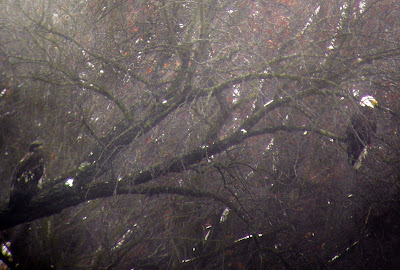 Well, if the Eagles can persevere I thought, so can I. Fortunately for them they are far better suited to the weather.
  Something plunges into the rushing water of the river that has just come over the dam. In a moment the plungee, a male Belted Kingfisher is back on his perch waiting to spot another fish for the next course of his lunch.(Correction: Thanks to Francois Portmann for correcting by inadvertent male Kingfisher into its proper sex, a female. Forget that avian males have the flashy colors, in Kingfishers it is the female who has the rusty orange belt second belt. The male has the gray belt only.)
 See the juvenile on the left (note that suddenly there are three Eagles on the branch) is doing the beak in the air look that we most often see from young Red-tails on the nest or from a sitting formel when something passes far overhead. In this case a family of American Crows has decided that mobbing Eagles is their Crow responsibility of the moment.
 Suddenly the cawing and fly-bys over the Eagles stops and upon closer inspection of some large black things moving on the far edge of the river it appears that perhaps the Crows are having a conference in their quieter en familia Crow language.
It went on for awhile.
Crows have one language, quiet and melodious, they are technically song birds, for use in discussions with their extended family and another, their famous caw sequences, that we hear them using when signalling long distances to each other or mobbing unwanted company. Eventually the largest Crow watches the other members of his family stride away.
 After a few plops of his bottom in the water, Crow just went ahead and upended himself in the freezing stuff and then wallowed in it.
  When Crow finished his bath, he gave me a look and then everyone in the Crow contingent went back to mobbing Bald Eagles.I'm going back come sunrise to see if the visibility is any better.Next up-- PonDove, Washington Square Park hawkwatcher and a moderator of the NYT Livestream Hawk Cam Chat Room, contributes to a Canadian Broadcasting Company podcast about people's interactions with wild animals in cities.
http://podcast.cbc.ca/mp3/podcasts/dnto_20120121_75997.mp3


