Showing posts with label East Village juvenile Red-tailed Hawks. Show all posts

Sunday, March 06, 2011

Pale Male, Pale Beauty, and Quicksilver's Vent


Photo courtesy of palemale.com

Pale Male folds his wings and brakes. I'd seen abrupt descents, in this case to the Carlyle, from a distance, but this photo shows the fold and angle of the wings necessary to make it happen. Pale Male is indeed a master flyer.

Photo courtesy of palemale.com

A little later Pale Male and Pale Beauty copulate on the ledge above the balcony rail on Linda, 920 Fifth Ave., on which Pale Male so often perches to survey his domain.

Looking at this pair of nether regions, reminded me that I had a question about another nether region.

Quicksilver's vent.

Now it is a bit of African Grey owner folk wisdom that an owner can sex their mature African Grey by looking at the bird's vent. If there are red feathers beside it the parrot is thought to be male. If no pink or red is in the area the bird is thought to be female.


Silver is definitely male. He had a blood test done for DNA. But a blood test isn't all that fun for a bird. At the time he had some health issues so he had to have blood drawn anyway, the vein in their neck is used, so we just added the test for sexing onto the list.

The nest issue is of course is that the bird has to be sexually mature. By the time a Grey is sexually mature, around 7 to 9 years, if he's perched somewhere and you attempt to get your eyes enough below his tail to look, he turns around rapidly and looks at you like, "WHAT are you DOING?

You haven't been creeping around before looking under his tail previously, and as these birds are prey animals they don't really like anybody to touch their tail in the first place, and I assume there is a natural suspicion that you might be up to no good back there doing whatever it is you're doing.

And when Silver is wrapped in a towel at the vet's office for an exam, he is growling and struggling so, or running around the floor like a mad thing or flying circles around the light fixture in the ceiling that I've never remembered to take a peek.

So the other day when he was climbing up a seated friend's bluejeans to say hello, and paying me no never mind, I grabbed the camera. He did turn his head around to check what I was doing when I got low and close but if he had turned completely around, as he normally would have, he'd have lost his grip on the cloth, ended up on the floor (only less than a foot away) but he was bound and determined to make the climb for some tickles so I got the shot.

And indeed Silver who is a male African Grey does have reddish feathers around his vent.

Now we need some other Greys to add to the sample. If you have or if you know any African Grey Parrots, not all are as concerned with their dignity as Silver is, so I hope you'll have an easier time getting a look, I'd like to know what you find out.

They have to be sexually mature, and it would be helpful if their sex was known by other means. Obviously in females they may have laid an egg and in males there are other behaviors that owners may have noticed and of course they can now sex a bird with feathers instead of blood, though that test is not thought to be nearly as reliable. And there is the blood test. By what means the bird was sexed would also be helpful with your information.

Let me know. And thanks in advance for scrutinizing parrot vents. (By the way if the vent is dirty the bird is ill and should immediately see a vet.)

Donegal Browne

Sunday, February 20, 2011

Mama and Papa Red-tail, the Nesting Raven Pair in NYC, and the Blackwater Eagles


Jeff Kollbrunner, of www.jknaturegallery.com/ a major watcher of Red-tailed Hawk pair Mama and Papa, and last year's single NYC nesting Raven pair has sent his first missive of the new season .

Some updates from Queens, NY. We visited the Ravens nest a few days ago to sadly discover it has been removed from the steel water tower. This must have happened recently, during our treks to search for Mama and Papa over the winter we could see the Raven nest from a distance and the last time we noticed it as best we can remember was about 4-6 weeks back. There are cell repeaters on the water tower and the nest was located next to one of these devices. We can only assume since it was high up, difficult and dangerous to access the cell maintenance folks must have removed it at some point. The Ravens were very vocal as they attempted to rebuild a new nest one level higher on the tower. Unfortunately, their branches were falling off the steel beams as there were no cables to anchor their branches.


Yesterday (Friday) we visited the nest site again, they started two more locations on the tower each more successful than the previous. The third location seems to be taking shape but very strong winds in NY today have done some damage and the size of the nest is reduced by about 30 percent since yesterday and the Raven pair was not present this afternoon. Hopefully they get back to work when the wind diminishes and can complete this new nest. I'm including photos of all three nests they have started.


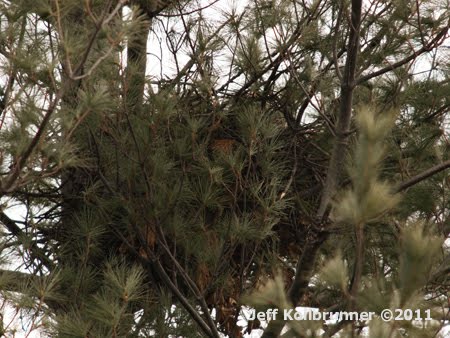
As for Mama and Papa, there is a major construction project on the expressway in their territory. It appears that Mama and Papa are not happy with all the heavy equipment, destruction of mature trees and constant commotion to widen the expressway. We have found Mama and Papa building a nest high up in a nearby white pine tree, this is only the second nest they have built in a tree. We hope this will be their nest for the season since the construction project has placed a significant amount of rat poison stations in Mama and Papa's territory, some are less than 50 yards from Mama and Papa's nest from last season. With a contaminated food chain the further away from this area the better. Unfortunately, the new nest location still has proximity to the poison and we are very concerned for Mama, Papa and their offspring overall safety this season. We all know the impact of rat poison in the city to birds of prey over the last number of nesting seasons. I'm doing all I can to negotiate with those in charge of the project and have the poison removed but it is an uphill battle and I'm not making much progress. I have included a photo of their new nest for this season.
I hope to be updating my website soon so everyone can stay up to date on Mama and Papa's activities and images from this nesting season including updates and images of the Ravens.
All the best, Jeff


In from Robin of Illinois--The Blackwater Eagles have their first chick!

D.B.

Tuesday, February 08, 2011

Pale Male and Pale Beauty Signature Postures, Parrot Pellets, Quicksilver, and the Hwy 59 Red-tail


Photo courtesy of www.palemale.com/
I've been looking at Pale Male and Pale Beauty for behavioral differences and I realized today that though they are very similar in coloration the way they hold their bodies at rest is sometimes very different.

Pale Male on the left sits in one of his signature poses. Sometimes it's the right foot and sometimes the left but we've all noticed that Pale Male likes sitting with one foot up or stretched out in front of him with his foot curled. He often has a look of focus though physically relaxed, of holding his fire, until the moment in which he'll suddenly tense, and burst off into flight.

Look at Pale Beauty on the right. She's slightly larger, and takes a more upright stance, belly out, neck back but head forward.

Notice that the pair is spending time perched on the Carlyle. In the past it has been a frequent spot for copulation, which should start soon.

While Pale Male and Pale Beauty were perching on the Carlyle, I was making a made dash in the car, through- you guessed it, yet another snow storm, to buy Tropical Fruit Nutri-berries.

What are Nutri-berries? Nutri-berries are these little specially parrot in mind, vitamin-enriched seed and dried fruit balls stuck together with canola oil and syrup that Quicksilver eats. And a good thing as otherwise Silver would be spending his eating life, cadging butter out of the butter dish, stealing pork chops off other people's plates, tearing holes in the bottom of the sunflower seed feed bag, crunching chicken bones for their marrow, with a few bites of apple, carrot, and broccoli thrown in for variety.

The vet once suggested we switch Silver to parrot pellets as they'd supposedly be so good for him. I'm not at all fond of the idea of feeding an animal totally on processed food but the vet was pretty insistent we at least give it a try. Fine.

The idea was to only present Silver with pellets, until he started eating them. By the third day of his eating nothing, dumping his pellets in the floor, and having an
extremely angry parrot on my hands, I decided to eat some parrot pellets in front of him, tell him how yummy they were and see if that would help. I threw a few of the multi-colored units into my mouth and crunched--dry, dusty, and no flavor whatsoever.

Would I want to eat these for the rest of MY life?

Not a chance.

Back to Nutri-berries and people food we went. But at this point, snow or no snow, we were at the bottom of the Nutri-berry bag so off I went cross county in the snow. And that is how I ran across the Highway 59 Red-tail.


He was sitting on a power pole. I saw him, (Oh Boy!), drove past. and then pulled onto the verge of the road, grabbed the camera, and got out. I didn't even have the camera to my eye and he was off the pole...

..and doing a curved fly-by to check me out.


He increased the curve...

...flew over the farm granary, (The granary is quite possibly the reason he's in this spot, as if you have grain, you have rodents.)

...headed down the sight line of the power cable...

and headed for the top of the next power pole down. This hawk appears to have "eyes" on his back.


Then he gave me the eye. I realized that if I stayed he might be scared off and loose his only chance at food this late in the day with all the deep snow.

I retreated. I do hope he got dinner.

Silver did.


Donegal Browne

Wednesday, February 02, 2011

Pale Male's Tail and Is Doorstep Dove Alright?


Photograph courtesy of www.palemale.com/
Sally of Kentucky, who volunteers at a wildlife rehabilitation center, has been trying to come up with field marks to help watchers identify Pale Male from his newest girl, the possible Pearl. She is also quite pale and looks very much like Pale Male in many ways.

Sally said,

See the dark thin bars on each of his tail feathers? It is obvious from the top as well when his tail is flared a bit. Those are the bars I was noticing the new pale Pearl does not have on her tail.

But Pale Male does.

At first I thought Sally was talking about the terminal dark bar near the tip of each tail feather of a Red-tailed Hawk which are lighter in Pearl than in Pale Male but not nonexistent. But Sally is looking at pale horizontal stripes all the way down each of Pale Male's tail feathers that appear to be almost ghost bars of his juvenile tail.

Double click on the photo above and look particularly at the tail feathers on the upper part of Pale's tail. Do you see them?


3:22pm
I looked out the door earlier today and there was Friend and Doorstep out on the picnic table. I'd worried about them as the weather has been so inclement and the snow very deep. I was happy to see they'd found the bird seed I'd spread especially for the ground feeders who don't use the feeders.

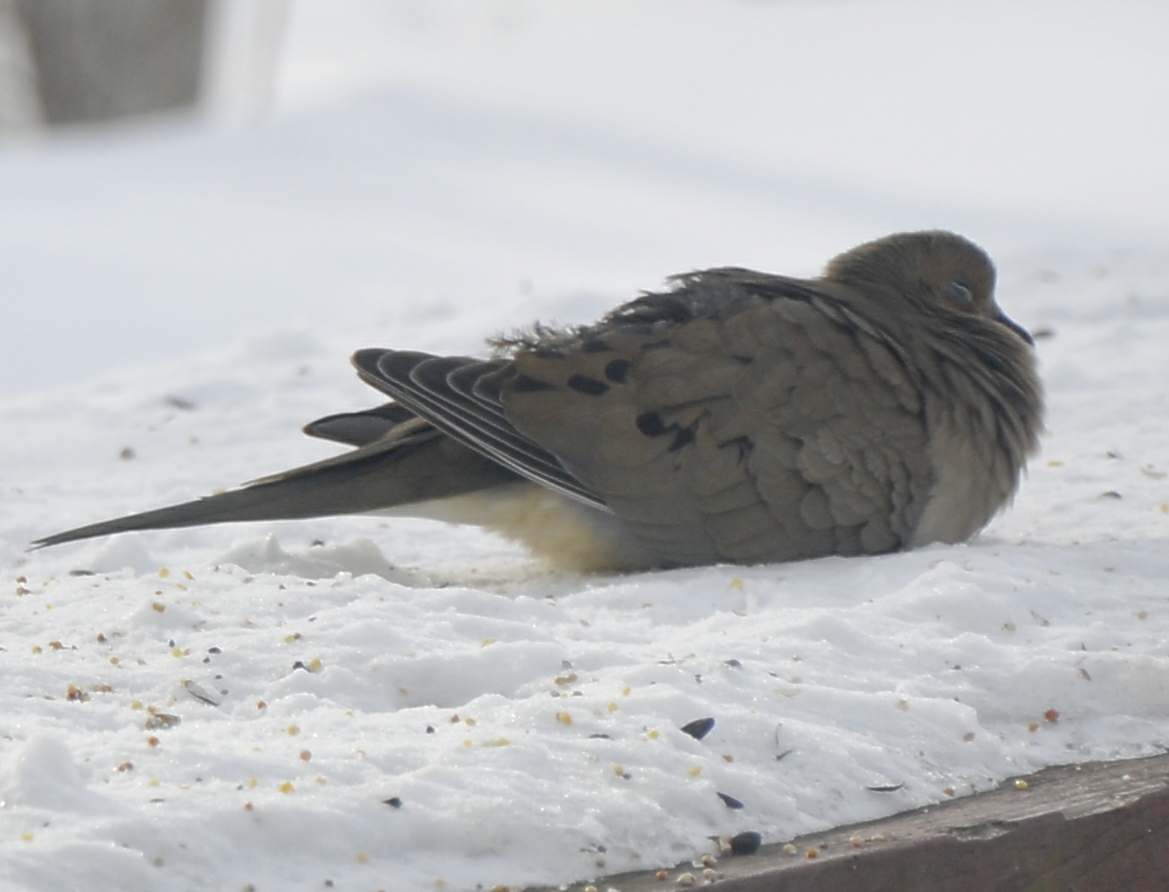
But what is going on with Doorstep Dove? (on the right). Is she just having a nap? But her feathers are fluffed and don't look to be in as good condition as they do normally. Compare Friend's smooth feathers on the left.

Look at the exposed under layer feathers on her back. Are there missing feathers? Damaged ones? Or is she just not caring for them properly. What's going on?

Her eyes slip closed and then she rouses herself and stands.

She seems to be having trouble maneuvering through the snow, and stops after a few steps to peck at some seed.

She starts to walk over to more seed. Is she limping?

She is limping and favoring her right foot. So far she isn't having to use her wings to keep her balance but she does seem to be wincing with each step.

Then she pauses with her right foot up and looks at me.

She then continues her walk to a more seed populated area.

As per typical behavior of Mourning Doves in the cold, both birds hunker down on their feet while eating and even while walking the small distances for the short trips to more interesting seeds.

Friend keeps an eye on me.

3:24:23pm Doorstep Dove is tending her right foot. Did standing on the heating element and/or warm water of the bird bath have a negative effect on her foot later during the blizzard? Or did she have a close call with the local Cooper's Hawk which could explain an injured foot and the strange condition of the feathers on her lower back. Was it just the extended cold, snow, and biting wind?

Because of her less then tip top condition, I'm concerned about Doorstep as the forecast for tonight is a wind chill of minus 30F.

3:26pm Doorstep Dove goes back to her original position and rests. Friend plays sentinel and periodically forages near her.

The squirrels appear to have retired to their drays to semi-hibernate through the storm. Not one has appeared yesterday or today. Notice that the English Sparrow twig pile has been drifted in 2/3 of the way up. The right wall of the "nest" is nearly covered in places.
A wave snowdrift walls the back step. Doorstep Dove got her name from snuggling up to the patio door during cold weather. She gave up the habit when Pyewackit entered the household. I assume because Pyewacket spends a good bit of time with her face a half inch from the glass. As Pye was attempting to predate the feeding area I felt everyone would be safer with Pye in the house as opposed to outside the house. Besides Pye being much better fed and comfortable. But every move we make as humans has an impact on what is around us in the natural world. Perhaps Doorstep would have been warmer near the door if Pye had never come in but perhaps not as the drift was created by wind swooping the snow on both sides of the drift.

I'm likely not getting to the front door until Spring.

Donegal Browne

Tuesday, January 04, 2011

NYC Juvenile RTH Caught in an Air Shaft Since Before the Blizzard and What Made Thousands of Birds Fall to the Ground When in Flight?


Photo courtesy of CNN

http://news.blogs.cnn.com/2011/01/03/what-made-thousands-of-birds-fall-from-the-sky/

Above is the back story from CNN from Robin of Illinois.
Below the New York Times article in from Bill Walters of NYC.


U.S. | January 04, 2011
4,000 Dead Birds Drop From the Sky
By CAMPBELL ROBERTSON
Scientists are trying to determine why, on New Year's Eve, red-winged blackbirds rained on Beebe, Ark.

If you haven't been following the story do check them out for the sake of discussion.

As of yesterday, authorities said they thought that as the birds appeared to have trauma to the breast, internal bleeding and blood clots that the Redwings had been flushed from a large roost by the fireworks and as the fireworks were above them they flew too low and ran into houses, trees, and the like in the dark.

Normally when a bird hits a building it breaks it's neck and drops to the ground dead or it bounces off and if alive is grounded but I thought perhaps some might have been so full of adrenaline that they were able to take off again but died in flight. Hmmm.

The reports speak of breast hemorrhaging and blood clots but were they checked for broken necks? A broken neck comes from impact. Hemorrhage might have other causes besides an impact.

BUT, look at the above photograph. They are lying in a roadway many have dropped there where there are no obstacles to speakd of . What is going on?

Then today, once again the news delving Robin of Illinois, sent in a report of another episode of 500 Red-winged Blackbirds (and Starlings) in Louisiana, who appear to have met their demise in the same manner a the Beebe birds, whatever that is--

Robin says,

Okay, back to the drawing boards. If the Beebe birds were shocked into flying into solid objects, causing death, what is the reason this time?

As one commenter wrote: If it starts raining frogs, I'm getting the hell outta here.

Here's the link for the Louisiana story--

http://www.huffingtonpost.com/2011/01/04/birds-fall-from-sky-louisiana_n_804196.html

Also a video link from Robin-

http://www.cnn.com/video/#/video/us/2011/01/04/dnt.la.bird.deaths.wafb?hpt=T2

PLUS BIG NEWS TODAY ABOUT A GREAT SAVE FROM THE NYC RAPTORS GROUP, PERSONIFIED BY BOBBY HORVATH AND JAMES O'BRIEN ON-SITE.

HURRAY! THE GOOD GUYS DO IT AGAIN!

Here is a rescue update from wildlife rehabilitator Bobby Horvath explaining what happened after a concerned resident contacted NYC Audubon and thereby The NYC Raptor Group, about a hawk who had been trapped in a small airshaft for over a week--

Ok here's the longer version for anyone interested .

After hearing the particulars from the apartment owner I thought maybe this was possible with the use of my 18 foot long nets by 2 rescuers . I stand 6 ' so including the net I can reach about 25' off the ground or if I lean over the roof I can reach down about 22' down. Once I climbed thru this little 3' by 2' hatchway in the basement to get into the air shaft I hear James , who's already there telling me from the shadows-- this doesn't look good. The bird was on a window sill on the 4th floor , exactly where we have no access from either below or above so we thought of a new plan.

The bird could fly from the front of the building to the rear locked in this shaft but couldn't get enough height to get out. Just as I got to the apartment the caller tells me its right on the sill behind a locked window. It spooked as soon as I walked into the room..

There was a smaller pane next to the closed one that could open but I couldn't fit any net thru it so we opened it anyway and waited for James to disturb the hawk enough till it flew back to the sill . I hid blindly to the side of this opening and waited on James' directions when to lunge at the window and it worked.

I'm sure he didn't have many more days left in him with no food or water and would have eventually ended up grounded and possibly too late to save.

I'm pretty sure its a boy and as Cathy [Bobby' wife and fellow rehabilitator. D.B.] will tell you that's the sex we seem to get in the most this time of year. Of the 8 redtails we've gotten in the past month, 6 were juvenile males. She strongly believes that all "silly" males ,animal and human alike, get into trouble without their mom, and the young females do much better on their own early on. She may have a point. I cannot win this argument and I cannot vouch for other rehabbers numbers either. In any event we'll do our best and hopefully this one can go back but it probably won't be released until it molts because of the damaged primaries, due to confined space.

Jame's observation [of a second juvenile in the area D.B.] means there most likely is a nest nearby but it would be a tough one to find unless somebody points it out.

There was a kestrel nearby and there is a nest as well about 2 buildings away that a fledgling was rescued from this summer. Though it seems unlikely, its a good spot for raptors proving city birds are quite adaptable.

They said the park is close by but is it big enough space wise and prey wise to support all these birds? I would think they are hunting elsewhere as well . It all went very smoothly and I am very happy how things worked out today. I just wanted to share the whole story with you once I had time.

Of the 2 recent redtails rescued from the Wall Street area the confirmed poisoned one is beginning to make improvement but months away from knowing its outcome but the more recent one is outside today in the flight cage and might be able to go back soon. I don't know of a release site there unless there is a park close by as I think getting 2 from the same spot they must be resident youngsters but it doesn't mean they must go back to the same spot if it isn't in their best interest .

The other issue is releasing birds in the winter is not always recommended and we do regularly over winter certain birds but they need to be cage space willing. The last batch of birds we did release were all in perfect shape, getting really antsy, and were picked to go as the best decision before they injured themselves or caused major feather damage.

Bobby

NEXT TODAY'S OTHER RESCUE PARTICIPANT FROM NYC RAPTORS WAS FAST MOVING JAMES O'BRIEN WHO IS ONE OF OUR LOCAL NATURE PHOTOGRAPHERS AND A WILDLIFE BLOGGIST. TO READ JAMES' ACCOUNT AND TO SEE SOME PHOTOGRAPHS OF THE HAWK, THE CONCERNED RESIDENT, AND THE SUPER OF THE BUILDING, ALL WHO WERE INSTRUMENTAL IN THE RESCUE AS WELL , HIT THE LINK FOR JAMES' BLOG BELOW--

http://yojimbot.blogspot.com/

AND VERY SORRY TO SAY, STILL NO WORD OF A GLIMPSE OF LOLA FROM CENTRAL PARK HAWKWATCHERS.

Donegal Browne

PLUS COMING SOON-Singer Brian Dougherty (he's an amazing tenor), has a NYC mystery raptor sighting, and a double opossum night during a snow storm in Wisconsin...just LOOK at those tracks. Oh dear, I do hope he isn't going to break the serving bowl from my mother's 2nd best china. Oops.