Monday, March 26, 2018

Quicksilver the African Grey Parrot, Squirrel the Cat, a Pin Cushion, a Puppy, More Cats and Beefy's Reef Besides!

Busted!  Once again Quicksilver the African Grey Parrot is caught in the act.  For whatever reason, Silver has never met a full pincushion he can bear to leave alone.  He has a compulsion....the pincushion must be plucked of it's pins.

And he is serious about it.  He will not be denied.  Note how his eyes are a touch slitty.  If I leaned down right now to pick up a pin to replace it, he would likely nab my hand with his exceedingly sharp beak.

We must proceed with caution.  Let's take a look at the bigger picture.


Squirrel the Cat has arrived to check out the action.  Parrot vs Human interactions with the added variable with a pin cushion are always fascinating.  Who is going to bleed. Note where Silver's feet are.
As everyone else is qawking at them Squirrel comes forward and sniffs them.  Hmmm.  No unusual smell.
Look at the top left corner of  the photograph.  Look how much closer Silver's feet are.
This is when I realize in real time how much closer Silver has gotten to my face and the camera.  I lean back. 
 Pulling all the pins is a compulsion for him at this moment.
Why?
I haven't the slightest.  But I know it is.
We've been here before.
I stare at the pins.  Silver stares at me.
He then leans over and carefully pulls the three or four remaining pins in the cushion.  That completed he will just walk away and I'm allowed to pick up the pins for the hundreth times this year.

Why?

I haven't the slightest idea.

I'm open to theories.


Donegal Browne

Friday, March 23, 2018


Welcome back to the kettling Sandhill Cranes.  

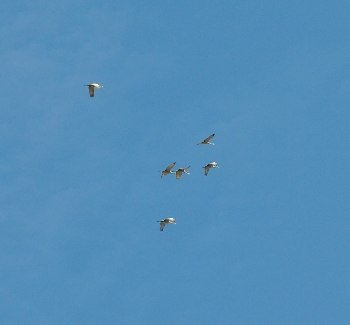
The 7th Sandhill is still out of frame as the others continue their circuit to the  top of the funneling air.  As to the four who tend to stay close to each other, I suspect those may be the females as they are tending to stay close to one another possibly to use the slightly reduce resistance by the use of formation.

I think this may be the only photograph I in which all seven cranes are visible...four down right, one far left and what appear to two males right of center.  Note  the directions in which they are headed.

The females, down right, continue their flight formation continuing  to reduce even more air resistance.


Note the three down right.  They are nearly exactly in the same flight position.  Obviously the best one currently for the job at hand.


 When in doubt of their heading look for the bit of white which is their heads.


Oops  a near mid air collision, center.
The turn is made and off they go higher.

And higher.  Note the further upward angle.

And round the other direction.  Higher.


Two bottom birds and down right bird head right.  The top three  left making the turn.

Then  five using the break in air pressure from the wake of the bird before them angle steeply up, gaining height without much effort.
Four on right leave this kettle loosing a bit of altitude when they leave it and head for the next where the lead male circles at the top of a second vortex of air out of frame.

The last crane finishes this vortex and heads right towards the other cranes who have lost a bit of altitude, as she will, making their way to the next vortex.

Donegal Browne

P.S. Heading out to see what today may bring.

Thursday, March 22, 2018

Wait! Those Aren't Funneling Turkey Vultures, Those Are SANDHILL CRANES!

    
I look up and there far off in the sky are Turkey Vultures kettling!  I run for the camera. 

Related image I
                                  Courtesy of  www.aerospace.org/
While I do that lets talk about kettling.  Basically kettling is circling up on the updrafts of  warmer air created by warmer terrain, like paved roads for instance or darker colored ground without cooling grass on it.The rising air lifts the birds up on those big wings and they may have to flap now and again but it is downright relaxing compared to all the usual flapping they have to do ordinarily to gain altitude.

I'm back and look through the camera.  HEY!  Wait a minute those aren't Turkey Vultures those are Sandhill Cranes! 

I'd never seen Sandhills kettle but it does makes perfect sense.  No doubt a behavior of many species of wide winged heavy birds. 

Turkey Vultures only weigh a couple of  pounds and kettle whereas a Sandhill male of average weight is 10.1 pounds, and a female is  8.9 pounds so they can really put this behavioral advantage to good use. 

By the way though not pictured above there is a Sandhill Crane way up at the top of the kettling air waiting for everyone else to get closer.  I'm assuming he is the lead bird of the moment.

That makes seven birds in this particular Sandhill flock.


Here are all seven of the Sandhills in their current positions.  The bottom four are heading right.  The one above them is going up steeper and right while the one on the left is in a different position all together.

This may be the only shot in which I managed to get everyone in the picture.

Speaking of pictures, blogger doesn't want to load anymore right now  so we'll continue on tomorrow.

See you then!

Donegal Browne