Tuesday, October 26, 2010

WARNING This Post May Be A Bit Graphic for Some: No It Isn't Charlotte But We Were Concerned There For Awhile


Photo by Brett Odom
Last week I got a phone message from Brett Odom saying that there was something of concern and I should give him a call.

Gulp.

Last time we'd been in touch a pair of Peregrines were making themselves at home on the previous site of Charlotte and Pale Male Jr.'s nest. This was rather worrisome because as we know, Peregrines are one of the few creatures that can take out a Red-tail in a New York minute.

Ordinarily at this time of year, Pale Male Jr. is off on his annual vacation so we also knew it was likely that if Charlotte was going to defend that particular piece of turf the Peregrines kept sitting on, she'd be doing it by herself.

Double gulp.

Then Brett emailed me the above photograph. Could that be Charlotte? Note the carcass has no visible feet nor can we see a beak, but the coloring did look kind of like Charlotte. What if we're only seeing her bottom half below the belly band? She's a very dark bird with a very dark belly band. Now granted the carcass looks pretty small for a Red-tail, but also note that most of the feet and legs are missing, the tail and wing tips are missing.

The head is there, lying in the dark and unfortunately due to angle we can't see the whole beak to tell if it's curved or not. And what if most of the breast is missing and it's folded back onto itself would that foreshorten the effect and slew our size perception?

Could all the missing bits just be making it appear smaller than we're used to?

Well...maybe?


Photo by Brett Odom
Then Brett got this photo with one of the Peregrines included for size perspective. The carcass does look very small for a hawk. A large Peregrine and a small Red-tail are the same length. Charlotte is not a small Red-tail. Charlotte is a big girl. But what about the possible illusion we might be getting because of the missing bits?

But it does look small so how about we attempt to figure out what other species it might be. I thumb through my Peterson's Field Guide to Eastern Birds, over and over again. Nothing really fits. I keep thumbing.

A Willow Ptarmigan? Shouldn't be here, it would have to be very very lost. Keep thumbing.

A feral pigeon? Well, feral pigeons only have certain color morphs and that isn't one of them, unless there is one I missed. But I've seen a lot of feral pigeons

The whole time Brett and I are asking each other things like, why did they eat the feet and strip feathers and not really eat the usual parts? No tail to be seen, primaries appear gone from the right side wing. But then again if that's the case, where did the feathers go? Whole days are passing.

Why doesn't the carcass appear to have been noshed on beyond those unusual parts mentioned? Was it poisoned and the Peregrine can tell and that's why she isn't eating it?

In the meantime, I send the photos to John Blakeman, who beyond his thoughts on the physical discrepancies of size and all, he stated that no self respecting Red-tail would let herself get caught by a Peregrine on a ledge like that--which was heartening.

But well, we all make mistakes.

We need something definitive.

I ask Brett if it's possible for him to get a photo from a higher angle so we can see the beak and whether the breast is missing and the skin folded over on itself. The light has been terrible. New York City is having completely overcast days.

Here comes the weekend, and I get a text from Brett. New photos. Much better light and a higher angle. It's not Charlotte! Yea!!!! Boy do I feel better.

But then again. WHAT is it then?

Next from Brett, surprise, surprise--Now there are TWO of whatever up there.


Photo by Brett Odom

Okay, Peregrines do cache food, but the first carcass has been up there quite awhile. And whatever species it is, all I can think, is that it must be easy to catch but doesn't appear to be very tasty as they are just letting it lay there.

Speaking of what species, it's driving me crazy. I zoom in and the second carcass appears to have a white scalloped edged tail, rather like a Mourning Dove. But not Mourning doves as the color is all wrong, unless the color balance is off. No. A Mourning dove's belly is much closer of a color than these are. But because of the tail, perhaps something similar? Or not. After looking again at the tail, perhaps I'm just looking at bright sun on feathers causing glare.

What's your take?

Donegal Browne

Thursday, October 21, 2010

The Legend of Pale Male


The White-bellied Nuthatch are back and...


The Legend of Pale Male opens in theatres November 24th.


Here's the link for the trailer.
http://trailers.apple.com/trailers/independent/thelegendofpalemale/

Donegal Browne

Sunday, October 17, 2010

The Walmart Red-tailed Hawk and the Red-winged Blackbirds


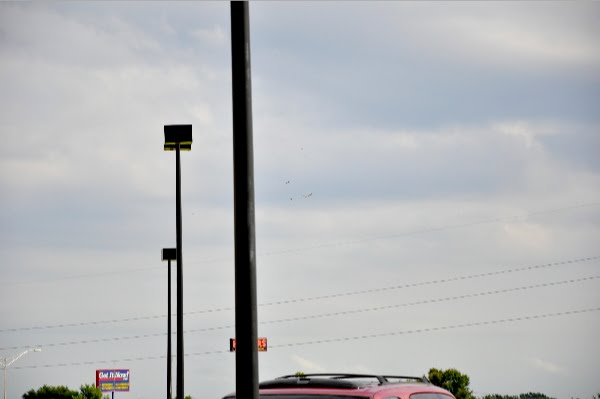
I pulled into the parking lot, got out of the car, and suddenly noticed that one of the fixtures on a light pole seemed to have an extra lump. An extra electrical gee gaw? Or perhaps a hawk?
Can you see the lump?


See the pole beyond the black car,that appears to be coming out of a small tree, center? What is that lump on top of the fixture?


The lump then proceeds to fly off the pole.

Aha! A lump no more but rather a Red-tail in pursuit of a bird. But in the air? Not a hunting technique that isn't often effective for Red-tailed hawks. Closer scrutiny of the initial picture once it was loaded into the computer shows the hawk, leaning over and peering into the tree below its perch.

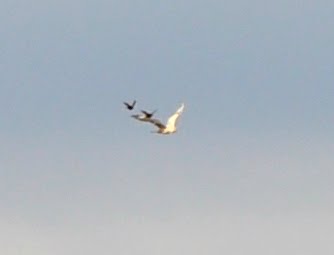
Then there are two smaller birds in the mix. But like a good predator the pole sitting Red-tail keeps her eye on the initial prey and pursues it to the exclusion of other gyrating bird distractions. (At least that may be what's going on. I have my doubts as this is a mature hawk. Besides always remember, "Never underestimate a Red-tail".)

Still focused.


And then there are three smaller birds. From exactly where, I've no idea.
The initial bird of focus is gaining ground while the other two appear to be lagging intentionally. I'm beginning to suspect a planned Red-winged Blackbird group effort.

Now the two extras have repositioned themselves under Pole Sitter.

My actual view at the time.

The distracting lower bird is doing all kinds of flapping, curving, and general eye catching moves. And the Red-tail appears to be giving him the eye.


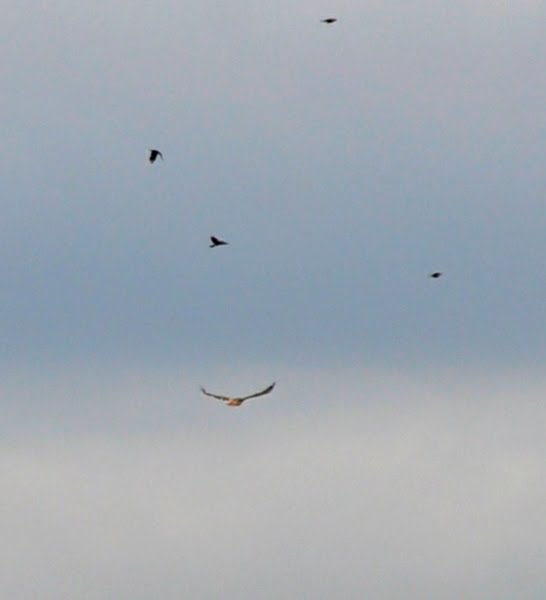
The hawk is now the center of a mobbing triangle.


Bottom bird, now appears to be staying in the blind spot directly behind the hawk's tail. Or at least what the Red-wing may believe is a blind spot. It may well not be considering how Pale Male Jr. lures pigeons to catch up to him in their anti-predator circling maneuver by slowing down, then flipping round in midair on a dime, and nabbing the closest pigeon.

And gotcha! The bird lands, folds his wings, and pecks away at the Red-tail's wing. Now keep in mind that a Red-tail is perfectly capable of whipping round upside down with talons up which might dump the Red-wing off. A move they use when a Peregrine is attempting to nail them in the head from the air. But Pole Sitter doesn't do it. Why?

The move I've seen Red-tails in the country use to dislodge a Red-wing is to make a sudden flight just barely under a tree branch. In the cases I've seen, the Red-wings flew off in time not to be knocked for a loop, but it's conceivable that an unwary Red-wing could get smacked by the branch, disabled, and the Red-tail could have his way with him.

As Wing Bird comes off one of the other birds starts a dive from above.

Finally a glimpse of shoulder patches, if there was any real doubt previously which species tends to land on a Red-tail in flight and peck them while riding. Indeed these are Red-winged Blackbirds.


More buzzing. The Red-tail seems to have pretty much forgotten, (Or is this a ploy?), that she was initially doing the chasing.


Naked eye view.

Now there are various moves above Pole Sitter by the Red-wings.


Look carefully. The birds are to the right of the pole.


Now a touch from above instead of below and behind.

And then there are four.

And Pole Sitter just keeps flying...
This may well be one of those instances where the Red-tail continues this game until the Red-wings get just a little too cocky and Pole Sitter, biding her time over days, eventually ends up with a delectable snack.


The easily recognizable wing patch feathers of Red-wings are regularly found in Red-tail nests.

It is said, "Patience is a virtue", and most successful Red-tailed hawks have it in abundance. To say nothing of the added virtues of the top-of the-line Red-tails such as Pale Male-- who have all the other virtues as well, including stealth, the ability to incorporate varied hunting techniques, learn from their own experiences, the knack of unpredictability, and lest we forget the wonderful gift of cleverness.

Donegal Browne