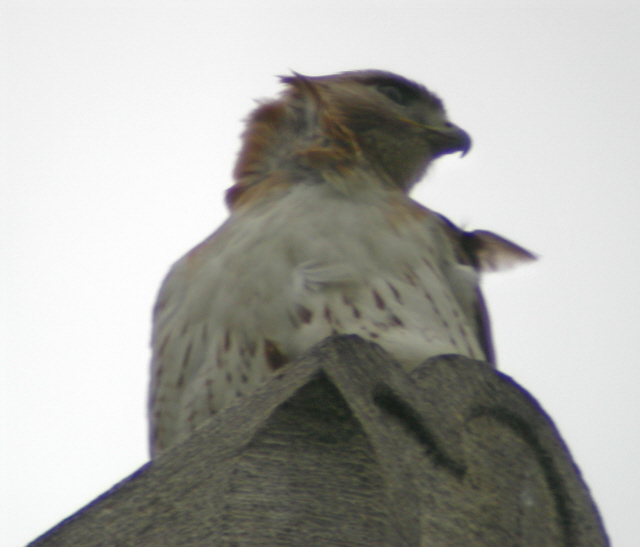
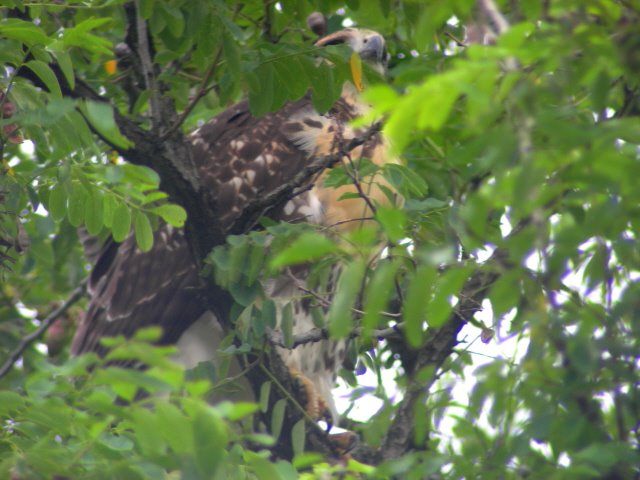
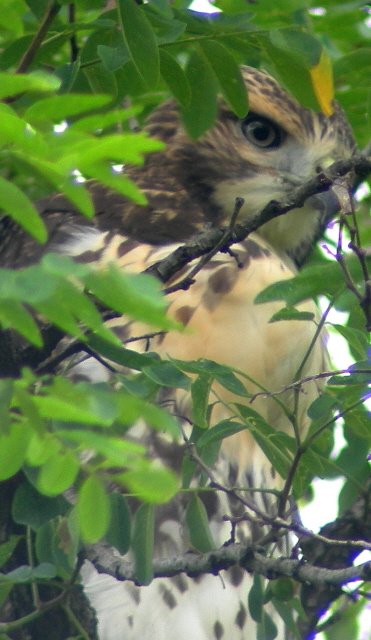
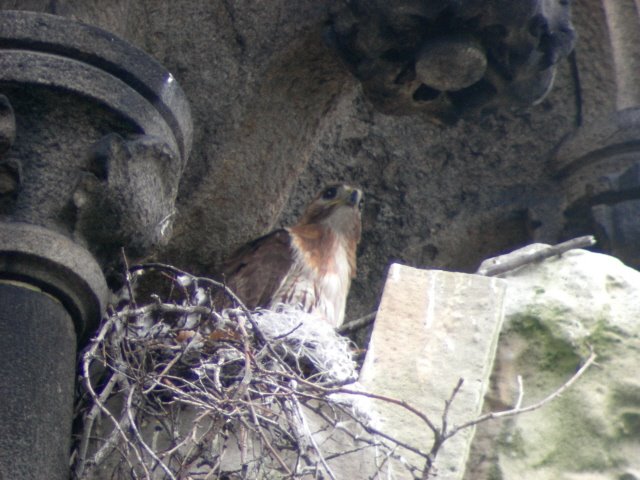
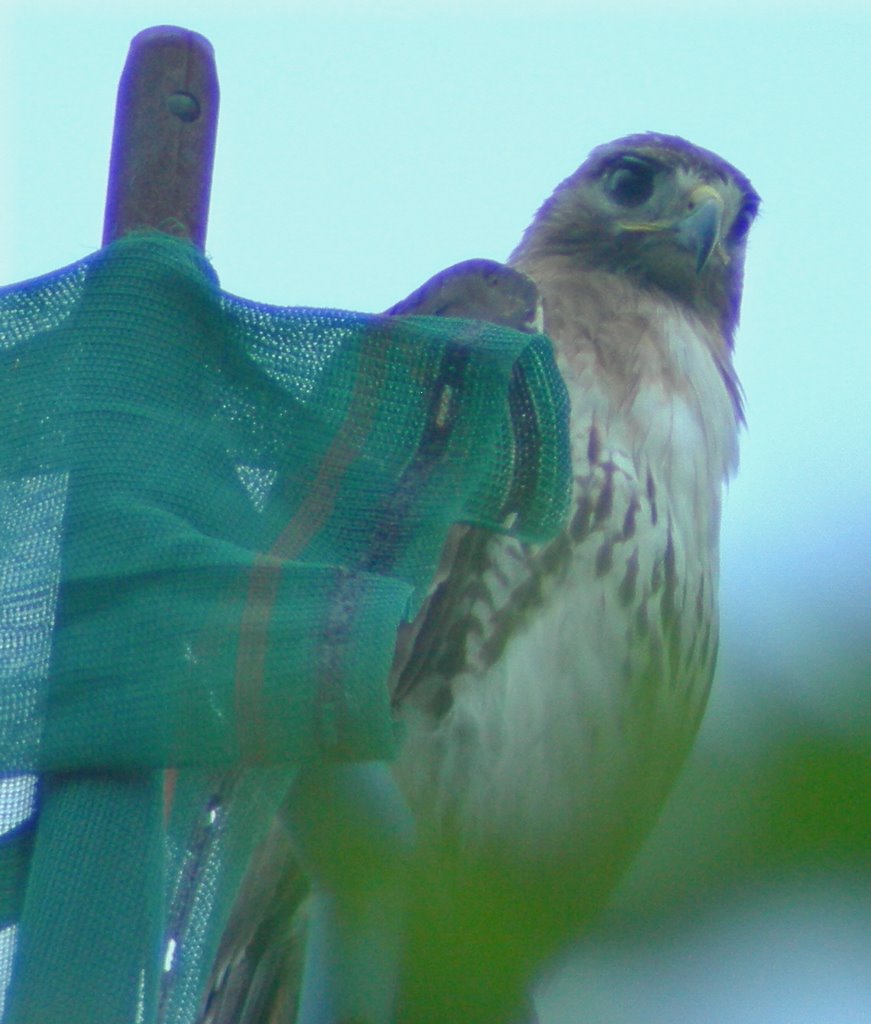
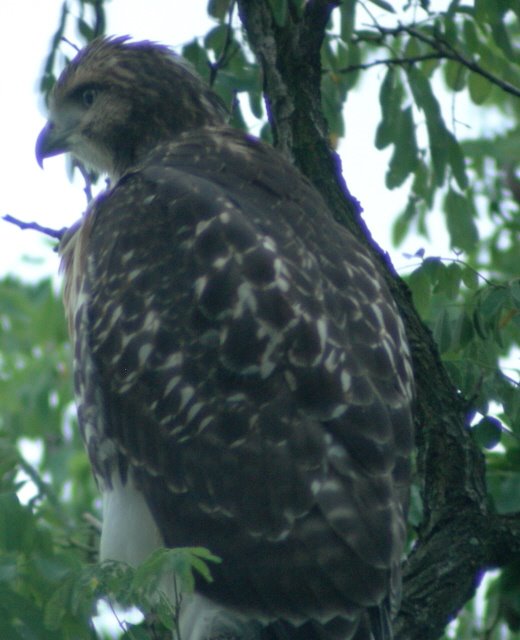
Photograph by Donegal Browne
Male or Female? John Blakeman's foray into the discussion.
He writes...
Donna,
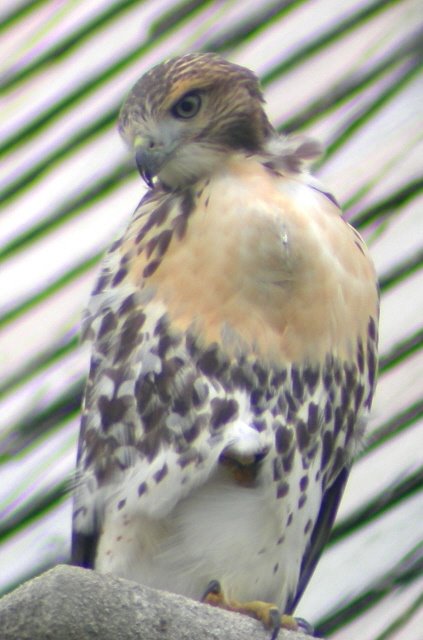
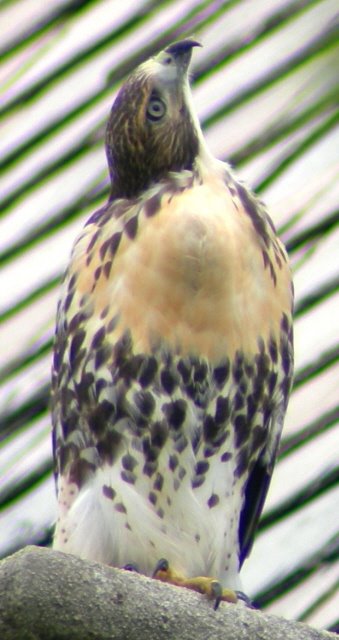
The bird on the left is definitively a female, the bird on the right a male. It's the width of the bodies that's diagnostic. Your term "chunky" fits perfectly. We've got a male and a female here.
The length of the primaries is not significantly different, proportionately. The difference is the way the birds are perched. Big Sister is at the edge, with her tail and primary feathers going straight down, so they appear relatively longer. Little Bro,' at the instant of this photo, is perched further in on the ledge and is leaning further forward, elevating his tail and folded wings. I don't believe that he has shortened primaries. The appearance of this is a mere artifact of the photo and the birds' relative positions.
By now, the feathers are fully descended and hardened. Any marking patterns should remain, except for a moderate bleaching through the summer.
This portion of the text refers to a discussion between John Blakeman and I about the relative "skittishness" of male and female Red-tails. My observations with the Manhattan pairs at the Trump Parc, 927 Fifth, and at The Cathedral lead me to believe that the males are less skittish. Skittish in my case defined by perching proximity to humans, movement from perch upon discovery, and the distance from humans in which they will take prey. Falconers, with a bird on the fist, have a well known opposite opinion.
I then suggested that perhaps as these males had chosen urban territories that they might be less "skittish" than the norm or that experience of years in this density of humans had diminished their skittishness. And since all the tiercels had lost at least one mate, the females of of these pairs had had less time to acquire the experience to become less skittish in relation to humans. D. B.
I'm not sure how the males' tendency for skittishness really applies to wild, non-captive birds, if at all. We falconers know this phenomenon well. It occurs in all raptors. But how it plays out in interactions with humans at a distance, as in NYC, as opposed to a human to which the bird is tethered on the fist, I'm not sure. I tend to think that it plays no role in how male red-tails live in urban areas.
The fact that the three NYC males have all lost mates may -- or may not -- be significant. I don't know of any continued studies of rural pairs that document similar losses, but perhaps this is common. Perhaps you are on to something REALLY BIG in raptor ecology. Raptor biologists have known for decades that more females are produced than males. We've never really understood why this is so. Males are smaller and would seem to have a reduced probability of attaining adulthood, so that's a second whammie. The first is that fewer males are hatched than females.
But perhaps females, for whatever reasons, tend to die off in adulthood. Perhaps egg-laying takes a toll and they don't live nearly as long as the males. Another reason the NYC red-tails need to be seriously studied.
--John Blakeman
(Note: Before anyone gets all priggish, about "scientific proof", do realize, that this is the start of how you get it. These are the sorts of discussions that constantly occur in private in order for hypotheses to be formulated. Models must be evaluated, observations discussed, methodology considered, and in the end, a hypothesis to be ground out, that is an explanation, a reasoned proposal, suggesting correlation between multiple phenomena. Then that hypothesis can be more formally tested through observation and experimentation within guidelines.
And why is this discussion being held in what might be construed as a "public forum"? Because the Hawkwatchers, of different experience and of more or less expertise there is no doubt, are still what the Cornel Lab of Ornithology would call Citizen Scientists. They've run a number of studies, in which regular folks from all over the world, given what to look for, how to do it, and a place to send the data, have made a valuable contribution to our knowledge of the biological world.
Consider, what we observe can bring questions to the table that those with less intimate field hours with Red-tailed Hawks would never even think to ask.
Another Note, while we're at it. The human brain evaluates and identifies many things automatically. For instance it has been scientifically proven that a human child needs to see seven non-identical dogs before he or she is able to identify "dogness". In other words, the young child will be able to identify the eighth dog as a dog, however different it is from the first seven. Therefore those that discount practitioners and people with intimate contact and experience with a phenomena under discussion, discount extremely valuable insights, knowledge, and this sort of automatic brain evaluation. Darwin had many a very enlightening discussion with his barber who had bred canaries for decades.
How about a third? Note: Don't discount ideas immediately out of hand, just because they seem too bizarre. There is a documented article in NEW SCIENTIST in which it is shown that the analytical skills of male humans can be reliably measured by the relative lengths of their index and ring fingers. Strange but true, I kid you not. D. B.)