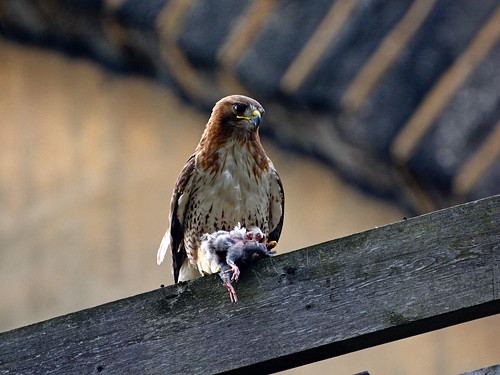
What does Isolde think about while sitting on the nest for weeks at a time? She isn't telling but now that she is higher in the nest brooding young instead of incubating eggs, she can at least watch the world around her from a slightly better vantage point.One imperative I think would be to keep some visual track of Norman when possible. Then of course there is the care of the eyasses but there are still long stretches at this point in their development when they are deeply asleep and warming is all they need. What it appeared that she was looking at at this particular moment was a young squirrel making his way across the parking lot. Prime prey in the exact position for easy capture but she not only will not leave because of the kids but some also believe that there is a no kill zone around all Red-tail Hawk nests. And I must admit I have seen pigeons and other usual prey very near Red-tail nests both here and in rural areas, seemingly oblivious to the hawk, and left completely unmolested by both members of the pair.The thought is that there is an evolutionary advantage to this. If the nest is in an innate no kill, i.e. non-aggression area in and around the natal area, a hawk's usual lightning supposedly automatic responses would be mitigated and they wouldn't accidentally kill an eyass by mistake in a reflexive unguarded moment.
I've always wondered about that though an instance the other day with Quicksilver the African Grey gave me pause. Silver is eleven, old enough now to become hormonal in the Spring and not altogether in control of himself at those times.
The other day, I'd been gone quite some time doing grocery shopping. Silver isn't left to his own devices on an open play area when no one is home as there are cats in the house and who knows what he might get into that wouldn't be healthy, either to himself or to the object, while unmonitored. Therefore when he's told that I have to go to the store he happily goes into his sleeping cage for a nap while repeating "Gotta go to the store". When I returned, as is usual, by the time I'd put the packages down Silver was letting me know he'd like out by beeping. I went in greeted him, put my hand into the cage to have him step up and he hacked at me with his beak. I withdrew my hand with speed, retreat being the better part of valor in those moments, at which time he attacked the side of his food bowl with a vengeance for a few seconds. He then stopped dead, stood for a beat stock still and then said in his best slightly high pitched truly penitent voice, "I'm sorry, I'm sorry." While looking up at me as if he was completely astounded by what he had just done.
He was penitent and stepped onto my hand with impeccable manners.
Perhaps a no kill zone does need to be a part of a hawk's innate make up. Though I have noticed that when a tiercel visits the nest while the formel is there that his manners are impeccable and there is the slightest subservient posture when he brings food. Food being a possible trigger, I suspect, for a leap with talons at the ready.
And come to think of it, the lack of response cannot be iron clad no matter what because there are times when a nest must be defended and therefore when needed the aggression response must be there.
Has anyone seen a kill take place in the immediate area of a nest during breeding season?
 Photo by Peter Richter of http://queensraptors.blogspot.com/
 The Triborough Bridge Nest with Atlas' new mate Andromeda on board along with a rather large tattered plastic something. I've asked Peter for clarification but I rather got the impression that the ubiquitous plastic may have attached itself without the help of the hawks. I'd certainly prefer it took its leave sooner rather than later.
According to Peter, Andromeda hasn't laid any eggs yet, not for want of copulation you understand, and there is certainly still time for another clutch.
 Another shot of Belligerent Cardinal--same spot, same attitude.
 (Note the top eyass may just have the tip of her tongue hanging out. If so it isn't just young mammals who do it then but young birds as well. Though one would think that a beak might pinch a bit if she had a startling dream. Yes, according to REM measurements, birds absolutely do dream. D.B.)
Donna,
I have attached some more images of Mama and her nestlings taken on 4/13 and 4/16 as of the 16th the nestlings are about 7-8 days of age. It is fairly clear at this time the order of the hatches. In the close up image of the three nestlings from our left to our right is the third, second and first to hatch. The first to hatch is the strongest, most active in the nest and can keep its head up at all times. The second is getting fairly strong and can keep its head up most of the time. The third to hatch still has some noticeable spotty bare skin and can hardly keep its head up. I have added many more images on my website from this years nest in the Nest Photos 2010 Gallery link and I have also added some new programs available under the Lectures & Field Photography Workshops category links.
All the best,
Jeff
************************************************************************
As it is a great time to be out birding, I thought it might also be a good time to look over the American Birder's Association Code of Birding Ethics.
************************************************************************
PRINCIPLES OF BIRDING ETHICS
Everyone who enjoys birds and birding must always respect wildlife, its environment, and the rights of others. In any conflict of interest between birds and birders, the welfare of the birds and their environment comes first.
Code of Birding Ethics
1. Promote the welfare of birds and their environment.
1(a) Support the protection of important bird habitat.
1(b) To avoid stressing birds or exposing them to danger, exercise restraint and caution during observation, photography, sound recording, or filming.
Limit the use of recordings and other methods of attracting birds, and never use such methods in heavily birded areas, or for attracting any species that is Threatened, Endangered, or of Special Concern, or is rare in your local area;
Keep well back from nests and nesting colonies, roosts, display areas, and important feeding sites. In such sensitive areas, if there is a need for extended observation, photography, filming, or recording, try to use a blind or hide, and take advantage of natural cover.
Use artificial light sparingly for filming or photography, especially for close-ups.
1(c) Before advertising the presence of a rare bird, evaluate the potential for disturbance to the bird, its surroundings, and other people in the area, and proceed only if access can be controlled, disturbance minimized, and permission has been obtained from private land-owners.
The sites of rare nesting birds should be divulged only to the proper conservation authorities.
1(d) Stay on roads, trails, and paths where they exist; otherwise keep habitat disturbance to a minimum.
2. Respect the law, and the rights of others.
2(a) Do not enter private property without the owner's explicit permission.
2(b) Follow all laws, rules, and regulations governing use of roads and public areas, both at home and abroad.
2(c) Practice common courtesy in contacts with other people. Your exemplary behavior will generate goodwill with birders and non-birders alike.
3. Ensure that feeders, nest structures, and other artificial bird environments are safe.
3(a) Keep dispensers, water, and food clean, and free of decay or disease. It is important to feed birds continually during harsh weather.
3(b) Maintain and clean nest structures regularly.
3(c) If you are attracting birds to an area, ensure the birds are not exposed to predation from cats and other domestic animals, or dangers posed by artificial hazards.
4. Group birding, whether organized or impromptu, requires special care.
Each individual in the group, in addition to the obligations spelled out in Items #1 and #2, has responsibilities as a Group Member.
4(a) Respect the interests, rights, and skills of fellow birders, as well as people participating in other legitimate outdoor activities. Freely share your knowledge and experience, except where code 1(c) applies. Be especially helpful to beginning birders.
4(b) If you witness unethical birding behavior, assess the situation, and intervene if you think it prudent. When interceding, inform the person(s) of the inappropriate action, and attempt, within reason, to have it stopped. If the behavior continues, document it, and notify appropriate individuals or organizations.
Group Leader Responsibilities [amateur and professional trips and tours].
4(c) Be an exemplary ethical role model for the group. Teach through word and example.
4(d) Keep groups to a size that limits impact on the environment, and does not interfere with others using the same area.
4(e) Ensure everyone in the group knows of and practices this code.
4(f) Learn and inform the group of any special circumstances applicable to the areas being visited (e.g. no tape recorders allowed).
4(g) Acknowledge that professional tour companies bear a special responsibility to place the welfare of birds and the benefits of public knowledge ahead of the company's commercial interests. Ideally, leaders should keep track of tour sightings, document unusual occurrences, and submit records to appropriate organizations.
Please Follow this Code and Distribute and Teach it to Others
The American Birding Association's Code of Birding Ethics may be freely reproduced for distribution/dissemination. Please acknowledge the role of ABA in developing and promoting this code with a link to the ABA website using the url http://www.aba.org. Thank you.