Showing posts with label rural hawks. Show all posts

Monday, July 02, 2012

Staturday Report for the Fledglings of Pale Male and Zena in Central Park

 Photos by Jeff Johnson

 Fifth Avenue Fledgling Watcher Jeff Johnson was back on the track yet again on Saturday.  
Photographs plus the commentary in italics are his.  Unitalized
thoughts are mine. 


 Donegal,
At noon on Saturday I decided to start at 82nd Street by the MET and make a shallow foray into the museum grounds thinking that Pale Male or Zena would be hunting. No joy spotting either of them soaring, hunting, or even perched anywhere. Though it's only been a week that their eyasses have fledged, I wonder if the parents are already doing less "give away" support. Today all three fledges demonstrated good flying skills and were more active than I've seen previously. It wasn't until I walked all the way down to the knoll above the Sailboat Pond that I spotted a Red-Tail. In the upper left corner of the frame is my  Fledge 1 sighting.
In this next frame he/she appears to be in great health. I sought to use the fledges head movements to find Pale Male or Zena. Goes without saying that their eyeshight, height, and ability to triangulate is superior to mine, but they never aided me today. Only when they began serious begging did they help me spot Pale Male. I never did see Zena.
 Fledge 2 was spotted hanging out in the favored tree behind the Kerbs Cafe.

 I'd moved in to about thirty feet observing this beautiful fledge when a whoosh of flapping wings announced another fledge streaking by. It moved too fast for me to provide any good frames, so I combined several of them to make them more interesting. Fledge streaks by…briefly alights on 5th Ave wall…zooms down to leaking hydrant by the cafe (doesn't drink…saunters out a few yards to ogle the bystanders..then uses a ground effect running leap into some brush to attack a selection of twigs.


 Seeming very pleased with itself the fledge launched with a screech into the treeline near Alice In Wonderland.

In a near midair with a Red-tail fast mover vectoring in from the SE quadrant it awkwardly planted itself on a limb alongside the Red-tail it bushed wings with. At first I thought it had bumped into Pale Male delivering a meal, but it was another fledge and the two began a little squabble. Both are in the upper left corner of this frame (one in dim sunlight and the other in shadow).


After continuing to bicker a minute or so one stayed venting its wings to the heat while the other flew off to the NNE.

 You can see it in the upper left corner of this frame. Flew just beyond the next hillock.

 [She] calmly appeared to be observing the human circus below.


Now the fledge that had stayed behind elected to leapfrog its sibling into the trees across the walkway.
 Moving below it  I took this frame and it appears to have a little food in it's crop, though I never saw a meal delivery all day.
 Twenty minutes later (It's late afternoon now) there was a raucous bit of vocalizing and two fledges swooped into "their" tree behind the Kerbs Cafe. Again I expected a meal delivery from Pale Male or Zena, so I positioned myself on some high ground to better observe incoming traffic. Again I didn't see anything of a food drop.
 Walking back toward the Sailboat Pond I caught the silhouette of the fledge who wasn't down by the Cafe.
 This fledge wasn't begging at this  time and seemed intent on hiding. Maybe it was tired of small bird hassling.

We couldn't blame her if she were hiding from the mob, but she may also be practicing her stealth mode.  Not only do young Red-tails have obvious urges to "kill" inanimate objects they also seem to have an urge towards stealth behavior, another necessary skill for making a hawk living.

 Getting close to the north end of the Model Sailboat Pond and three was a fledge being decidedly less withdrawn. In the upper left corner you can see the fledge fully aware of the attention it's getting. 

Jeff,  I agree that the fledgling is aware that there are eyes on her but she is likely quite unconcerned or really all that interested in the attention itself.  If I were to guess, I'd suggest that she is watching  the humans as part of her landscape, an active part, she's watching the behavior of humans to later have a handle on human behavior, much in the way her parents appear to visually record prey patterns for later use. 


Here is a closer frame of the fledge...


It's really great to have these Red-tails among us. It's been pointed out to me by knowledgable Hawkwatchers that just because I didn't see a lot of Pale Male or Zena doesn't mean they are unconcerned or inattentive. They are just staying less visible as they continue to nurture the education and life skills of their fledglings. 
Jeff
Absolutely true. 
 I believe that Red-tailed Hawk parents are wired for stealth when it comes to tending their fledglings.  The behavior would be a safe guard against possible predators.
Though as with most of a Red-tailed hawks urges towards certain behavior, they can be modified by experience.  That's my opinion at any rate.
We've seen that Pale Male especially,  and even some of his mates, usually to a lesser degree,  recognize hawkwatchers of long standing, those who have proven their "good behavior", i.e. by not bothering him and not doing anything suspect around or to the fledglings, and will regularly appear with complete unconcern while going about his business in front of those he knows, even while tending his progeny.
In fact one of the hallmarks of adult hawks that we tend to think came from Pale Male's nest, beyond their paler coloring is their nonchalance in tending their fledglings in public. 

Pale Male Jr. did it.  Tristan (Pale Male III) did it--as did Riverside Mom.  Some urban hawk parents are far more reticent about exposing their fledglings location.
You ask, why should the parents bother with stealth when the fledglings are often begging their  brains out, loudly and continuously when a parent presents him or herself?

Though the parents many feel because of their upbringing exposed to few humans that stealth feels right,   these eyasses  have grown up surrounded with people.  They have begged and been fed under the gaze of many human eyes as their parents have no other choice in many urban nests but to expose the location.  (The parents having watched humans and taken the chance of an urban site, likely decide when the site is chosen, that humans are very unlikely to appear at the nest site.  And if humans do later appear near the nest site, the parents are ready to make things so hot for the humans they'll retreat.)

Rural eyasses are very rarely fed when the eyes of humans are on their nest.  The parents wait until the humans leave and then fly to the nest and feed the young.  The eyasses learn that begging with a human staring at them before the parent arrives will  likely get them nowhere so they learn not to do it, which is what their parents have in mind. 
(A caveat here, if the parent is already on the nest and in the middle of a feeding they will often continue feeding. Note while being fed on the nest vocalized begging by young is at a minimum.  I hypothesize the actual "taboo" behavior for parents is flying to the nest under human eyes.  Though once you are recognized as  are a normal safe part of the landscape they will do it.)
 When to beg is a learned behavior.
When I observed the nest of the County Road M Hawks in Wisconsin, I heard begging only twice.  It was very strange after listening to city eyasses and fledglings beg to the high heavens at the slightest sight of their parents.
The  first time was when I'd pulled to the verge of the road from where I observed them with the window open and one eyass didn't see me right away.  
The second instance was when a fledgling, who really liked the parental prey delivery service and saw little reason to hunt for himself,  was being weaned.  His parents had decided enough was enough and he was going to have to do some hunting on his own.

Stubborn Fledgling  had decided he didn't want to hunt and he'd beg until he turned blue, loudly, vociferously, and in front of a regiment of strangers if necessary to get his way.  Which he did in front of me though periodically glaring at me as if  to say "Would you just go away".  As he likely thought if I did, or at least still strongly hoped,   somebody would have had enough of the racket and would arrive with lunch.

I'm sure he was profoundly disappointed when I finally did leave and no take-out arrived.

As I saw both fledglings weeks later hunting on their own, Stubborn Fledgling did eventually bite the bullet when he got hungry enough and learned to do it himself.
City Hawks and Country Hawks adjust quite smartly to their respective environments.

Happy Hawking!
Donegal Browne


Thursday, March 10, 2011

Pale Male Sleeps, Mama (and Papa) and Raven Mom Sit Nests, See America's Oldest Bird Mom, Hear a Screech Owl Trill


Photo courtesy of palemale.com
Pale Male, premier urban hawk, readies himself for sleep. He, as we know, is not in the least bothered by observing humans.

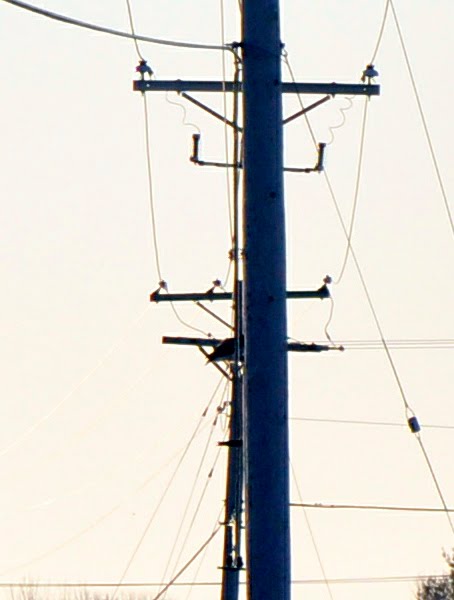
On the other hand, though I'm quite far away from the above power line, which only a moment ago had a beautiful rural Red-tailed Hawk, the Tall Grass Prairie female to be specific, perched on said wire, upon sighting me she was off like a rocket. This pair is good when it comes to diversions and obscuring themselves, hence why you've not seen them before. I try; they win.

Typically off she goes INTO the light which dazzles my eyes.

I saw her curve this direction but was so dazzled I couldn't catch where she went and had to wait until I got home to see what she was up to.

Can you see her?

Now? See her tail below the second cross bar. She's hunting late in the day and I don't want to bother her so I don't try again. Perhaps one of these days she'll get used to me. Maybe. But she has an entire territory to retreat to if she must and I'm only able to look from 1 or 2% of it. She doesn't have to get used to me to make her living.

FROM JEFF KOLLBRUNNER, www.jknaturegallery.com/ A CHIEF WATCHER OF MAMA AND PAPA

Donna,
Mama has overnighted and once again she has started early in the nesting season as in past years. She may have overnighted as early as Saturday March 5th unfortunately we were not able to check on Saturday, however, Mama definitely overnighted on Sunday March 6th. Papa stays nearby and keeps a close eye on his territory near their nest.
As for the Queens Ravens they appear to be in their nest as well. It appears they started mid-week Wednesday March 9th. I have not had as much time to spend observing the Ravens but I am reasonably certain they are nesting. I will get to observe them more this weekend to confirm they are staying in the nest.
I did not get a chance to send you new images of Mama and the Ravens in their respective nests but I will send you some images soon.
Best, Jeff

Congratulations to Mama and Papa-The first over night of the season as far as I know, but then again, Mama and Papa often take get the earliest start on a family each year. All the best!


Photo Courtesy of the U.S. Fish and Wildlife Service
America's oldest wild bird mom (that we know of anyway D.B.) has a new chick.
(And she's looking really good besides. Just check out those fine feathers!)

"She's at least 60 years old, flies some 50,000 miles a year, has had almost three dozen kids – and now she's got another one."
http://news.blogs.cnn.com/2011/03/09/americas-oldest-wild-bird-is-a-new-mom/

To see video of an urban Screech Owl just before fly out, and hear its trill go to James O'Brien's blog http://yojimbot.blogspot.com/

Happy Hawking!
Donegal Browne

Wednesday, April 08, 2009

Urban Red-tails Kay and Jay, Wild Turkeys, and the Ms


PHOTO BY CHERYL CAVERT
Easing her way back into life as usual--
April 7-Kay in a tree at Riverparks at 12:30 pm - about 1/3 mile west of the nesting tower.


PHOTO BY CHERYL CAVERT
A closer look at Kay in the same position.

PHOTO BY CHERYL CAVERT
Kay on the tower, around 5:15 pm.


PHOTO BY CHERYL CAVERT
Kay and Jay, sunset, keeping an eye on things.


PHOTO BY CHERYL CAVERT
Crop bulging, Jay keeps a particular eye on an attacking Kestrel who seems to be a serial offender.

Cheryl says, "I have seen the Kestrel zinging Jay before at sunset. Also several Tulsa Hawk forum members have captured screen shots of a kestrel on the tower.
- Cheryl


Some answers to my questions of yesterday to Rose Cuthbert, Tulsa Hawkwatcher--
Donna,

There are not many pigeons in the park, but then there never are. There is, however, an abundance of mourning doves.

The Langenheim pair does has a nest nearby, about maybe a quarter of a mile at the most. Right along the creek bank in a tree. It is way way back in someone's yard so any observations must be done at a good distance. Cheryl found it. I don't have the kind of camera equipment she does, so I just normally drive by to make sure it is still up there and if there are any hawks flying around near it.
Rose


Thanks Rose. So that's the nest that was found in the back yard.

Have you ever seen one of the Tulsa RTs nab a Mourning Dove? I don't remember ever seeing it. We have a few in Manhattan but rare compared to rural areas and I've not seen the urban hawks get one. I'd think the Red-tails would have a much harder time catching Doves than they do pigeons. Mourning Doves don't circle, are harder to spy on the ground due to coloration, and are very fast up and through the air to cover.

Here In WI I've seen Doves sitting on wires not far from an RT. It could just have been a Dove who wasn't long for this world. But maybe not as these rural hawks seem to usually stick to voles, mice, and I hear rabbits though I've not seen them with one of those either.

I was told by a retired dairy farmer in the area, Ron Wade, that back when he had dairy cows and therefore lots of grain around to feed cows that a flock of pigeons lived on his farm. They would often sit up on roof of the silo to sun themselves. At which time the resident Red-tail pair, would come sweeping round the silo from the rear and pluck off a pigeon, rather like the hunting of urban RTs coming round the corner of a building and snatching a perched bird.

Therefore a some point in time at least some rural Red-tails hunted pigeons, but as there are so far fewer of them than there once was, perhaps fewer hawks know the techniques. And there are just far fewer pigeons available in the first place to hunt at the current time as many of the dairy farms are now gone.


NOW TO THE Ms--
The M formel: Same position, different day, with different light. I was there a bit after sunrise. Very blustery, temps in the 20's, and as usual no sign of the tiercel. Though no doubt he is there, as usual, enjoying his cleverness at not being seen.


THE WILD TURKEYS START STRUTTING THEIR STUFF IN WISCONSIN--
I was up early this morning and was rewarded with a pair of male turkeys displaying first against each other until one, "won the field", the second retired and then showing off for the hidden females in the bushes.

VISITS BY BOTH KAY AND JAY TO THE TULSA KJRH NEST


All the wonderful screen captures today are courtesy of Tulsa Hawkwatcher Sally of Kentucky as are the following updates on Kay and Jay.
http://www.kjrh.com/content/news/hawks/default.aspx
8:22 a.m. Kay visits the tower. Checks her nest, moves a piece of bark and a stick near the eggs, then perches on the rail.

http://www.kjrh.com/content/news/hawks/default.aspx
A little hawk tai chi and a rouse of her feathers, then she settles to survey her realm, Queen of KJRH tower! Cam was zoomed on her feet in the nest but someone was watching and pulled out so we could see all of her! Yes! She looks fit and fine and is NOT calling!! Looks pretty contented, actually. 8:32 She rouses once more and flies off right. Gee it was good to see her in person!!


http://www.kjrh.com/content/news/hawks/default.aspx
10:26 a.m. Jay in nest briefly, very cropped up! I think today he has swallowed the softball! He must have gone out on the camera support because he came back over to the nest, steps ever so carefully into the bowl with the eggs, talons still curled with care, and moved a few twigs.


http://www.kjrh.com/content/news/hawks/default.aspx
He hovered over the eggs as if about to sit (my heart was breaking) Then ever so gently rolled the pale egg a bit, then looked up in a half-sit, seemed to think a moment, then walked over and got up on the bar.
He is now surveying his kingdom as well. Flew off 10:37.
Oh goodness that was heart-wrenching for me...if they had human feelings it just looked so touching and sad, like "Hi little egglets, I still love you, I want to care for you but something tells me its too late"...I know, I indulge in the dreaded anthropomorphic illusions, but after all isn't that partly why we love these birds? We feel we "know" them in some intimate way?

Sally

Indeed. D.B.

Wednesday, March 18, 2009

Is It Thunder? Deck Fox, Swans, Geese, Mystery Duck, The M Red-tail Nest or Is It Nests?

IS IT THUNDER?
Is this proof she survived the winter?
HERE ARE TWO PHOTOS OF A RECENT SIGHTING OF A MYSTERY IMMATURE RED-TAIL IN TULSA

Photo by Russell Mills of KJRH TV Tulsa
http://www.kjrh.com/content/news/hawks/default.aspx

Photo by Russell Mills of KJRH TV Tulsa
IS IT THUNDER?

Jackie Dover's map of Tulsa Hawk sightings. See red arrow. Confirmed sightings of Thunder. Also the location of a recent sighting of the mystery hawk.

Photograph by Cheryl Cavert of the Tulsa Hawk Forum
11-18-08 --Confirmed photo of Thunder.

Photo by Cheryl Cavert of the Tulsa Hawk Forum
12/25/08 Confirmed photo of Thunder

Photograph by Cheryl Cavert of the Tulsa Hawk Forum
http://www.kjrh.com/content/news/hawks/default.aspx
1-6-08 This one is from a different location from the other three, Zink Park. It is a possible Thunder. I just included it as another photo to compare. --Jackie

Photograph by Karen Anne Kolling
The Fox on the deck has become a regular at Karen Anne Kolling's seed bowl!

The fox is showing up once every 2-3 days, and, besides some birdseed, he eats some peanuts in their shells, so since he is eating here anyway, I have put out some unshelled (unsalted) peanuts. He does not eat a lot, so I don't know if he is not hungry, or if he just doesn't like seeds and nuts that much,

Karen

Photograph by Karen Anne KollingI only see swans once every few months, and they usually come right up to the seawall for bread, but these guys were only interested in napping -


Photograph by Karen Anne Kolling

Photograph by Karen Anne Kolling

Photograph by Karen Anne Kolling

Photo by Pat GonzalezCanada Goose, Bronx River

Photo by Pat Gonzalez-- Mystery Duck?
Donegal,
Since January, I've seen this duck at the NY Botanical Garden swimming in the Bronx River, usually surrounded by male and female mallards. For the life of me, I don't know who I'm looking at. I've searched all my guide books and online and can't find any pics or illustrations of a white duck or goose with this shape and size bill. Any ideas?
pat


Well, I'm thinking that perhaps your mystery duck is a hybrid. A mix of domestic farm duck and Mallard. After all your white duck hangs out with Mallards and the bill looks a little mallardish so that's a thought. Another thought is that it could be a mostly albinoistic Mallard.Do any readers have any thoughts or comments on mystery duck?
NOW THE KAY AND JAY CARTOON PAGE

A collaboration of Bob McCargar and Jackie Dover of the Tulsa Forum
(Courtesy)
From Carol Vinzant our favorite squirrel rehabber--
Project squirrel' needs your help
VOLUNTEERS NEEDED Tracking animal population --who can help? 'Anyone willing to look outside'


March 13, 2009
BY
KARA SPAK Staff Reporter/kspak@suntimes.com
They live among us in the city or suburbs, charming nut hoarders scampering underfoot and overhead. But the humble squirrel is much more than an ever-present rodent with more charisma than a rat. The little guy is a powerful indicator of the health of the local ecosystem, said Steve Sullivan, curator of urban ecology at the Peggy Notebaert Nature Museum .
More---http://www.suntimes.com/lifestyles/1475088,CST-NWS-squirrel13.article
THE M NEST, N1, COMPLETE WITH A SITTER. She's there.
See her? Tail left, head right.
And further back just outside the mid-oak tree nest field is the second nest, N2, that I mentioned in a previous blog. As it is what I would consider close to the other nest, a rural Red-tail territory often thought to be about 2 square miles, give or take a bit depending on the food supply, my first thought was that N2 was built as a possible choice for this season but the hawks chose N1 to actually use. But the first time I looked at it, I thought I saw some movement. Imagination? Squirrel? So each day I've been taking another look just in case.
Where is it exactly?
We're standing on the edge of the field, with N1 to the left. Start at N1 and move your eyes to the back edge of this field. Do you see three clumps of trees slightly left of center photo? Then there is sort of a blank area with some things further back and then a black blob of tree and vegetation where the back of the field meets the side of the field.

Here is the view from the front. Starting left, some short trees, then a 3 tree -ish line of trees, then a tree that is further back. That tree is the N2 tree. Look carefully and you'll see the nest near the top of the tree.
And today when I looked at N2, guess what I saw?


Wonders never cease. There is another sitting hawk up there!
Seems awfully close to the other but then how many country hawk nests have I watched?


Though it did enter my mind that this might be the N1 tiercel using N2 as a blind. That is a tad far fetched, I admit, but this is the bird that lured me into looking directly into the sun.
OHIO RED-TAIL EXPERT JOHN BLAKEMAN'S TAKE ON THE TWO NESTS, N1 AND N2.

Donna,

Red-tails will occasionally nest somewhat close to each other. They maintain separate territories, but happen to have nests near the mutual edges of the two territories. If there is enough food, they tolerate this arrangement.

But you won't see three of them hunting together in nesting season. Sometimes in winter, but not now.
John Blakeman
Once I read the information from John, it confirmed a thought I had had about a possible territorial line. I have never seen either of the N1 hawks fly beyond the RR tracks. I now assume that is a boundary line.

Back to N1, and she's still up there in the unseasonable 71 degree weather.

Then I hear the honking of Geese, they seem to communicate quite a bit. With each other, geese on the ground call to them, it's grand being a Canada Goose.
Well they fly in, in a typical loose V, and then decide to turn south, I presume because there is a lake in that direction.

So far so good. Banking together when...

...something happened. Most likely the very stiff wind currents of today caught them off guard as they banked to turn, and they started bashing into each other. I wonder if they ever knock each other out of the sky?

7 seconds later, everybody is back with the program if a trifle close to their fellows in a couple of places.
The House Finches are coming out of their winter Spruce shelter, pairing up, and singing, singing, singing.
The male Robins have arrived in mass, are battling over territory, and singing their wares Just in case the females appear.
Donegal Browne