photo courtesy of www. palemale.com
Octavia feeds the thriving three on the Fifth Avenue nest shortly after Pale Male delivered dinner.
 Note there are no photos of her doing this as we were far too busy keeping the fire away from the nest area to take time out for photos. 
The nest sitter's mate then appeared on the scene, not so much to yell at us but rather to perch in a tree and wait for any prey that might be flushed out of cover by the fire.
As I mentioned briefly before, at every burn I did there was at least one, I expect experienced Red-tail, who appeared on the scene the moment a fire was lighted or even before. No dummies, they know that a fire exposes prey and they're ready to take advantage of the circumstances.

Dale Dean of Landscape Restoration explains the next step of the burn plan.
This was a 140 acre wetland burn with a 4 million dollar house in the middle. One never wants to loose control of a fire but it was particularly crucial in this case to say the least. All went very well.

A week later things had really begun to get green but this nest in a very tall oak, oaks leaf out slightly later, is still visible from a distance.
Neither hawk seemed distressed by any of the proceedings. In fact as soon as the fire was lit, the male positioned himself in a handy tree poised for hunting.

Last season on my first burn, I'd scared the pants off myself, when I'd lit this patch which was twice the height it is this season, and it went up in a huge wall of fire in seconds.
This year with the very wet Spring, which pushed many burns closer to the cutoff of May 15th, when things had already begun to green up, it was impossible to set it alight at all. It was very disappointing not to get a second crack at it and perhaps eradicate it from that area.

I found another Red-tailed nest a few days later. Can you see it.

Look carefully at the nest and it appears there is at least one eyass in it.
NEXT UP THE MYSTERY BIRD!
  
The full strength indigo color is showing on a bit of his wing. Is he leucistic? Or upon thought, I'm betting he's a male Indigo Bunting who is molting.
AND NEXT...JUST BECAUSE I'VE NOT FOCUSED ON A THIS PARTICULA CHARACTERISTIC BEFORE..
 
Because his "crown" actually is white, not striped.
From blog contributor Robin of Illinois....
The great osprey rescue
By Jackie Jadrnak / Journal North Reporter on Wed, May 15, 2013 SANTA FE – Badly tangled in fishing line, the female osprey dangled upside down – perhaps for a couple of days – while her mate fretted and called from their nest and the air above.
An outdoorsman getting ready for a canoe outing with friends down
the Rio Chama on Sunday happened to spot her and – talk about luck – he
and a friend on the trip happened to be wildlife biologists with an
expertise in raptors.
There’s no way they were going to leave her there.
Bob Murphy, on his day off from U.S. Fish and Wildlife Service in Albuquerque, cuts a fishing line that was tangled around a female osprey near Heron Lake in northern New Mexico. A group of people spotted and rescued her on Sunday, May 12, 2013. The opsrey is being treated at The Wildlife Center in Espanola.
“I thought she was dead,” said Dale Stahlecker, who has a business in Santa Fe. But then he saw her move.
Hustling back to the canoe put-in site, Stahlecker told his fellow canoeists they had to do a rescue.
“I thought maybe someone fell in the river,” said Bob Murphy, a
wildlife biologist with the U.S. Fish and Wildlife Service in
Albuquerque, who does a lot of raptor work in his free time.
Instead of launching canoes, the friends launched a four-hour
effort that brought together helpers ranging from an electric company
linesman to personnel at Heron Lake State Park, where the trapped osprey
was dangling about 60 feet up a Ponderosa pine.
“It really was a big group effort,” Murphy said. “People from completely different walks of life were coming together.”
The first issue was how the heck to get her down.
Stahlecker called some friends in the area, who in turn called around to other people they knew.
State park personnel brought a ladder, but it reached only halfway
to the first branches on the towering pine. A linesman with the local
electric utility offered a 50-foot expandable pole, thinking they could
use it to cut the fishing line holding the bird, while others gathered
tarps to catch her if she fell.
But the pole was about 10 feet too short.
And the area was too steep for a bucket truck.
It was time for Murphy to climb the tree.
In a telephone interview, you could almost hear him verbally shrug. “I’ve climbed a lot of trees to raptor nests,” he said.
The linesman provided Murphy with “pole irons,” a metal iron
strapped on the lower leg with a spike just beyond the heel that sticks
into the tree and helps support a climber. State park workers provided a
sturdy rope, and canoeists came up with carabiners, which combined to
provide a harness, along with safety and belaying lines that provided
security for Murphy’s ascent.
“If you fall, it’s only a foot or so,” he said of the system,
adding that it took only about 15 minutes up the tree and five minutes
down. “The worst thing is the ants crawling on the tree and biting your
arms.”
While the osprey was obviously disturbed by his presence and
started flapping, Murphy said he was able to grab her feet, pull her
close, use a knife to cut the monofilament that was coiled around her
feet and up to her shoulder and neck, then carefully place her into a
backpack for the trip back down.
“On one of her toes, there was a lot of scraping from the
monofilament, but the bottoms of her feet looked good. … Her eyes were
bright,” he said.
In the darkness of the backpack, “she never moved,” he added.
The rescuers took the osprey to The Wildlife Center in Española,
where “we think that she’s going to be OK,” development director Cheryl
Bell said with some caution Tuesday.
The ability to use their feet to snag fish for food is crucial for
ospreys, Stahlecker said. Without the ability to grip, this osprey
couldn’t be released back into the wild.
Bird improving
If all goes well, the bird will be released in a week, Bell said.
Circulation appears to be coming back to the toe that was most strangled
by the line, she said. The osprey also has neurological problems from
dangling upside down for so long. “She kind of shakes and does funny
gripping things with her foot,” Bell said.
“But she’s improving. We’re feeding her with a tube down her
throat. … She is getting amino acids and supplements and today bits of
salmon,” she said. The bird likely got dehydrated and malnourished by
not feeding for a couple of days, Bell said, noting that tube feeding is
needed because ospreys generally won’t eat fish they didn’t pull live
out of the water themselves.
This osprey was found Sunday, May 12, 2013, near Heron Lake hanging from a tree by her nest. She was incapacitated by fishing line tangled around her legs and sent to the Wildlife Center in Espanola for rehab. (Photo by Dale Stahlecker)
Ospreys, which typically weigh 3 to 4 pounds and have a wingspan of
63 inches, showed up at Heron Lake in 1989, Stahlecker said, likely as
spinoffs from a population that grew around Durango, Colo. Now, they
have at least 19 territories around that body of water, he said.
“They were really affected by DDT,” Murphy said of that pesticide.
“Their population crashed, but they made a tremendous recovery.”
This isn’t the first bird The Wildlife Center has seen tangled in fishing line, Bell said.
“We had one with the line wrapped so tightly around the leg, the
leg fell off,” she said. “Every time I walk around that lake, I’m
picking up fishing line.”
“We’ve got to get the message home to people that they can’t be
messy,” Stahlecker said, explaining that the bird saw fishing line as
good nest material, and it ended up “terribly tangled” around her.
While the Mother’s Day rescue may have saved the osprey’s life, it
may have ruined her chances to raise any young this year. Although
Murphy was unable to see if the nest in the Ponderosa pine held any
eggs, the biologists said her time off the nest would have killed any
embryos.
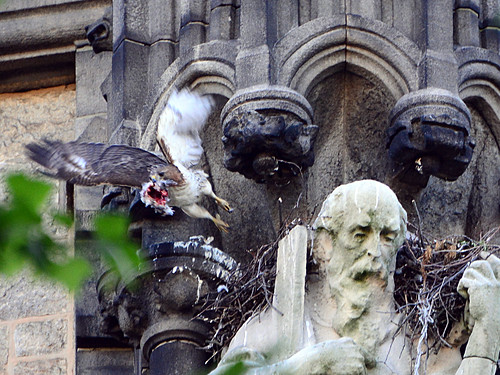 Photo courtesy of http://morningsidehawks.blogspot.com/ Having fed the eyasses Isolde whips off the nest with a partial pigeon. Check out the adventures of Isolde and the New Guy (or is it Norman after all) on Rob's blog, http://morningsidehawks.blogspot.com/
HAPPY HAWKING!!!!
Donegal Browne
| ||
Showing posts with label Osprey. Show all posts
Showing posts with label Osprey. Show all posts
Friday, May 17, 2013
Red-tailed Hawk Nests and Prescribed Burns, Invasive Phragmites, the Mystery Bird, White-crowned Not White Striped? And the Great Osprey Rescue And Isolde at the Cathedral


Sunday, April 26, 2009
Saturday Miscellany-Sutton Eagles, NYBG Great Horned Owl, Blackwater Osprey, and Hilary's Canada Goose Nest Problem

PHOTOGRAPH BY PAT GONZALEZ
Pat is referring below to the photographs of the newly fledged Great Horned Owls in the New York Botanical Gardens posted yesterday. This is Mama Owl looking at Pat look at her newly fledged Owlets.--
Pat said, "I meant to include this photo with the others in my last email. This is the momma owl watching me rather intensely as I photographed her offspring. Her ear tufts are rather flat. Is that a bad thing?"
I answered, "Well as she is looking at you look at her babies, it likely isn't a good thing. In fact I suspect that had you gone a few steps closer to her progeny, she might well have gone for you."
And a Great Horned Owl going after you is no joke. When I was in training, I met two ornithologists who had lost eyes to Great Horns while attempting to band the young on the nest. (I don't remember them wearing hard hats way back when. They've wised up since.) I don't want to scare you, particularly as you've done just fine so far and this Great Horned Owl is undoubtedly somewhat habituated to people being closer then would be normal, or she wouldn't be in the Gardens, but I suggest that you wear a hat from now on.
Supposedly, I was told this anyway, in an Owl attack if you are wearing a hat and the owl goes for you, you grab off the hat and pitch it at the owl. The owl will then go for the hat, sink her talons into it, take off with it, and shred the you-know-what out of it... instead of shredding your head. So you loose a hat, no biggie. Better than the alternative.
And like I said this owl is no doubt much more used to people being around than your usual wild owl who nests in the countryside and sees people infrequently therefore don't make yourself crazy over it. Just a suggestion for a rather far fetched possibility.
Great Horned Owl video also from Pat--
http://www.youtube.com/watch?v=LBcVMzOGF5I&feature=channel_page

Screen Capture Courtesy of Jackie Dover, KJRH TV Tulsa, and
http://www.suttoncenter.org/eaglecam.html
A thunderstorm rolls into the Sutton Bald Eagle territory. Wonderful stuff from Jackie Dover of the Tulsa Hawk Nest Forum--

Jackie, Bville of the Tulsa Hawk Forum
Screen Captures courtesy of Jackie Dover, KJRH TV Tulsa, and
http://www.suttoncenter.org/eaglecam.html
These are screen capture sequences featuring the Sutton Avian Research Center's bald eagles at Sooner Lake, near Stillwater, OK. This nest is on an artificial tower built after the original dead tree site fell down. Here's the live cam link, from which folks can also explore the Center's website. http://www.suttoncenter.org/eaglecam.html
This series of captures is from the evening of April 18. Some nasty storm clouds reached the lake around 8 p.m. One eagle parent flew off the nest, the other immediately calling vigorously after it, it seemed.

The first quickly returned. The rain and frequent lightning lasted at least a half hour.
(Did it occur to anyone else that though it was grand that they put up a substitute nest stand for the pair, as they've made it out of metal, they have contrived for the Eagles to nest on top of one giganto lightning rod?)

Screen Captures courtesy of Jackie Dover, KJRH TV Tulsa, and http://www.suttoncenter.org/eaglecam.html
The parents sheltered the eaglet the entire time, huddling together in the same pose. In all these captures, the birds are revealed only by the lightning flashes, in both the wide and close shots. It was quite the display.

Screen Captures courtesy of Jackie Dover, KJRH TV Tulsa, and http://www.suttoncenter.org/eaglecam.html
I will shortly send you another series of captures at the same nest.
Jackie, Bville of the Tulsa Hawk Forum
Now there is parental protection for you. I suspect that the female is closest to the eaglet and dad is slightly sheltering mom while protecting little eaglet from the storm as well. Good luck Eagles!

Screen capture courtesy of Robin of Illinois and
the Blackwater Osprey Cam.
From Blackwater Watcher and long time blog contributor Robin of Illinois--
Posted on the Blackwater cam site: "We have our first egg of 2009! We could see one or two more, normally coming about three days apart."
(Interesting that a Red-tail usually can create an egg every other day while an Osprey takes 3 days.)
(Interesting that a Red-tail usually can create an egg every other day while an Osprey takes 3 days.)
**************************************************************************
Next up an email from Hilary Sortor, a New York City college student concerned about a possible disturbance to a Canada Goose couple's nest down near Pier 64 on the Hudson--
Hi Donna,
I hope you are well! I met you last year up at the Fifth Avenue nest and you subsequently helped me learn what to look for when watching the red tails nesting at City College.
I haven't seen much of them this year, sadly, although I had a really good look at one of them eating a pigeon in a pocket park on Broadway a couple of weeks back - drew quite a crowd and was subsequently chased off by the pair of kestrels that live in that area.
I continue to enjoy reading your blog and wish there was more time in the day for birds and other creatures... maybe when school is out.
I'm writing because I thought you might know who to contact about this: Pier 64 has been under construction up until three days ago, and is now open to the public. While it was closed, a pair of Canada geese felt it was sufficiently free of humans (and probably more importantly, dogs) to construct a nest on the lawn at the far end of the pier. I did not realize that's what was going on until I walked out there this evening with my dog and saw the female on the nest and the male standing guard (I moved my dog well away as soon as I saw the female wasn't getting up and the light bulb went off in my brain).
Hudson River Conservancy has roped off the area, but it's not much of a buffer - maybe 20-25 feet. The male was surrounded on three sides by people as he tried to keep an eye on everything - I try not to anthropomorphize, but both geese seemed very worried.
There were a lot of people out there this evening with dogs, etc. getting much too close.I'd seen them out there a couple of days ago, but the male was in the water and there weren't any other people around, so I wasn't sure there was a nest until tonight, or I would have contacted you sooner.
My fear is, that area will be packed over the weekend with the good weather, and I don't know how good that will be for the geese.
What can be done? Who should I contact? People around them tonight seemed pretty oblivious to the situation, or hopefully, they would have backed off. If you have any ideas, please let me know.Thanks for any advice you can give, I appreciate it, and enjoy the weekend!
Best,
Hilary
I forwarded Hilary’s email off to Park Ranger Andrew DiSalvo who has been helpful in the past. Though the pier is not within his current area, I’m hoping he will be able to point Hilary and the Geese to the Ranger or Rangers who may be in the Pier 64 area or as an alternative-- in whatever correct direction will help them.
Donegal Browne
I forwarded Hilary’s email off to Park Ranger Andrew DiSalvo who has been helpful in the past. Though the pier is not within his current area, I’m hoping he will be able to point Hilary and the Geese to the Ranger or Rangers who may be in the Pier 64 area or as an alternative-- in whatever correct direction will help them.
Donegal Browne
Subscribe to:
Posts (Atom)