Showing posts sorted by relevance for query charlotte. Sort by date Show all posts

Sunday, March 04, 2012

Are Charlotte and Pale Male Junior Back? Plus the Known Nest History of Junior and Charlotte. And a Favorite Pale Male Copulation Spot

                                                  Photo courtesy of http://www.palemale.com
Charlotte on the nest center and Pale Male Jr. flying off the nest on the Trump Parc building, Central Park South, 2005

                                     
I was told second hand that someone had ID'd the pair building a nest on the Plaza Hotel as that Pale Male Jr. and Charlotte. They are the longtime southern Central Park pair, who were known to have built nests in that territory circa 2002 through 2010.  Others disagree.  


What do I personally think?  I just don't know.  I've not seen them so I can't give a personal opinion. 

 I've gotten in touch with some of their previous chief watchers in hope they'll compare the pair currently in residence with their memories and with photographs of Junior and Charlotte from past years. 


I do hope they are alive.  

Therefore lets look at previous photos of the pair for comparison with the current resident hawks if you see them.

Look above at how extremely dark Charlotte is, with a very heavy belly band.  The "light areas" on her breast are a dark cream color as opposed to a white.  Junior on the other hand is much lighter overall.  His belly band is scant but not as light as Pale Male's is.
xxxxxxxxxxxxxxxxxxxxxxxxxxxxxxxxxxxxxxxxxxxxxxxxxxxxxxxxxxxxxxxxxxxxxxxxxxxxxxxxx


Photograph by Donna Browne
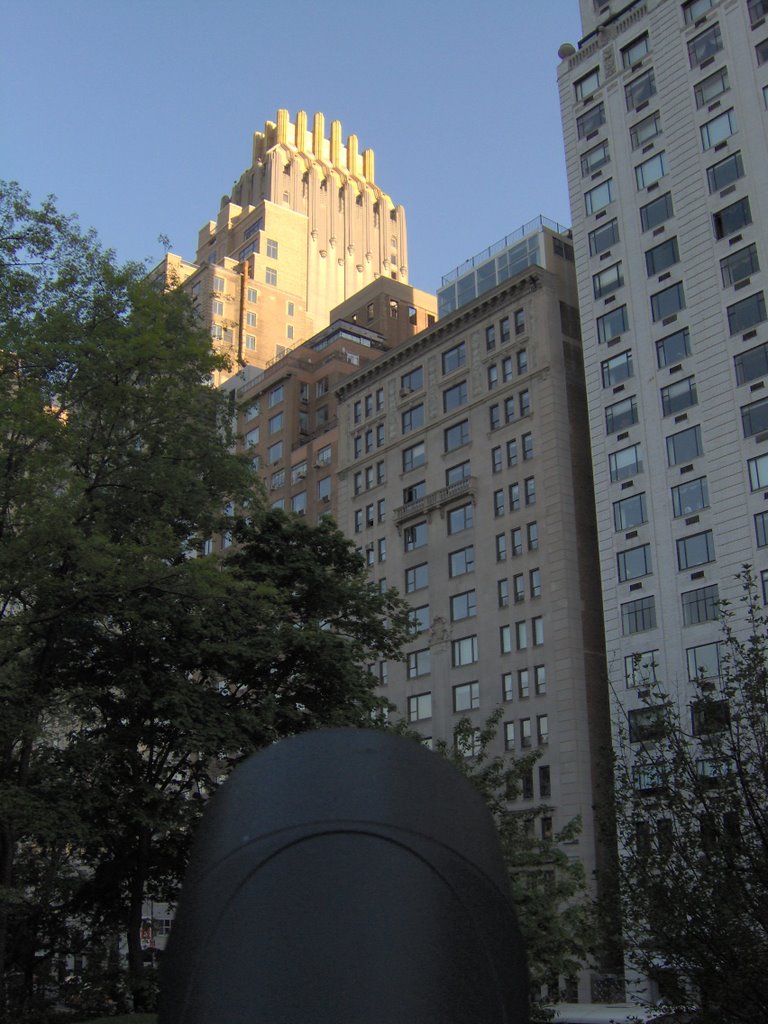
  The building with the gold top is the Trump Parc on Central Park South and the Avenue of the Americas.  The nest pictured at the top was located on the third from the right corbel, in the bottom row of corbels mid-building.

(Many thanks to wonderful author and original hawkwatcher Marie Winn for investigating what that particular architectural feature is called back in 2005.)


After Pale Male and Lola's nest failed in 2005, a neighbor of the Trump Parc contacted Marie Winn and told her she was seeing hawks going back and forth to the Trump.  It had already been reported earlier in the season that once again Junior and Charlotte's eggs had blown away but as hope springs eternal Marie told me about the possibility that something was going on up there after all if I wanted to check it out.


So I packed up my equipment at the Hawk Bench and headed South.  Do keep in mind that back in 2005 Pale Male and Lola were the only successfully nesting hawks in NYC-- that we knew of.  (We've all found each other in the other boroughs and beyond since.)


As you can see from the photograph of the Trump Parc taken from the park, the nest is way way up there and the sight lines are horrible from the ground.  Not to be deterred, I found a high spot in the park with a view, set up my tripod and started to watching...and  watch.  The view was so steep from where I sat that day that if a hawk was sitting the nest or even standing deep she could not be seen.  I keep watching and going on the third hour of nothing I was getting restless and glanced over at a squirrel,  caught myself looking away, got my eye back on the nest just as a HAWK flew in from the south and one took off the other side of the nest and round the building.  It was a nest switch quick as that!

We viewed the nest mostly that year from Little Hill,  the best angle we could find on the ground. (Later there would be spots on roofs and looks out windows.)  No there wasn't a handy bathroom, or a restaurant, or even a bench to sit on that hot summer as there was when we watched Pale Male but after the grief of no hatch at 927 in 2005 after struggling to get Pale Male and Lola's nest spot back for them,  we still could exalt as  many of us saw our first urban eyasses courtesy of  Junior and Charlotte who had overcome their years of tough circumstances and  succeeded. 


Speaking of tough circumstances--a little background about the Trump Parc nest.  

Pale Male Jr. and Charlotte had nested on the corbel for some years before being successful in 2005.  It is a very inhospitable nest site as wind blows the nesting material away as it does the eggs or in wet weather invariably the cold or the wet seemed to kill the eggs.  In 2006 after the first set of eggs blew away, Junior and Charlotte double clutched, a second clutch of eggs was laid.  That summer there was a drought  and the nest was successful.  Big and Little were hatched and fledged beatifully.

At least one of the current pair that has been seen frequenting southern Central Park has been observed in the inset of a window in the top  row of windows nearest the gold roof .


Photograph by Brett Odom, 2008

Pale Male Junior left and Charlotte right


After another failure at the Trump Park Nest in 2006, Junior and Charlotte moved to a air exhaust window ledge nest site at 888 Seventh. Avenue in 2007. (above) The primary problem with this site for the hawks originally was that it did not overlook a green space. 

Therefore on June 13, 2007,  888 was the jumping off point of a famous NYC hawk event, which occurred when Charlotte and Pale Male Jr.'s  eyass Ziggy fledged down into a plaza near the Ziegfield Theatre during morning  rush hour.   Grounded fledglings are a common problem in urban areas,  and Ziggy, like many others of her ilk  couldn't get airborne again. 

 (In natural areas and also at a very few nesting sites in NYC, the newly fledged hawk can climb up into bushes, branch then into small trees, then big trees,  where she is out of danger and then can be easily fed by her parents until she is better flighted.  At a very few nests in the city, the fledged youngsters can actually make their way back to the nest, which is what rural fledglings do normally.)


But back to Ziggy attempting to climb the wall of a building as there was absolutely no helpful vegetation around,  while a crowd gathered around her in the plaza on June.  First off a homeless man picked her up and was about to make off with her when the crowd put the cabash on that activity and Ziggy was placed back on the concrete to wait for some kind of authorities to arrive and deal with her.  


They waited.


Eventually various members of various "authorities" did arrive and a discussion ensued as to exactly which authority actually had the authority to take custody of Ziggy.  I'm told the discussion took awhile.


Eventually, thank goodness,  renowned rehabber Bobby Horvath appeared on the scene and gave Ziggy a look over.  Then whichever "authority" that after discussion was decided to be the authority, decided that Bobby should take Ziggy back home to the Horvaths rehab center in Long Island where she could be observed for possible non-visible injuries and practice flying in a flight cage.

On the 19th Ziggy was taken to Central Park, a Park Ranger,  than kept an eye on her until Charlotte and Junior appeared in response to her begging cries about 24 hours later and began their parental duties as if there had never been a break.
Photograph by Brett Odom 2008

 Now back to how the previous pair looked--                           
This is Charlotte about to place nesting material . Note she is in bright sunlight which tends to brings out the gold in Red-tailed hawk feathers but she still appears very dark. Note the contrast of her "backpack straps" with the rest of her back.

xxxxxxxxxxxxxxxxxxxxxxxxxxxxxxxxxxxxxxxxxxxxxxxxxxxxxxxxxxxxxxxxxxxxxxxxxxxxxxxxxx

Photograph by Brett Odom, 2008

Another look at Pale Male Jr., May, 8, 2008, right.  In this muted light his head appears far lighter than his back.  (Compare the coloring with the photo that heads the blog in which the difference in color between the two isn't as highly contrasted.)  Charlotte is barely visible on the nest center.  Yes Junior flew up to the ledge and managed to get the extremely long piece of bark inside.  It wasn't easy.

If you happen to see the Red-tail pair who frequent the territory below that of Pale Male and Zena in Central Park.  Take a good look.  Could it be Pale Male Jr. and Charlotte?

Photo by Brett Odom--Big beautiful Charlotte in flight.

                                           Charlotte, photo by Brett Odom, 2009
          Note how dark her patagial mark is. That's what the mark is called that appears from her neck, extends and then stops midway on the leading edge of her wing.  And her wrist comma, the dark curved mark starting at the leading edge and curving down  just before getting to her primary fingers.  

And check out that heavy belly band!

As this is the time of year when one can often see the hawks circling and get a good long look, compare the above photo with the larger of two hawks busying themselves around the Plaza Hotel.
Photo of Pale Male Jr by Brett Odom, 2009
 Compare Junior above to Pale Male below.  They do resemble each other in a coloration rare in the city, and the reason that many believe that Junior is the son of Pale Male.  A DNA test of the two birds would be the only way we could know scientifically that he positively was related.

Tristan, the late mate of Isolde, now mated with Storm'n Norman, was called informally Pale Male III and also believed to be a son of Pale Male by many watchers.

 When we get to the history of the Divines and the Cathedral Nest of  the Church of St. John the Divine, we'll talk more about the sweet, endearing,  and very relaxed Tristan.
Photo by Donegal Browne

One of Pale Male's favorite copulation spots, Linda #3.   And one of the places where he and Zena were observed copulating yesterday.

HAPPY HAWKING!
Donegal Browne

P.S.  Also keep in mind concerning the current Central Park South pair- either Junior or Charlotte may have passed and taken a new mate so if one is not an original of the pair it doesn't necessarily discount the other as not still being alive with a new mate.  And don't fail to send in your sightings if get some!

Monday, March 17, 2008

888 Nest Update:Charlotte and Junior Do Bark and Is It Hot in There? Plus What Happened to the Third Egg on the Briarwood Queen's Nest Last Season?


Brett Odom who has the best seat possible for a view of Junior and Charlotte's nest, sent in these wonderful photos. Charlotte has just entered the nest and here comes Junior with a rather large and unwieldy piece of bark. As they came in together, and I've seen female Red-tails strip bark, let it dry and retrieve it for their nest lining, I'm wondering if Charlotte, feeling somewhat hormonal or gravid perhaps, may have "asked" Junior to do the heavy lifting on this one.

Notice Charlotte's tail in the air as she works on the nest. Junior on the other hand is still doing his best to get the bark into the nest. Another instance where Junior tries very hard to "please" Charlotte. A few season's ago when he was doing another task on the Trump Parc nest, Charlotte watched carefully and when he was done, she went up to leave a few feet and then touched beaks with him on her way out. A Red-tail kiss. (Jeff Kollbrunner reports that he has seen Mama and Papa "kiss" as well.)


A zoom closer, in order to check the condition of the bark. See the thin dry strips on the edges? Either they found the perfect piece or it was stripped some days ago and allowed to dry before bringing it to the nest.

Charlotte comes out into the sun and checks the territory. Now I've always wondered if the hawks on this nest might get extremely hot in that recessed compartment out of moving air with the sun streaming through the glass. I'm supposing it comes to mind, as those of you who were around for this pair's double clutch hatch on the Trump Parc in 2005, saw Charlotte and the eyasses do quite a bit of panting under the afternoon's very hot westering sun for many days.
I asked Brett what he thought--
Donna

From what I understand from talking with the management of 888 7th Ave., the floor of the building that the nest is on is a storage floor. There are louvres on the walls of this floor. I wouldn't be surprised if the floor was slightly air-conditioned and some of the cooler air escaped from the louvre slats, cooling off the area of the nest somewhat.
Also, last year, I noted that the eyass would change her position frequently during the day to always stay in the shade. When the sun would move and reposition the shadows, the eyass would move from one area to the next, staying in the shade. The Trump Parc nest obviously had no shade during the afternoon when the sun was in the west. So, I'm not so worried about the parents or eyasses overheating. The nest is very well ventilated.
Brett Odom

That's a relief. And Brett also mentioned that the residue on the windows also helps cut some sun penetration into the nest space. Just another handy use of baby hawk poop.


I also asked Jeff Kollbrunner of http://www.jknaturegallery.com/ if he knew what had happened with Mama and Papa's third egg last season. The other two eggs produced nice strong eyasses and I knew that shells are removed from songbird nests but what happens to an egg that doesn't hatch or remains more or less complete on a hawk nest? ---


Donna,

The third egg may have hatched. I'm not sure, when I saw the egg the eyass's were about four weeks old. The third egg had a small oval shaped hole at the top side about the size of a half dollar. I could not tell if it hatched and died or it didn't hatch and the eyass's broke it open, or maybe the parents. The egg was otherwise intact. Mama picked it up and flew off with it when the eyass's were about a month old.

Jeff
(I do like getting those loose ends tied up.)
Donegal Browne

Friday, May 05, 2006


View of the nest from Little Hill

The Trump Parc, the gold and peach building on Central Park South, just west of Fifth Avenue, hosts the nest of Pale Male Jr. and Charlotte on its west face. Go down from the gold crown on the top, further down past the peach section with it's row of corbels and at the top of the yellow see the second row of corbels. The nest is located on the third corbel from the left.

Little Hill, one of the few places in Central Park where the nest may be viewed, particularly at this time of year with the trees in full leaf, is a knob of rock located just inside the southern wall of the park and across the street from The Hampshire House and The Essex House on Central Park South.

Field Notes 04 May 2006

Sunset- 7:56PM
Temperature- 79 F.
Sunny
Wind 5-10MPH
Humidity- 27%
Moon-1st quarter

All times PM unless otherwise noted.

Charlotte and Pale Male Jr.

4:30 Columbus Circle, the pigeons are agitated. They bank and wheel but I don't see any hawks.

4:34 Still a distance away on Central Park South, I see Charlotte and Jr. circle over The Hampshire House, one RT dives between the Trump Parc and The Hampshire House. The other flies up, there is a member of the genus Falco in the mix, sharp wings and tail, fluid wingbeats, it follows the rising RT.

4:36 Standing on the sidewalk in front of Little Hill, both RTs back in view, one swoops again, wings folded into the same area, between Trump and H.H. Falcon appears. RT above it. Falcon to NE into Central Park. RT follows. Several pigeons sit watching the drama on the railing of Art's roof. Jr.'s pale head flashes in the sun flying S over trees, Charlotte comes from direction of nest.

4:42 Charlotte and Junior begin to circle in front of Trump. One clockwise the other counter clockwise, nearly meeting with each circle. Courtship dance, they continue circling, over CPS, over the Artist's Gate of Central Park, then the trees. One RT folds wings to body, swoops over nest, pulls up.

4:44 Both RTs back to near meeting circles

4:45 One RT lands on metal rod protruding from Hampshire House chimney , NW corner, just below the molding. Charlotte?

4:47 Other RT above chimney flies toward Trump. I can't see and need to get inside the park and to Little Hill, get the scope set up. I run toward the Artist's gate. No RTs apparent from that angle. I turn the corner and start W. Lawn east of Little Hill is fenced off. Both ends of the sidewalk that pass Little Hill are gated off but Little Hill has a large group of people having a picnic on top of it. How did they get there? I can't see the hawks. I can't see anything but trees. I finally find a 20 foot gap in the fence adjacent to the jogging path.

5:05 Junior folds wings dives towards Central Park. Charlotte circles the nest then goes behind The HH then The Essex, continues W.

5:10 Jr. buzzes the nest. Jr. swoops over nest and circles, then continues with several more swoops over nest, goes N to S disappears behind HH. Reappears, circles HH, reappears again, looks to be landing on nest, veers off to the the S. Jr appears circling with talons down.

5:16 Jr. is back swooping over the nest repeatedly, then HH.

5:19 Both Red-tails in near meeting circles, over nest, over street, over Little Hill, then Jr. to HH Chimney rod, alert, preens mid-back, alert to Gapstow Bridge area.

5:22 Jr. is off and up, folds wings, swoops over top of Trump, then to 58th, Charlotte follows.

5:26 Jr. to front edge of nest, facing S, right wing out, "mantles" edge of nest. Wind lifts wing, up, down, alert, facing out, then looks at nest bowl, wing gets higher, higher, focusing on bowl of nest, wing down but still spread, looks out.

5:30 Jr. looks into bowl, walks center, half sits, fluffs, tail to HH, head to wall, head still completely visible. Keeps looking over right shoulder, settles, wing tips and tail tip visible.

5:32 The Cooper Union student picnic is over and they've disappeared as has Jr.

5:45 Art's railing is bare. Aha, two pigeons copulate on top HH railing. House Sparrows attempt to crunch and eat the egg shells left by the students. Calcium supplement? Chipping Sparrow appears on the lawn a few feet away, knoshing on grass that's gone to seed.

6:00 Flock of Starlings begins it's through foraging march across the lawn. Jr. still on the nest. Charlotte?

6:25 The same.

Time to check on Ben Cacace and the GM Peregrines.
(I'm told I've been remiss in not introducing Ben a bit better. So here goes. Not only has Ben watched the peregrines for 10 years, he's one of the original 5th Ave. Hawkwatchers, one of the most respected observers in Central Park, an utter computer whiz, and lest we forget, a great guy who is generous with his hard won knowledge of raptors, his expertise in myriad other areas, and with his photographs. Besides he ALWAYS has the absolute correct time.)

6:50 The female Peregrine, Mrs. P. is perched on the GM building, three windows east of the NW corner...GM NW 3, posterior to viewers.

6:55 She preens.

6:56 She stretches wings, preens back, toes curled around railing.

7:03 Preens left wing. (The edges of the first few GM windows from the W corner, do a little "Stonehenge" effect each evening. Lighting and darkening with the angle of the sun.) The light begins to touch GM NW 3.

7:05 Mrs. P is very still, looking down.

7:38 Mrs P does a full body stretch, first on one leg and then the other. She's up flies east and then lands GM NW 5. (nest switch area) She faces in, listening, looking. She jumps down from railing out of sight. Mr's P's head appears between far left railing upright in 5, and the E wall of 5. He drops out of sight. He flies to GM NE 5 , facing wall.

7:43 Turned out, he defecates.

7:44 Mr. P one foot up.

7:48 He preens.

8:10 Still there, foot up.

8:18 Still there.

8:24 Gone!

8:25 Civil Twilight. Ben spots him. Mr. P is perched on the top edge of furthest E top window on the north face of Nine West.

8:30 Difficult to see but there.

8:37 Still there.

EXIT

(I'm also remiss in not noting the addresses of the buildings mentioned. They're coming.)

Friday, March 21, 2008

Red-tailed Urban Nests-Scant Ones In Particular


Photo: D. Browne
Charlotte on the Trump Parc Nest-June 10, 2005
Note the depth and distribution of the nesting material.


Photo D. Browne


Night Falls: Charlotte on the Trump Park nest. June 14, 2005

Twigs had fallen from this side of the nest and we thought the "noodle" may have been added in an attempt to keep the twigs on. Now keep in mind this nest site had been used for at least three season and it didn't get larger it often seemed to get smaller until there was enough eyass feces to stick it down a bit better.


See the top of Big's head just past the item that looks very much like a kid's swimming pool noodle. (In order to use shorthand for the eyasses and minimize superflous words and typing , the largest eyass was named Big and the smallest Little.) Earlier they were Likes Rain and Doesn't Like Rain....too long and clumsy though originally funny

After reading John Brakeman's previous post that included some thoughts on the young hawks nesting on the air conditioner at PS 188, Brett Odom, who keenly watches Charlotte and Jr., emailed his thoughts on shallow nests and young hawks.


Donna,


I read your post from March 17 and noted where John Blakeman discusses the shallowness of the PS 188 nest and equates that with the youth and inexperience of the PS 188 pair and could be problematic in raising a successful brood.

While I certainly do not argue that the PS 188 pair is both young and inexperienced and their shallow nest which is built on an air conditioner cover could pose incubation problems, I would like to point out that Charlotte and Junior’s first nest at the 7th Ave. location was also incredibly shallow and the bowl of the nest possibly had some exposure to the foundation that the nest was built upon.

I say last year because this year they have added more nesting material and it is a slightly larger and deeper nest. However, because of its location behind a dirty window, it is very difficult to see exactly what shape the nest was in, even with binoculars and a spotting scope.


The most significant difference I see between the 7th Ave. nest and some of the other photographed nests around the City is that the 7th Ave. nest is not built on top of a foundation with obstructions (e.g. pigeon spikes) or material made of an open network (e.g., tree branches, metal mesh or grill work). Instead, it is built on a solid metal ledge. I would not be surprised if Junior and Charlotte?s nest last year was more donut shaped with very little "floor" since there was no fear of eggs dropping through the bottom of the nest or windy updrafts that would interfere with incubation.

Instead, the pair appeared to be more concerned with building high nest walls to keep any eggs from rolling away. Most of the other City nests, with a few exceptions, are either built in a tree, on some kind of open man made material or on top of pigeon spikes. Pale Male and Lola's nest had the unfortunate experience in the past few years of being built on top of metal mesh, open grill work and pigeon spikes (let's hope that with the removal of the pigeon spikes the nest will be successful this season).

All of these nests would require much more substantial and deeper nests to allow for proper incubation and allow for the required egg rolling by the adults without obstructions or eggs dropping through the nest bowl. I would think that at least with regard to Junior and Charlotte, last Year’s shallow nest was a product of 1) it being a first year nest, and 2) the location since it not only sits on top of a solid foundation which prevents windy updrafts that could interfere with proper incubation,it is also behind glass which protects it from wind and other natural elements. So, at least in this instance, I do not think that a shallow nest necessarily equated with inexperienced parents or posed a problem with successful incubation and hatching.

As most of New York City knows, thanks to covers on the NY Daily News and New York Post, Junior and Charlotte successfully raised a very capable red-tailed hawk fledgling last year.

Sincerely,

Brett B. Odom


Brett,


I sent your email on to John Blakeman and no doubt we'll have his thoughts on your thoughts soon. But in the meantime your step by step breakdown, made me think of a few things as well.
We've discussed in the past that perhaps a very firm foundation for a nest, such as the carriage on PM and L's nest, might fool the hawks into thinking they have enough material when perhaps they don't. Charlotte and Jr. had a firm foundation on the Trump Parc but it's hard to tell if it affected how much material was brought to the nest, because without a perimeter of pigeons spikes, almost all of their nesting material blew off every year.


Without the nesting material to raise the eggs up a certain amount I've always believed that the eggs tended to "drown" during intense periods of rain, then as the sides of the nest had blown away, the eggs being no longer alive lost weight and blew out as well. Or didn't drown, though I think water had something to do with it, (perhaps the subsequent chill with contact with the masonry, as their only successful hatch on the Trump occurred during the second clutch, warmer weather , and a drought, no water.)


It is very interesting to me that when they failed yet again and went looking for other digs, they chose a site in which there is very little wind. In fact they are doing something that I never thought that a Red-tail would do. They are virtually nesting in a box. I think that is a first. I know of no other RTs that have nested in a box but we don think that Jr. us urban born so more prone to creativity. It also shows that as C and J are building the sides of the nest high (as PM and L did yearly but not the bowl where their problem was perhaps coming from, because they were conceivably fooled by it's stability) they'd most likely wanted to build high sides but the material blew away, or fell off. Now they may have figured out that high sides keep eggs from rolling out so they aren't making that mistake again. Also note wind was a terrible problem for them..


They now have a virtually windless enclosure. Their initial criteria is definitely changed. No longer do they feel the need to be so far from people, nor so close to the park. In consequence they have far less wind to contend with and according to Brett far fewer neighbouring raptors at least for the moment. Jr. has done a number of observed firsts such as roosting on a building for the night as opposed to always roosting in a tree as the other urban RTs seem always to do at least so far. now he and Charlotte have gone and done it another first. And as always as other birds see it work they will follow suite.


But I still can not get over the fact that Junior and Charlotte are really and truly nesting in a box. They cannot survey a good bit of their territory without getting up, going to the door and sticking their heads out. I never thought I"d see the day.


P.S. One more thought on the AC nest, it has no perimeter of pigeon spikes, and therefore it may not be scant trips with twigs on the young parent's park it may be the twigs won't stay on. There were a pair of young hawks some years ago who repeatedly attempted to us air conditioning units and they could never get the nest to cling to the unit... no spikes, decorations, or protrusions to hold the nest together. Maybe that's how to help make nesting sites for RTs. Put perimeters of Pigeons spikes on large AC units. :-) Particularly if you see them attempting to use one.

P.P.S Rob from Bloomingdale Village and I were talking that in order not to have to call Isolde's new mate, Cathedral Mature Male just like Tristan her previous mate was called Cathedral Mature Male, which makes the whole thing generic and not specific, clarity after all being what science is about, forget just plain old communication, the new mate should have a name. We'd been calling him new mate, new guy, whatever but for brevity sake, we're looking for suggestions. You can either place your choice in the comments section her or got to the Bloomingdale Village link on the link bar and put your choice int he comment section there. Personally I like names that relate to physical characteristics or to behavioral attributes.

Tristan was a stealth hunter. He was extremely patient, standing around relaxed, one foot up waiting for game to come by. The new guy on the other hand is Mr. Energy. He whips around flushes pigeons in explosive clouds were ever he goes. I thought of Nitro, explosive but a bit too chemical. Currently I'm thinking about Flash or as he's Mr. Speedy there is Dash....
His penchant for squirrel--Squirrel Bane--too long. I did see him do something I'd not seen before. Most RT dispatch their prey with a squeeze of the talons or if young, hop up and down on it while holding it it both talons. The new male had caught a rat, it moved and instead of squeezing or doing the jump up and down bamming thing, he used one taloned foot and bopped it against the side of the tree trunk. Very unraptor like. Rather startling and unique actually. How about Bopper?

Donegal Browne

Tuesday, October 26, 2010

WARNING This Post May Be A Bit Graphic for Some: No It Isn't Charlotte But We Were Concerned There For Awhile


Photo by Brett Odom
Last week I got a phone message from Brett Odom saying that there was something of concern and I should give him a call.

Gulp.

Last time we'd been in touch a pair of Peregrines were making themselves at home on the previous site of Charlotte and Pale Male Jr.'s nest. This was rather worrisome because as we know, Peregrines are one of the few creatures that can take out a Red-tail in a New York minute.

Ordinarily at this time of year, Pale Male Jr. is off on his annual vacation so we also knew it was likely that if Charlotte was going to defend that particular piece of turf the Peregrines kept sitting on, she'd be doing it by herself.

Double gulp.

Then Brett emailed me the above photograph. Could that be Charlotte? Note the carcass has no visible feet nor can we see a beak, but the coloring did look kind of like Charlotte. What if we're only seeing her bottom half below the belly band? She's a very dark bird with a very dark belly band. Now granted the carcass looks pretty small for a Red-tail, but also note that most of the feet and legs are missing, the tail and wing tips are missing.

The head is there, lying in the dark and unfortunately due to angle we can't see the whole beak to tell if it's curved or not. And what if most of the breast is missing and it's folded back onto itself would that foreshorten the effect and slew our size perception?

Could all the missing bits just be making it appear smaller than we're used to?

Well...maybe?


Photo by Brett Odom
Then Brett got this photo with one of the Peregrines included for size perspective. The carcass does look very small for a hawk. A large Peregrine and a small Red-tail are the same length. Charlotte is not a small Red-tail. Charlotte is a big girl. But what about the possible illusion we might be getting because of the missing bits?

But it does look small so how about we attempt to figure out what other species it might be. I thumb through my Peterson's Field Guide to Eastern Birds, over and over again. Nothing really fits. I keep thumbing.

A Willow Ptarmigan? Shouldn't be here, it would have to be very very lost. Keep thumbing.

A feral pigeon? Well, feral pigeons only have certain color morphs and that isn't one of them, unless there is one I missed. But I've seen a lot of feral pigeons

The whole time Brett and I are asking each other things like, why did they eat the feet and strip feathers and not really eat the usual parts? No tail to be seen, primaries appear gone from the right side wing. But then again if that's the case, where did the feathers go? Whole days are passing.

Why doesn't the carcass appear to have been noshed on beyond those unusual parts mentioned? Was it poisoned and the Peregrine can tell and that's why she isn't eating it?

In the meantime, I send the photos to John Blakeman, who beyond his thoughts on the physical discrepancies of size and all, he stated that no self respecting Red-tail would let herself get caught by a Peregrine on a ledge like that--which was heartening.

But well, we all make mistakes.

We need something definitive.

I ask Brett if it's possible for him to get a photo from a higher angle so we can see the beak and whether the breast is missing and the skin folded over on itself. The light has been terrible. New York City is having completely overcast days.

Here comes the weekend, and I get a text from Brett. New photos. Much better light and a higher angle. It's not Charlotte! Yea!!!! Boy do I feel better.

But then again. WHAT is it then?

Next from Brett, surprise, surprise--Now there are TWO of whatever up there.


Photo by Brett Odom

Okay, Peregrines do cache food, but the first carcass has been up there quite awhile. And whatever species it is, all I can think, is that it must be easy to catch but doesn't appear to be very tasty as they are just letting it lay there.

Speaking of what species, it's driving me crazy. I zoom in and the second carcass appears to have a white scalloped edged tail, rather like a Mourning Dove. But not Mourning doves as the color is all wrong, unless the color balance is off. No. A Mourning dove's belly is much closer of a color than these are. But because of the tail, perhaps something similar? Or not. After looking again at the tail, perhaps I'm just looking at bright sun on feathers causing glare.

What's your take?

Donegal Browne

Wednesday, March 31, 2010

1 Fifth, and Junior and Charlotte Updates, Portmann Pix, and Red-tails With a Definite Ax to Grind (What IS Going On Here?)


From Francois Portmann, another memory-- Athena coming out of the East River after a bath.


Photo by Zach Lemle
From Zach Lemle, who keeps an eye on the 1 Fifth Hawks--

It's got a half a squirrel or bird in it's talons... early dinner I guess.

Zach, could that be Archie making a delivery to Whitney?


And an update from Brett Odom, chief watcher of Pale Male Jr. and Charlotte, the Southern Central Park Hawks-


Hey Donna. I just wanted to provide you with an update of Charlotte and Jr. Unfortunately, I am unable to provide any conclusive evidence today of an egg or even brooding behavior, but I can relay the following:

For the past 6 days I have not seen either Charlotte or Jr. However, this morning when I walked into my office I saw Jr. just as he landed on the nest ledge. He walked behind the glass and when I looked through my binoculars I could tell that Charlotte was also behind the glass standing up on the nest. Jr. then walked out from behind the glass and flew off. I continued watching Charlotte and I could tell that she was engaged in eating motions. She was definitely pulling the flesh off of something and eating it. Junior must have just brought her a meal.


Now, I am not sure if Charlotte had been on the nest all this time or perhaps she showed up just a few moments before Jr. and before I arrived in my office. While she was eating I had to leave my office and when I returned I could no longer determine if Charlotte was still behind the glass on the nest.


Perhaps it is good news that I have not seen Charlotte for 6 days soaring above CP or sitting on the Essex House sign. Maybe this means she has been sitting on the nest all those days and I just cannot see through all the dirt and the grime on the window to see her outline. Also, she could be sitting behind the afore mentioned plastic bag which has further decreased visibility through the glass.

Regards,
Brett


Photo by Francois Portmann
http://www.fotoportmann.com/birdblog/
More bad raptor news from Francois Portmann, it appears that the Great Horned Owl nest in the NYBG has failed. Visit his site for some cheer including the above Mallard hen plus the relaxing seal.


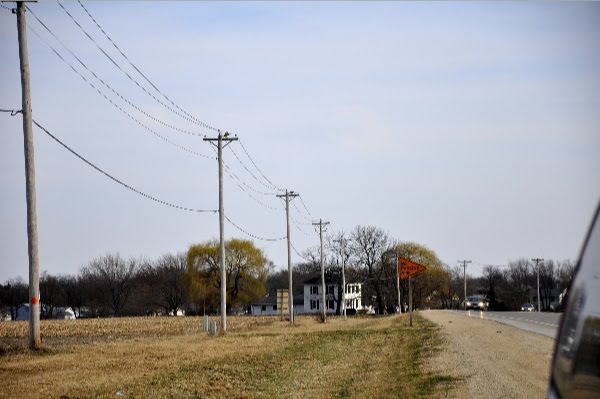
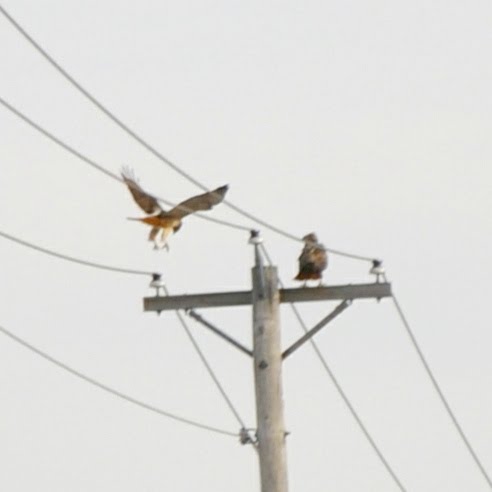
This is the post I was working on when the news arrived about Athena. I'd been out driving from one body of water to another looking for migrating water fowl when suddenly I saw a pale Red-tail sitting atop a power pole. 99% of the time stopping and attempting to get a photo of one of these power pole hunters is an act of futility. The minute I pull the scope out of the car, they hot wing it out of there so I wasn't holding out much hope...

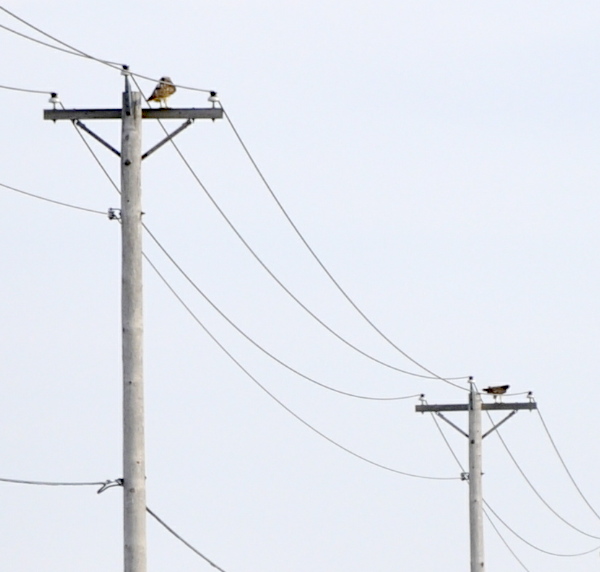
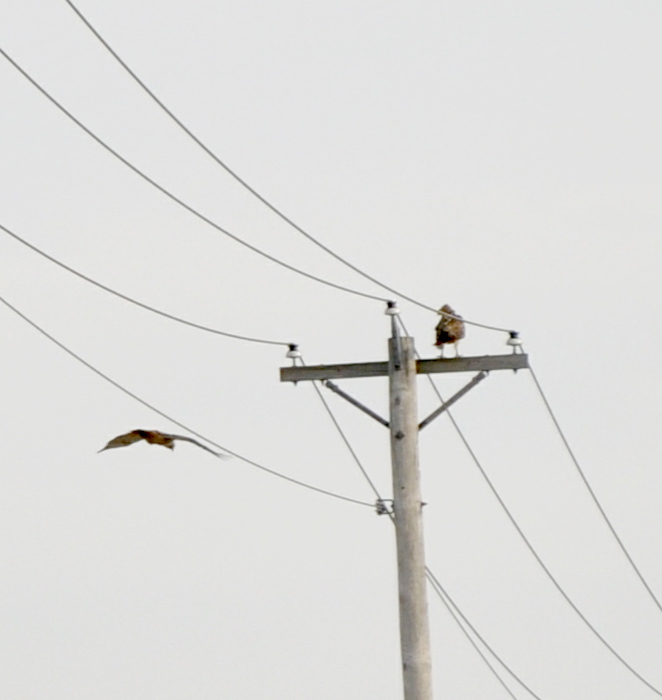
Following my best procedure so far, I pulled past the bird a good way as opposed to stopping before going past the hawk. I left the motor running and the radio playing. I then took the above photo before pulling the scope out to digiscope. Wow. The hawk is still there. Though you'll note something if you look carefully that I didn't see at the time.

There are actually two Red-tailed Hawks sitting on poles next to each other. This rarely to never happens even with bonded pairs.

I pulled the scope out, put the camera on, focused, and big WOW, the hawk hadn't even looked at me yet. What's the distraction that is making me so unimportant?


Okay, that's it. I'm getting the look. But no. It's then I notice another Red-tail make a couple of very short passes over this one. There is a high wind by the way. An attempt to copulate but the wind is buffeting the hawk so he can't get into position?


As it turns out that would be a big NO!


Because when Two lands he goes into a very aggressive posture. One appears to be ignoring Two. Or the hawk version of ignoring anyway.


Because when One turns his head, suddenly his head feathers have taken on a distinctive puffed "hairdo", his hackles are raised so high.


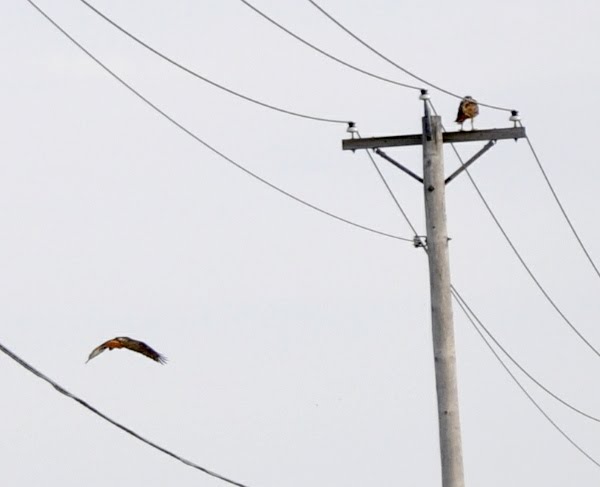
Interestingly, Two then takes off...

...and goes back to his previous perch on the other pole.


Then Two comes off that perch again and does some more passes at One.

One either raises his hackles and stares or pretends not to notice Two.


Oddly...

...Two then flies down and perches directly below One.

One appears to lean over and watch Two who appears to he watching for prey.

Two goes back to his original perch. ???

One appears to take a moment to look at me.

Two takes off his perch and screams the famous KHEEEeeee, trademark call, while passing below One.

Still screaming, he starts to circle back gaining altitude.


Here Two comes, One is still giving him his back.

More back.

One gives a look.

Closer.

And then BAM, contact.

One is knocked off the perch.


Back he comes.

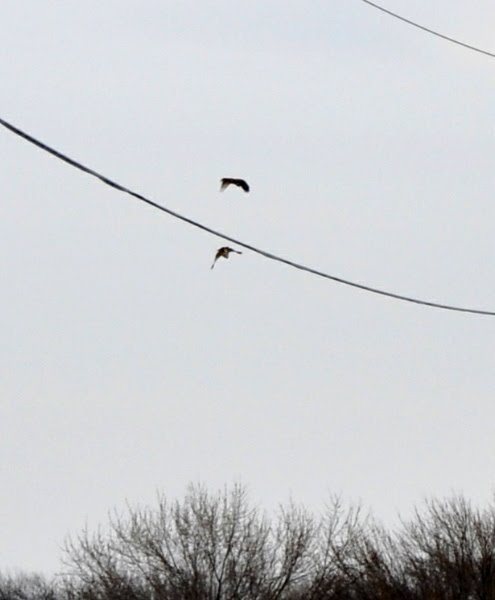
BAM! More fisticuffs. I've never seen this much contact in the city, ever.


Two comes off the perch. Note One passing the left pole.


CONTACT!!!

By this point I've lost track of who is whom.
(Somehow I skipped a photo right here, the bird heading for the top of the pole, I think One, perches and then comes off the pole like a bullet after the other hawk.)


Then back to jockeying for position.


Is a tail feather being pulled out?


More screaming.


Continue down to Park 2 below in the next post.