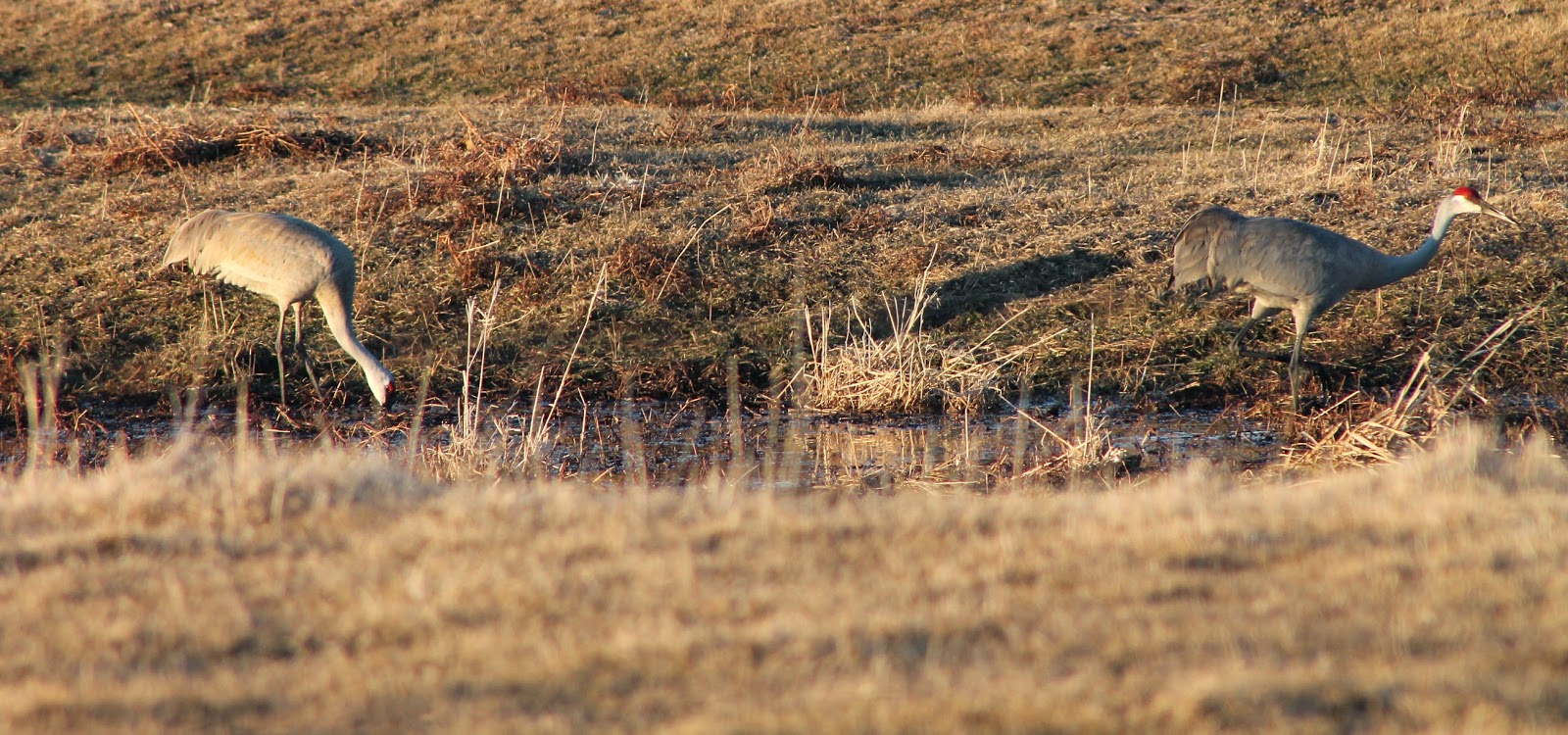
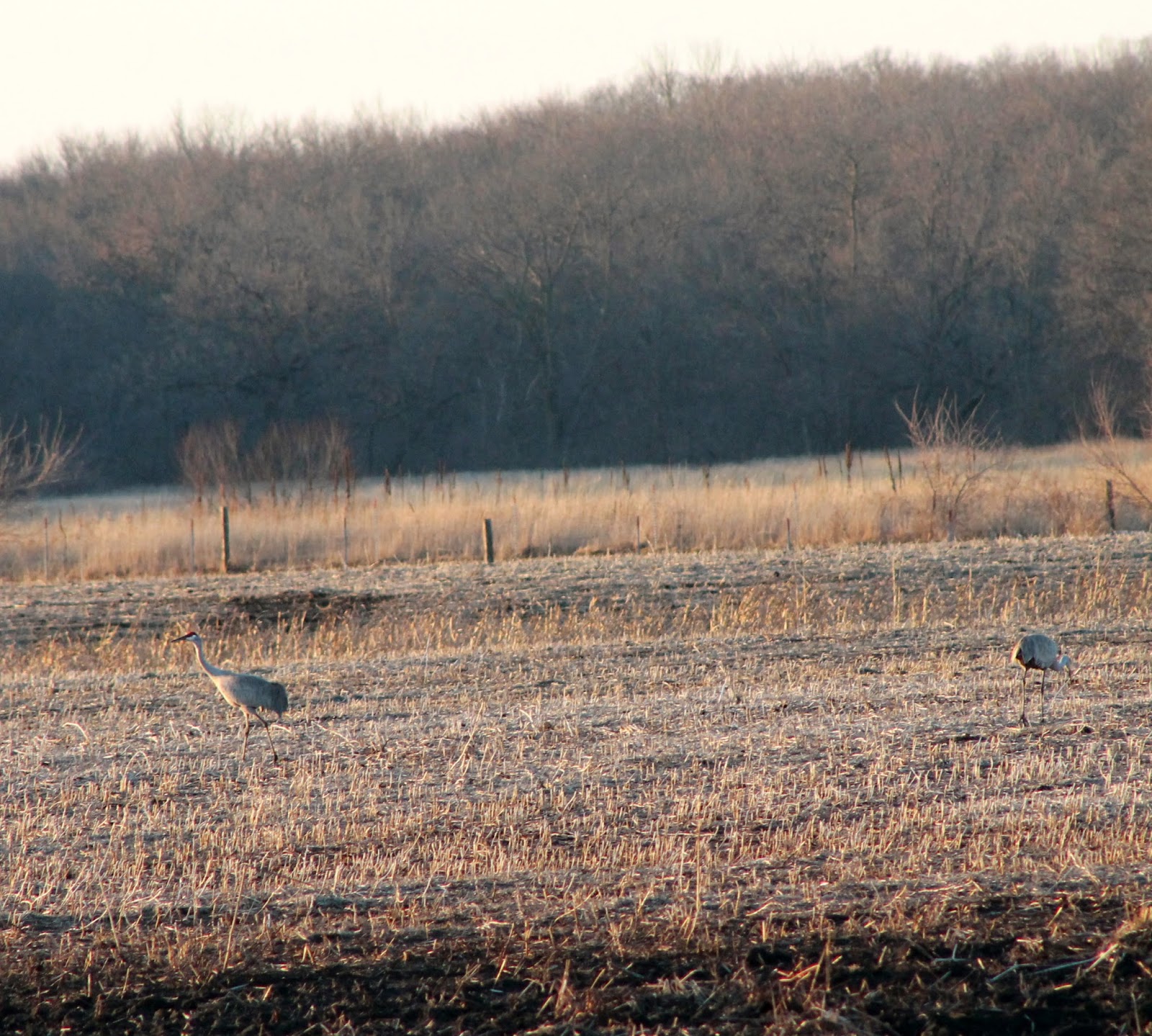
Sandhill Crane Emily, right, and Alfred, left, are foraging in the mud, in the same field in which we last saw them. This may bode well for a possible nest in the area.
The pair continues to poke their beaks into the creek and the mud along the sides for seeds and other goodies.
Sandhills are omnivores though in some regions they are mainly herbaceous and may augment their native food diet with cultivated waste corn, sorghum, and wheat.
Northern Cranes and those hard on breeding tend toward a more varied diet which includes small mammals, berries, insects, snails, reptiles, and amphibians.
Alfred notices me. Drat!
And the pair begins heading away while keeping an eye on me.
DRAT!
Vigilant stances. Then cars come from both ways and both Cranes take to their wings while I'm attempting to get the car further off the road.
They don't go far, just into the cornfield further down the road.
That's when I see the Canada Goose pair. Ah, could these be the pair from yesterday who were crowding the Cranes? Interesting. The Gander gives me a look.
And off they go as well. And that leaves an empty pasture. Off I go to see if Arthur and Guinevere the Red-tailed Hawk pair are sitting their nest yet. They are the Red-tailed Hawks we found perched in the dead tree with the rodent with a short tail.
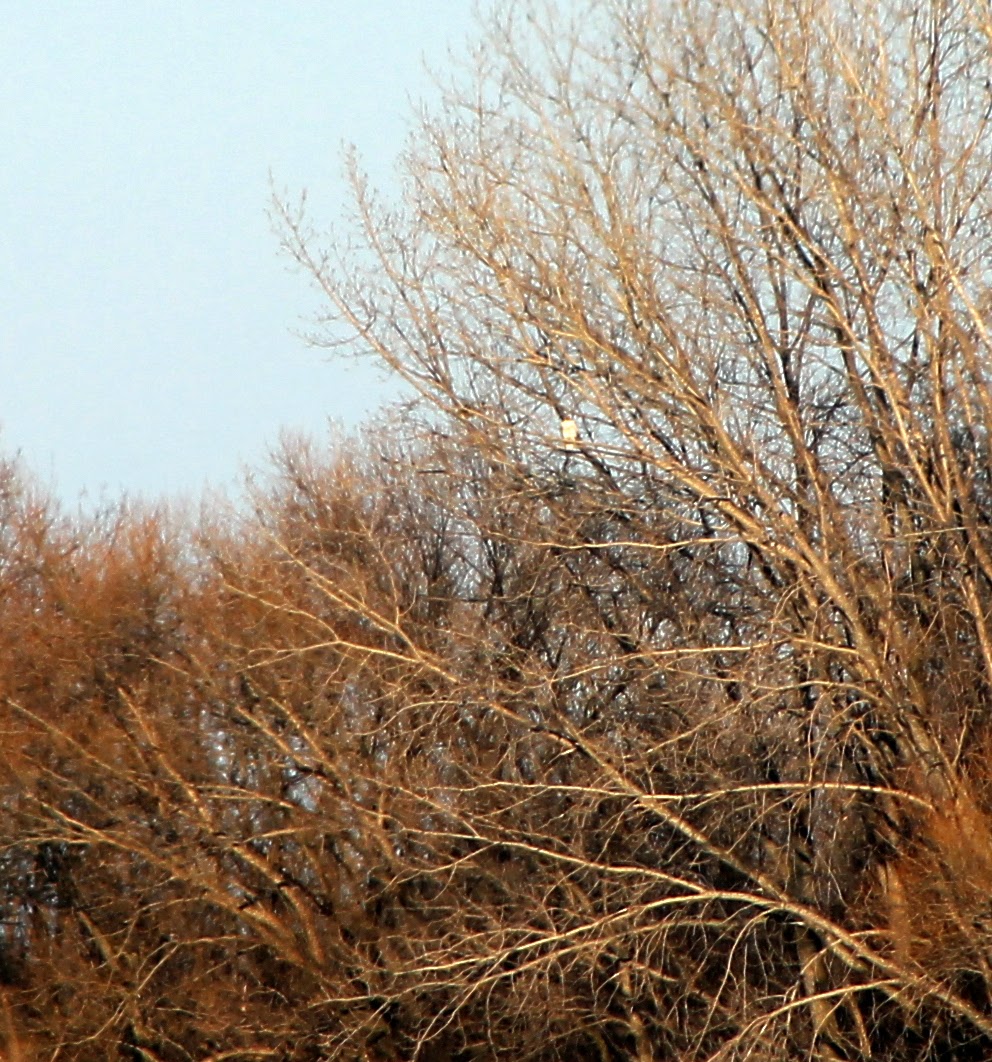
No sign of Arthur or Guinevere other then their somewhat bough obscured nest, left of center mid photo.
It is that expectant time of year after all. The waiting time. The time when all strain for the sound of pipping and the cracking of eggs.
Two posts today, so keep scrolling down if you haven't seen the post on the Teneke Bald Eagle Nest and that of the Gough Red-tailed Hawks.
Happy Hawking!
Donegal Browne
The Teneke Bald Eagle Nest which technically isn't in this particular fence row though it looks like it might be. It is actually located in a marshy area at some short distance from the fence row which borders this field.
This is the Eagle nest I found last season and asked for permission of the land owner to cross part way into said private land through the marsh on the other side. I suggested that side beyond it would be closer to come from the other side but also so there was absolutely no way I'd damage any crops in case he thought I couldn't recognize a corn stalk. I was refused. Sigh.
Therefore I'll do what I can. There is a creek that runs into the area with access from the road. In Wisconsin all waterways are public access. Therefore if I can come up with some kind of very flat boat that might make it up the shallow creek, I might be able to get a little closer later in the season.
In the meantime, I want to see if the Eagles are actually using the nest and if there is an Eagle sitting on some eggs up there.
A mid-range crop. No bird noticeable yet.
And an even closer crop of a long range photo. Yes! See the top curve of the white head? It is on the left side of the bowl. So they are using this nest, they've laid, and are sitting!
Next up a look at the Gough Red-tail nest which is not far down the fence row. As raptor expert John Blakeman suggested, Bald Eagle and Red-tail Hawk territories sometimes overlap.
The Gough Red-tailed Hawk Nest, without any trace of a sitting Red-tail.
Then I traveled further down the fence row looking for hawks.
Aha! See the hawk near the top of the tree?
I'd say this was the female. Did you notice the chubby look and a kind of heaviness? As longtime Pale Male watcher Stella Hamilton would say, "That hawk looks eggnant!"
It won't be long now. Possibly even tomorrow, they'll start sitting if the formel's look is any clue.
Onward.
I'd followed the tree line down to the corner and turned right. Their is a grayish spot in the tree that doesn't look quite tree-ish. I stop and scan the trees with the long lens on the camera.
See him center? That's the tiercel from the Gough nest.
He appears to be hunting.
Then he turns his head maintaining eye contact with the formel in her tree near the corner of the intersecting treeline.
Back into the car to hit three more spots before sunset.
I head for the territory of the two pale belly band-less Red-tailed Hawks. I can't find them. Running out of time.
Next on the list, Alfred and Emily Sandhill Crane.
Therefore, I'm posting this and check back if you didn't see a Sandhill post before you saw this one.
Got it?
Good!
Happy Hawking!
D.B.
Photograph by Francois Portmann http://fotoportmann.com/birds/
For those of you who have neglected going over to the Link Referral column on the right, and clicking on Francois Portmann's Photographs, you have been missing some absolutely spectacular work.
And now Francois has the feature photo spread in the March-April issue of Audubon Magazine and he is brilliant.
Photograph by Francois Portmann http://fotoportmann.com/birds/
See what I mean?
Exactly!
And it isn't just his proficiency with a camera, which of course he has, it is catching the bird moment as well as, in this spread's case the juxtaposition of Breezy Point, the urban environment across the way, and birds from the Arctic. It's art in a major way.
So go ahead. Check it out. We'll wait.
Click on Francois's link first-- http://fotoportmann.com/birds/, and then click on the link to Audubon Magazine where you'll get a sort of multi-media version of his photographs in the spread when you click on Gallery.
If for some reason that doesn't work for you, here is the link for the magazine and the article by Scott Wiedenthal. Once you get there scroll down the article a couple paragraphs and click on "Gallery, more images of snowy owls..."
http://www.audubonmagazine.org/articles/birds/so-many-snowies-study-scientists-are-discovering-how-little-we-know-about-bird
Honest, we really will wait for you to get back. It's worth it. Trust me.
Remember Emily and Alfred, the Sandhill Cranes featured on yesterday's blog?
(I know, I know, they weren't Emily and Alfred yesterday, but suddenly today I know their names.... my whimsy must have clicked in. What can I tell you?)
Well if you look particularly at Alfred, the crane in the rear, also look at his rear. Instead of being completely gray back there as all the field guides tell you he should be, he has rusty brown feathers on his back and also the lower part of his neck. This is quite common.
Hmmm. Why might that be?
Wait.
Next check out Emily's beak. After you left her yesterday, she leaned down and foraged around just into the water in the mud. See the glob of mud sticking to the tip of her beak?
The mud will be relevant in a minute.
The reason that many Sandhills have this rusty brown tinge on some of their feathers is because their feathers have actual rust on them.
How did they get rust on themselves? You might well ask as they aren't prone to snuggling with old rust bucket cars in scrap yards.
Well, in any number of places in which Sandhill Cranes spend their time, the soil has iron oxide in it. Therefore they forage around, get some mud stuck on their beaks like Emily and then preen...Ta Da! Rust colored feathers.
And their feathers will remain that color until they molt out and new ones come in. Who knew?
And speaking of odd tidbits about Sandhill Cranes, the next one is in relation to Canada Geese.
You'll remember how Emily turned around and appeared to be yelling at the Goose who was so close to her?
There are Canada Geese who are imprinted on Sandhill Cranes because they were raised by Sandhill Cranes and therefore want Sandhill Cranes for mates. (Not the case here as eventually that goose went off with another goose. More likely the geese were having some kind of territorial issue.)
At any rate, how do geese end up imprinting on Cranes in the first place?
Well you might ask.
For whatever obscure reason, every now and again a goose will lay an egg in a Crane nest. This would happen after the Crane nest had been built but was unattended as no crane eggs had yet been laid.
The Cranes are off doing Crane business, a goose passes by the empty nest and lays an egg in it. The Cranes come back, and don't seem to be bothered by this as they brood the goose egg along with their own after they lay them and also parent the gosling.
Precocial young like goslings, imprint on their parents directly after hatching, and if the "parent" happens to be a Sandhill Crane, they grow up learning to dance and attempting to seduce Sandhill Crane colts into being their mates, as well as migrating with flocks of Sandhills.
Fascinating isn't it?
Now go watch some birds, you just never know what you might see.
Donegal Browne