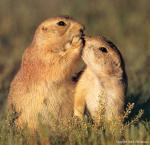
Just how smart animals are, how capable of interspecies communication, and what's wired in and what's not, are constant topics amongst the open minded observers in Central Park.
Below find lessons in never underestimating of what they may be capable.
Prairie Dog Communicationand Dr. Con Slobodchikoff
“Basically, prairie dogs are a universal lunch item. Everybody likes to feed on prairie dogs,” says animal behaviorist Con Slobodchikoff of Northern Arizona University. And the prairie dogs know that. When a predator approaches they emit a series of warning chirps.
Talking Prairie DogsPrairie dogs can talk. At least that’s the startling conclusion reached by Slobodchikoff.
His research flies in the face of conventional scientific thinking on the subject of animal intelligence.
He maintains that prairie dogs can convey complex information through a language more sophisticated than that of any animal ever studied.
Slobodchikoff has documented more than 100 prairie dog words all revolving around the same subject: predators. From his observation tower on the edge of a prairie dog colony outside Flagstaff, Slobodchikoff operates a directional microphone, a tape recorder and a video camera. From this vantage point, he can spot intruders, such as hawks, cats, dogs, and men and record the alarm calls these potential threats trigger in the prairie dogs.
“Each time we do experiments I’m surprised because each time even I don’t think these animals have the capabilities that our experiments show them to have,” says Slobodchikoff.
Back at his lab he digitizes his audio field tape into sonograms which show what each alarm call “looks” like, complete with adjectives.
The professor has discovered that prairie dogs use adjectives to differentiate objects. For example, they can describe the color of clothes on a human and whether he is tall or short. They can also describe how fast a man is moving or whether he is carrying a gun. And there’s evidence that the animals can remember that specific person for up to two months.
Each prairie dog colony appears to have its own dialect, much like New Yorkers sound different from Southerners. But researchers believe the basic language is the same. That is, a prairie dog from Arizona could talk to a prairie dog from New Mexico.
Animals vs. HumansDespite the documentation, the notion that the lowly prairie dog could have such a complex communication system is still met with some skepticism. Slobodchikoff explains that some people don’t believe animals are capable of cognitive functions.
Renowned biologist Jane Goodall knows something about that prejudice.“Every time some new discovery appears, there is an instant hostile reaction, not necessarily from the scientists but also from religious people in some cases,” says Goodall.
“There is a real strong need in the minds of many people to keep that line sharp between humans on the one hand and the rest of the animal kingdom on the other. I think the chimp, more than anything else, has helped to blur that line.”
Goodall’s work with the chimpanzee documented cognitive and emotional capabilities in that primate. But the idea that chimps could actually think and feel met with initial resistance. For example, when she used human pronouns to describe chimpanzee behavior.
“The first paper I wrote for “Nature,” the scientific periodical, they actually crossed out where I put “he and she and who,” and put “it” which, I thought, this is crazy. So we have come a long way since then.
Prejudice About Rodents But the prairie dog still has an image problem. This is no primate, with humanlike expressions. This is a lowly rodent.
“The prejudice is that lowly rodents have to be by definition fairly stupid. Therefore what I’m finding must be a mistake in the minds of at least some people,” says Slobodchikoff.
Not everyone who deals with prairie dogs is interested in their language skills. Ranchers say they are pests that ruin grazing land and carry bubonic plague. Slobodchikoff says the prairie dog’s reputation as a pest is exaggerated, and its potential contribution to research underestimated.
The Lessons of Prairie Dogs After all, says the professor, if prairie dogs have the ability to think and communicate, perhaps other species can do the same.
“If animals can think, if they have self-awareness, this sort of raises an ethical question about what it is we are doing with animals and how we really should treat animals,” he says.
Goodall agrees but is not optimistic.
“It doesn’t happen that way. The resistance continues. We go on trying to convince ourselves that we are different. That we are special,” she says. Of course, there are differences. After all, the prairie dog is not spouting poetry. But when it comes to the basic prose of survival, he’s got it down.
http://abcnews.go.com/onair/CloserLook/wnt_000303_CL_AnimalLanguage_feature.htmlCognition and Communication in Prairie Dogs by C. N. Slobodchikoff
My central research question concerns the relationship between the complex communicationsystem of Gunnison's prairie dogs and their cognitive abilities. Gunnison's prairie dogs (Cynomys gunnisoni) are social, colonial animals that are found in the American Southwest,within the states of Arizona, New Mexico, Utah, and Colorado.
There are four other species of prairie dogs: the Black-tailed prairie dog (Cynomys ludovicianus), found in the midwesternUnited States; the Utah prairie dog (Cynomys parvidens), found in the state of Utah; the White-tailed prairie dog (Cynomys leucurus), found in the states of Montana and Wyoming; andthe Mexican prairie dog (Cynomys mexicanus), found in the state of Chihuahua in Mexico.Gunnison's prairie dogs typically spend the winter in a state of torpor inside extensiveunderground burrow systems, then emerge in the spring to set up territories (Slobodchikoff1984; Rayor 1988). Each territory is defended by the group living on it, and the social structure can vary considerably within the same colony. Some territories are occupied by a single male or female, others are occupied by a single male and a single female, still others are occupied by a single male and several females, and some are occupied by several adult males and several adult females (Slobodchikoff 1984; Travis and Slobodchikoff 1993). The structure of the social system within a territory seems to be correlated with the distribution of food resources: uniformlydistributed food resources correlate with single male-single female territories, while patchily distributed food resources correlate with single male-multiple female and multiple male-multiple female territories (Slobodchikoff 1984; Travis and Slobodchikoff 1993).
The colonies are spatially fixed, and the extensive burrow systems can persist for perhaps hundreds of years.The spatial concentration of prairie dogs into colonies means that a number of predators can encounter a dependable food source throughout much of the year. Prairie dogs are preyed upon by coyotes, foxes, badgers, golden eagles, red-tailed hawks, ferruginous hawks, harriers,black-footed ferrets, domestic dogs, domestic cats, rattlesnakes, and gopher snakes. Also, prairie dogs are hunted extensively by humans for target practice and sport.
Prior to the introduction of rifles, prairie dogs were hunted as a source of meat by Native American peoplesfor at least 800 years (Slobodchikoff et al. 1991). Such predation pressure was probably important for the evolution of anti-predator defenses.
Prairie dogs have dichromatic color vision (Jacobs and Pulliam 1973) and can detect the presence of a predator from long distances. They also have an alarm call system that allows them to advertise the approach of a potential predator. The alarm calls are very loud and can carry for distances of more than a kilometer (Hoogland 1996). The burrows provide an escape route from most terrestrial and aerial predators.
The burrow architecture within a territory has several openings to the surface connected to a series of underground tunnels that can run a horizontal distance of more than 10 meters below the ground surface (Fitzgerald andLechleitner 1973). The alarm call system has proven to be a Rosetta stone for deciphering the information encoded in the prairie dog vocalizations.
When a prairie dog detects a predator, he or she emits a call that alerts other prairie dogs to the presence of danger. The call can be given as a single bark, or as a series of barks that comprise a calling bout. The external referent, the predator, can be seen and videotaped by field observers, as can the escape behaviors of the prairie dogs in response to the predator.
The alarm calls can be recorded on audiotape and brought back to the laboratory for analysis. The calls can be analyzed through Fast-Fourier transform to assess the acoustic structure of the vocalizations. Different parts of the waveforms of the calls can be measured, and statistical analyses or fuzzy-logic neural net analyses can be performed to determine whether calls elicited by different predators are similar to one another or different from each other (Slobodchikoff et al. 1991; Placer and Slobodchikoff 2000). The calls recorded for each predator can be played back to the prairie dogs when no predator is present and when no prairie dog is calling.
Key Terms & Common BehaviorsChirking: At the first sign of trouble this alarm call is sounded. This is a "chirk-chirk-chirk" sound.
Coterie: A family group of prairie dogs made up of 1 male, 1 to 4 females and their young, up to two years old.
Jump-yip: A strong arch of the back (the "jump"), followed by a shrill "yip". This occurs when a predator has left the area and in territorial displays.
Kissing: Family members greet with what looks like a kiss. They're not really kissing, but gently touching their front teeth together. This is how prairie dogs recognize each other.
Next Time You See A Prairie Dog, Ask About The Wife And KidsBy Leo Banks
CON SLOBODCHIKOFF is a soft-spoken, Berkeley-educated scientist with a shock of silver hair and a stout backbone. He needs the latter to endure the raised eyebrows of colleagues who can't bring themselves to accept the conclusion Slobodchikoff has reached through 10 years of painstaking research--prairie dogs can talk.
Yes, talk. As in tell family and friends of approaching predators, identify the predator, and in the case of humans, describe the clothing and even whether he or she is carrying a gun.
In the world of this animal behaviorist, born to Russian parents, now a professor at Northern Arizona University, prairie dogs are nothing like the rapidly procreating rangeland critters of popular image. He describes them as highly intelligent and capable of conveying complex information through a vocal language more sophisticated than that of any animal ever studied.
For years scientists thought animals could only give calls about their emotions, such as anger or fear. But Slobodchikoff says the more he analyzed the communication of prairie dogs, the more complicated the story got. "The Rosetta Stone of this is the prairie dog's alarm call," he says.
Slobodchikoff gathers data by sitting inside a tower on the edge of a prairie dog colony in the pine forests outside Flagstaff. The wood-frame structure is covered in burlap for concealment. Inside, he operates a directional microphone, tape recorder and video camera.
When a predator approaches, prairie dogs make a sound like a bird chirping, and Slobodchikoff records it. Back in the lab, he runs the tape through a computer program that digitizes it, and breaks it down into frequency and time. Changes in frequency and time are measured, and this data re-entered into the computer and analyzed to see if differences exist between predators.
They do. The alarm call for an approaching hawk, for instance, is different from that of a coyote, which is different from that of human.
In one experiment, Slobodchikoff had a gun-toting hunter appear in a prairie dog colony. The call the dogs gave for that person was distinct from the call they gave for another who appeared without a gun. For the next two months, the first hunter returned periodically, but without a gun. The prairie dogs remembered him as a potential threat and always gave the same call as when he had gun.
The only animal with comparable language ability is the vervet monkey of Kenya. It has calls for three predators, eagle, leopard and snake. Slobodchikoff's research has identified prairie dog calls for four predators--human, hawk, coyote and domestic dog. Badgers also prey on prairie dogs, but he has been unable to distinguish an alarm call for badgers.
Counting its predator words, and numerous adjectives to modify them by color, shape, size and more, Slobodchikoff places the numbers of words prairie dogs can speak in the hundreds.
They also have a kind of grammar--they can speed up or slow down their talking depending on whether the predator is running or walking through their colony. Slobodchikoff calls it a grammar because it follows the basic rules of how you combine sounds, the same way humans do.
And prairie dogs have varying dialects. Every colony pronounces words in a slightly different way, but dogs within the same species can communicate. In other words, a Gunnison Prairie Dog from Colorado could chat with a Gunnison Prairie Dog from Utah.
"My interest is in finding out if other animals can do this, too," he says. "Scientists haven't really thought to look because they just expected that animals couldn't talk."
But it's tough to get funding. A two-pound varmint talking to other two-pound varmints? It sounds too far out. Except to ordinary folks. Non-scientists are fascinated to learn that animals can talk, and don't think it's strange at all. In fact, they're surprised that more researchers aren't studying the question. Scientists are a much harder sell.
"I'd say 25 percent think my findings are interesting," says Slobodchikoff. "And 75 percent are either agnostic or outright disbelievers. When I first presented my research, colleagues told me I must've made a mistake."
ANOTHER OBSTACLE is overcoming anti-prairie dog sentiment. Hunters delight in finding them at the end of their gunsights, various government agencies are more than happy to tell you how to poison them, and ranchers complain that they carry bubonic plague. They also leave holes in the ground that can trip up horses, and they're worse than cows at stripping landscape of vegetation.
"They're a pain in the neck," says C.B. "Doc" Lane, spokesman for the Arizona Cattleman's Association. "They can do enormous damage to a field. They build entire prairie dog towns that can be 10 acres in size."
"If you drive from Denver to Boulder, in the Douglas County area, you'll see large plots of land with no forage at all," says Reeves Brown, executive vice president of the Colorado Cattlemen's Association. "They've been stripped clean and people think it's from horses and cows. But it's prairie dogs."
Brown recommends a little poison barley at the edge of the colony and a change in attitude: 'If we called them prairie rats, it'd be hard to have much sympathy for them."
Barley is only one way to skin a pest. The University of Arizona's agricultural agent in Coconino County, Slobodchikoff's home, hands out literature to anyone interested in getting rid of prairie dogs. Tips include using strychnine, toxic gas, trapping, shotgunning and pumping carbon monoxide into their burrows.
The latter is accomplished by dropping a cartridge inside, or running exhaust from a car or truck into the hole. "Actually a lawn mower would do the trick," says agent Tom DeGomez, who says two cases of plague in humans in Coconino County have been linked to prairie dogs.
He tells people the long-term solution is to plant trees. "They don't like trees because they like to pop their heads up and look around to see who's coming. They're paranoid," says DeGomez.
Paranoid? Hard to understand why. Navajos and Hopis have only been hunting them with spears and arrows for hundreds of years, and they even have traditional recipes for baked prairie dog. It's considered a delicacy.
"They're everybody's lunch," says Slobodchikoff. "Here's an animal people think of as simplistic vermin, yet it has a complex cognitive brain that can form concepts and remember things for long periods. I think prairie dogs have a lot to teach us."
http://www.tucsonweekly.com/tw/07-17-97/curr1.htm


