Monday, May 30, 2016
Lupine, the Orange Juice Butterfly, Small the Little Rabbit and Turkey Vulture Feathers
lupine (Lupinus polyphyllus)
Why? Just because they are quite spectacular when you come round a corner and POW!
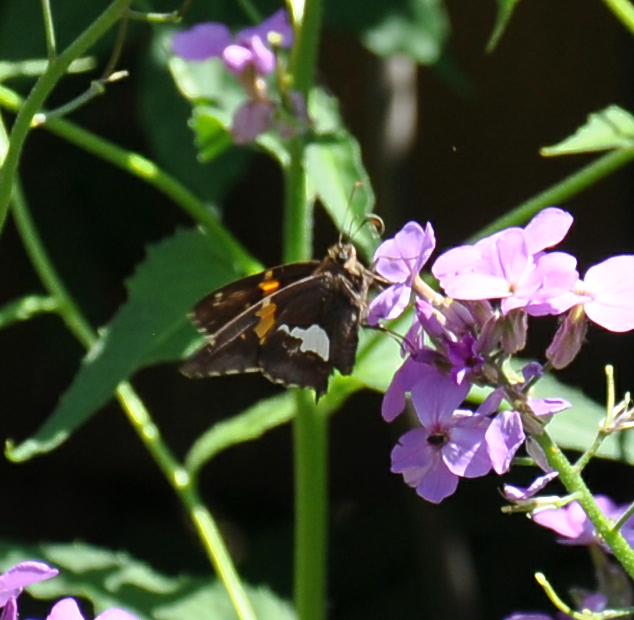
See the butterfly sipping from the orange? Well a fly kept landing on it so it just began to vibrate continuously, which kept the fly off.
See?
Here she is not vibrating. The white spot on her wing rather looks like a foraging turkey.
Smaller Bunny was under the feeder. Remember the other day when "Bunny" and a smaller rabbit were sitting under the Lilacs?
Well, this is Smaller Bunny. Small for short. She has slightly shorter ears and is...well, just smaller.
I'd been trying to count the Chimney Swifts in my neighborhood. There are also Chimney Swifts that hunt the downtown area of town late in the day as well, perhaps a quarter mile away and I wanted to know if they were two separate different groups. No definitive answer on that one yet. Therefore I had the camera pointed at the sky when this guy came along.
Now field guides will tell you that Turkey Vultures are two toned, though they often look quite black against the sky with perhaps a lighter gray on the rear edge wing feathers. In this case, because a flap was in progress and the sun caught the feathers just right to reflect the light in an unusual way, you can see the line of demarcation between the lighter feathers and the darker ones.
Oh! Remember I mentioned that the Catbirds are downright fiends for baths? They have taken to waiting nearby when I clean the bath and refill in in the morning.
I'm assuming that that way they can be the first in.
Keep you eyes open!
Donegal Browne
Friday, May 27, 2016
PART II The Thursday Micellany-Catbirds, the Reproductive Parts of Oak Trees and an Oriole Creates Acorns
When last we met, the female Baltimore Oriole had just gone from eating the catkins which produce oak tree pollen to touching her beak to the female part of the oak thereby, I'm assuming, inadvertently pollinating the oak tree. Then ZIP she was gone. It appeared she flew into the nearby evergreen.
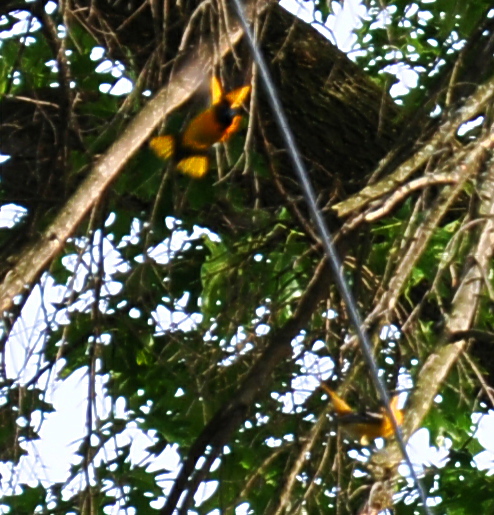
But when I get over there, it isn't the Mrs. it is the male Baltimore Oriole. Where did she go?
Where ever she zinged back in, and he flew straight up.
And then back round to the branch next to her.
She remains in what might possibly be a receptive posture for copulation. He does his little exuberant flight up... and then for whatever reason, they zipped off and I lost them in the trees. DRAT!
I go round to the front to see if they've come into the trees and there is a Catbird rapidly wallowing in the birdbath.
He stops and checks to see if I'm coming any closer.
By the way, the white dish under the bath is water for the rabbits and anyone else who needs a drink but isn't built to fly up to the bath.
She opens her eyes and checks me out. No I don't appear to be getting any closer.
She goes for one more splashy wallow...
And she's off!
I've not had resident Catbirds before but it turns out these guys just love taking baths. It appears they may be bathing twice a day.
Remember....ALWAYS keep an eye peeled for the good stuff!
Donegal Browne
The Thursday Micellany-Catbirds, the Reproductive Parts of Oak Trees and an Oriole Creates Acorns Part 1
For whatever reason suddenly there are Gray Catbirds, Dumetella carlinensis, in residence this year.
Then she gives me a binoc look...
And she's off. Yes I know the photo is blurry but I rather love bird feet position on a hasty retreat but that isn't it either. A Gray Catbird has chestnut undertail coverts which are a field mark for the species but one rarely if ever sees them. You'd think in this position they'd be exposed.
Nope.
A bit later I spy the male striding down the fence as if it were his personal walking path.
Next up for you botanists out there what are the variegated orange flowers above?
And how about this one?
Remember the Bleeding Hearts? On the right are the seed pods. and on the left is a pod just appearing from the protection of the blossom.
As you can see from the angle of the light that the sun is getting low, and time for the Chimney Swifts, Chaetura pelagica, and those that appear for a fill up before roosting or a night on the nest to appear.
Ever try to get a photograph of a Chimney Swift? There is a reason they are called Swifts.
And as Roger Tory Peterson describes them...they look "like a cigar with wings".
Sometimes their wings seem to be moving independently of each other. Which looks rather wacky. They aren't. It is just one of those strange birdie optical illusions.
Then I see a flash of orange heading for the oak tree! I've been seeing quick flashes of a male Baltimore Oriole, (another new species for my patch), through the window overlooking the feeding area in the early morning but the minute I see him, he's gone.
Okay....
It's a FEMALE Baltimore Oriole. Alright, there may well be a nesting pair!
She tips her beak up and appears to be eating the staminate catkins of the oak. Unless she is collecting bits for a nest?
While she's eating...a digression.
Oaks produce both sexual manifestations in Spring.. She is dealing with the "male" parts, the staminate flowers in catkins that produce pollen. The The female flowers are much more inconspicuous. They appear about a week after the male flowers. The snuggle in the base of twigs, they look more like tiny leaf buds and are hard to see.
Looks more like eating.
She gives me a look.
She flips round to the other side of the branch and gives me another look. She isn't nearly as shy as the male. But then she is up in a tree and he tends to appear on the fence of the feeding area and I'm peering at him through the window, perhaps 8 feet away.
Her beak goes to the female organ of the oak. I'm assuming she is eating a bit of it as well as pollinating the tree.
Wow. Who knew the activity of Baltimore Orioles could create acorns?
Whenever I discover something like this I'm quite newly boggled by the interconnections and complexity of the natural system.
Then suddenly she took off.
To be continued....
Then she gives me a binoc look...
And she's off. Yes I know the photo is blurry but I rather love bird feet position on a hasty retreat but that isn't it either. A Gray Catbird has chestnut undertail coverts which are a field mark for the species but one rarely if ever sees them. You'd think in this position they'd be exposed.
Nope.
A bit later I spy the male striding down the fence as if it were his personal walking path.
Next up for you botanists out there what are the variegated orange flowers above?
And how about this one?
Remember the Bleeding Hearts? On the right are the seed pods. and on the left is a pod just appearing from the protection of the blossom.
As you can see from the angle of the light that the sun is getting low, and time for the Chimney Swifts, Chaetura pelagica, and those that appear for a fill up before roosting or a night on the nest to appear.
Ever try to get a photograph of a Chimney Swift? There is a reason they are called Swifts.
And as Roger Tory Peterson describes them...they look "like a cigar with wings".
Sometimes their wings seem to be moving independently of each other. Which looks rather wacky. They aren't. It is just one of those strange birdie optical illusions.
Then I see a flash of orange heading for the oak tree! I've been seeing quick flashes of a male Baltimore Oriole, (another new species for my patch), through the window overlooking the feeding area in the early morning but the minute I see him, he's gone.
Okay....
It's a FEMALE Baltimore Oriole. Alright, there may well be a nesting pair!
She tips her beak up and appears to be eating the staminate catkins of the oak. Unless she is collecting bits for a nest?
While she's eating...a digression.
Oaks produce both sexual manifestations in Spring.. She is dealing with the "male" parts, the staminate flowers in catkins that produce pollen. The The female flowers are much more inconspicuous. They appear about a week after the male flowers. The snuggle in the base of twigs, they look more like tiny leaf buds and are hard to see.
Looks more like eating.
She gives me a look.
She flips round to the other side of the branch and gives me another look. She isn't nearly as shy as the male. But then she is up in a tree and he tends to appear on the fence of the feeding area and I'm peering at him through the window, perhaps 8 feet away.
Her beak goes to the female organ of the oak. I'm assuming she is eating a bit of it as well as pollinating the tree.
Wow. Who knew the activity of Baltimore Orioles could create acorns?
Whenever I discover something like this I'm quite newly boggled by the interconnections and complexity of the natural system.
Then suddenly she took off.
To be continued....
Subscribe to:
Posts (Atom)